Create Interactive Quizzes in Seconds
Simply upload a PDF, paste a URL, or provide text. Quizzify's powerful AI analyzes your content and automatically generates accurate, relevant questions. Stop wasting time and start engaging your audience.
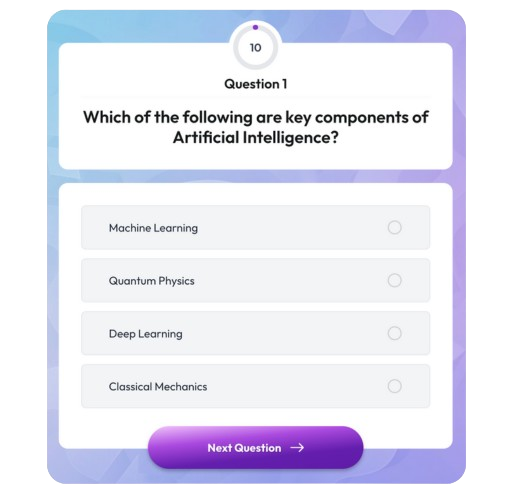
Everything You Need for Interactive Learning
Transform your static content into dynamic quizzes and assessments with our AI-powered tools. No more manual question creation.
Multiple Content Sources
Your knowledge lives everywhere. Now, so can your quizzes. Whether your material is in a detailed PDF report, a live webpage, or simple pasted text, our AI is ready to transform it into an assessment tool in seconds.
URL Content Quiz Builder
Don't just link to content—assess it. Point our AI to any URL, from a single blog post to a multi-page guide. It intelligently crawls, comprehends context, and generates precise questions that reflect the core information on the page.
Smart MCQs & Questions
Our AI crafts challenging questions with plausible distractors and provides automatic explanations for correct answers to reinforce learning.
Interactive Polls
Engage your audience in real-time. Instantly create live polls to gauge understanding or gather opinions during a presentation or lesson.
Export Results
Turn quiz results into actionable insights. Download detailed performance reports, track individual and group progress, and analyze response patterns.
Collaboration
Invite colleagues to a shared workspace. Co-create quizzes, manage a central library of assessments, and set permissions to streamline your workflow.
Revolutionizing Learning with AI
The traditional process of creating assessments is a major hurdle for today's fast-paced learning environments. Manually drafting questions, ensuring they cover key topics, and creating varied formats is tedious work that steals valuable time from educators and trainers. Often, the end result is a simple quiz that only scratches the surface of true comprehension.
Quizzify changes the game. Our platform leverages advanced AI that goes beyond keyword matching. It reads and digests your source material—be it a dense research paper or a simple webpage—with human-like understanding. By analyzing context, hierarchy, and key concepts, Quizzify crafts meaningful questions that challenge learners and accurately measure their grasp of the material.
Who Uses quizzify?
-
Educators who need to save hours on lesson prep and create more effective assessments that improve student retention.
-
Corporate Trainers tasked with verifying employee knowledge, ensuring compliance, and maximizing the impact of training programs.
-
Content Creators looking to transform static content like blog posts and guides into interactive experiences that captivate their audience.
How It Works
Provide Your Content
Simply drag and drop any PDF, paste text directly, or enter a URL. From a single article to a full textbook chapter, your content is our starting point.
AI Performs a Deep Analysis
In seconds, our AI reads and understands your material. It identifies core concepts, critical facts, and the relationships between them to find the most valuable information for assessment.
Your Quiz is Instantly Generated
A complete, relevant quiz is created automatically. Our system generates a variety of question types, including multiple-choice with intelligent distractors, to ensure a robust test of knowledge.
Review, Customize, and Share
You have the final say. Effortlessly edit, add, or delete questions. When you're ready, share your quiz with a simple link, embed it on your site, or export it for your LMS.
Explore Our AI in Action
Browse a live gallery of examples and preview the quality of our AI-generated questions firsthand. Discover what's possible for your content.
Farmacognosia
TEMA 1: INTRODUCCION A LA FARMACOGNOSIA FARMACOGNOSIA: Es la ciencia que se ocupa del conocimiento de las materias primas de origen biológico que el farmaceutico o la industria farmacéutica emplean para la preparación de medicamentos. La Farmacognosia es la ciencia farmacéutica que se ocupa del estudio de las drogas y las sustancias medicamentosas de origen natural: bien sea vegetal, microbiano (hongos, bacterias) o animal. Es la ciencia encargada del estudio de las fuentes naturales de materia prima de interés farmacéutico, estudiando tanto sustancias con propiedades terapéuticas como sustancias tóxicas, excipientes u otras sustancias de interés farmacéutico, aunque su uso sea básicamente tecnológico y no terapéutico. OBJETIVOS DE LA FARMACOGNOSIA: 1. Determinar el origen sistemático, la especie, de la que procede la droga. 2. Establecer las características morfoanatómicas y organolépticas, que permitan la caracterización de la droga. 3. Investigar los métodos óptimos de producción de la droga: en caso de droga vegetal: cultivo, mejora, recolección, conservación, extracción de principios activos (PP.AA.). 4. Establecer la composición química de la droga, tanto cuali- como cuantitativa. 5. Obtener extractos que contengan los PP.AA. 6. Controlar la calidad de las drogas. 7. Establecer las propiedades farmacológicas de las drogas (Actividad). 8. Investigar nuevos PP.AA. que puedan constituir un punto de partida para el diseño de nuevos fármacos CONCEPTOS En un sentido amplio, la Farmacognosia abarca el conocimiento de la historia, distribución, cultivo, recolección, selección, preparación, comercio, identificación, evaluación, preservación, y uso de drogas y sustancias de importancia económica que afectan la salud del hombre y otros animales. En un sentido restringido, la definición de Farmacognosia abarca el particular conocimiento de los métodos de identificación y evaluación de drogas naturales. Farmacognosia Especial: estudia las drogas naturales agrupándolas de acuerdo al tipo de componente en: gomas, mucílagos, pectinas, glicósidos cardiotónicos, saponinas, flavonoides, cumarinas, cianogenéticos, resinas, aceites esenciales, alcaloides, y otros. Planta medicinal: todo vegetal que contiene en uno o más de sus órganos sustancias que pueden ser utilizadas con fines terapéuticos o preventivos o que son precursores de hemisíntesis quimiofarmacéutica. Droga: toda sustancia natural o sintética que tiene propiedades terapéuticas o medicinales y que se utiliza en la elaboración de medicamentos. La palabra droga procede del vocablo holandés “droogen” que significa secar, o droog cuyo significado es sustancia seca. Droga vegetal: parte de la planta que contiene el principio activo y que se utiliza en terapéutica. Se denomina así a las plantas o sus partes enteras, molidas o pulverizadas (flores, frutos, semillas, tubérculos, cortezas, otras partes) frescas o secas, así como los jugos, gomas, látex, aceites esenciales o fijos y otros componentes similares, que se emplean puras o mezcladas en la elaboración de medicamentos. (FA 7 ed.) Droga cruda: drogas vegetales consistentes en sustancias naturales que no han sufrido otro proceso que la recolección y secado. Sustancias naturales: sustancias encontradas en la naturaleza y que comprenden plantas totales o sus partes anatómicas, jugos, secreciones y otros constituyentes vegetales; animales completos o sus partes anatómicas, glándulas u otros órganos, y otros constituyentes animales que no han sufrido cambios en la estructura molecular originaria. Preparado de droga vegetal: son preparados obtenidos a partir de la droga vegetal, que fueron sometidas a ciertos tratamientos como molienda, extracción, fraccionamiento, purificación (entre otros). Principio Activo: sustancia química con actividad farmacológica y que genera el uso terapéutico de la droga. Toda sustancia química o mezcla de sustancias relacionadas, de origen natural o sintético, que poseyendo un efecto farmacológico específico, se emplea en medicina humana (FA, 7 ed). Una droga puede contener varios PP.AA. Asi mismo puede contener PP.AA. antagónicos (es decir, con efectos contrarios) o PP.AA. sinérgicos (cuyo efecto al ser administrados conjuntamente se potencia). Fármaco: todo compuesto que independientemente de su origen, grado de preparación y elaboración, puede tener utilidad para prevenir, curar, mitigar o diagnosticar enfermedades. Medicamento: Producto que tras sufrir manipulaciones con la aplicación de técnicas adecuadas y dándole una determinada forma farmacéutica y dosificación correcta, está preparado para su administración a un organismo enfermo. Toda preparación o producto farmacéutico empleado para la prevención, diagnóstico y/o tratamiento de una enfermedad o estado patológico, o para modificar sistemas fisiológicos en beneficio de la persona a quien se le administra (FA. 7 ed.). Farmacopea: es el texto oficial que codifica los principios activos, excipientes y productos farmacéuticos y contiene las especificaciones que estos deben cumplir para demostrar su calidad y resguardar la salud de la población. La expresión “oficial” refiere o significa “de la Farmacopea” y se refiere a cualquier título, sustancia, preparación o ensayo incluido en las monografías y capítulos. - Drogas vegetales oficiales: Son aquellas especies vegetales cuya monografía se encuentra - codificadas en Farmacopeas. Drogas vegetales no oficiales: Son aquellas especies vegetales que no se encuentran codificadas en Farmacopeas PREPARACIÓN DE DROGAS VEGETALES PARA EL MERCADO COMERCIAL Obtención a partir de: Plantas silvestres o cultivadas. La OMS (2003) ha recomendado cultivar y recolectar las plantas medicinales siguiendo protocolos llamados “de buenas prácticas agrícolas y de recolección” (BPAR). FARMACOERGASIA: Se encarga del estudio del cultivo, recolección, secado y almacenamiento de las plantas. CULTIVO DE PLANTAS MEDICINALES, ESTUDIOS PREVIOS: 1. Conocer los factores climáticos y atmosféricos, edáficos y topográficos relacionados con la ecología de la zona elegida que pueden afectar a la producción. 2. Proceder a la selección y mejora del material a cultivar. 3. Determinar los procedimientos de mecanización de los cultivos que facilitarán el proceso de recolección. VENTAJAS DEL CULTIVO DE PLANTAS MEDICINALES: • Permite obtener materia prima abundante, homogénea y de alta calidad, mediante cultivo de especies seleccionadas. • Permite controlar algunas de las variables que pueden afectar a la producción. • Permite obtener plantas medicinales en igual estadio de desarrollo, lo que facilitará las labores de recolección y secado. FACTORES IMPLICADOS EN LA PRODUCCIÓN DE PLANTAS MEDICINALES Factores climáticos y atmosféricos Factores edáficos • Temperatura • Humedad • Radiación solar • Régimen de vientos • Caracteristicas físicas • Caracteristicas quimicas Factores topográficos OTROS FACTORES IMPLICADOS EN EL CONTENIDO DE PRINCIPIOS ACTIVOS Factores intrínsecos • Ontogenia • Herencia (Razas químicas o quimiodemos: Población de plantas químicamente diferentes dentro de una misma especie, es decir, se trata de plantas de una misma especie con características morfológicas similares (fenotipos similares) pero que tienen una composición química distinta (genotipos distintos), esto da lugar a diferencias en su composición química.) REGLAS GENERALES PARA LA RECOLECCIÓN DE DROGAS VEGETALES 1. Raíces y Rizomas, en fase de reposo vegetativo. 2. Hojas, en época de floración. 3. Cortezas, en primavera. 4. Flores, antes o durante la polinización. 5. Frutos, antes o después de la maduración. 6. Semillas, cuando están maduras pero antes de la dehiscencia. 7. Gomas, resinas, látex, en tiempo seco. CONSERVACIÓN DE DROGAS VEGETALES Inmediatamente después de la recolección de las plantas, se ve alterado su equilibrio metabólico y suceden reacciones y fenómenos que degradan la droga. Alteraciones por causas internas: Reacciones enzimáticas Hidrólisis de glúcidos, ésteres; oxidaciones; condensaciones; polimerizaciones; reacciones entre componentes de la planta. DESECADO 1. A temperatura ambiente - Desecado al sol - Desecado a la sombra 2. Con calor artificial - En estufas o armarios de desecación - A contracorriente - En estufas a vacío Tener en cuenta: - Temperatura → Flores y hojas: 20-30 °C → Cortezas, leños y raíces: 30-65 °C. - La ventilación tiene que ser forzada, la droga colocada en estanterías sobre tejido metálico, separadas 10-15 cm. ALMACENAMIENTO Y CONSERVACIÓN DE DROGAS VEGETALES: Los depósitos deben ser - Limpios - Incombustibles - Frescos - A prueba de insectos y roedores - Sombríos - De bajo contenido de humedad
Biology Test Review Q2 before exams
Homeostasis Test Review Name: KEY Look at the graph above and answer the following: What is a behavioral explanation for the change in temperature between 7am and 9am? Exercising (anything someone chooses to do to increase their body temperature) What is an environmental cause of the change in temperature between 10am and 11am? Staying inside somewhere with a thermostat, the temperature is overall stable What is an internal response that would cause the change between 11am and 12pm? Sweat glands secreting fluids to help cool the body temperature down, vessels dilating, etc. 2. Name 3 things Sam’s body does to stay warm while she is outside without her coat on. (List the systems involved & what they do) 1. Shivering (muscular system, quick contractions to warm up the body) 2. Sweat glands are not secreting fluids (integumentary, the skin is keeping heat preserved) 3. Blood vessels are constricted to keep heat in (circulatory system) 3. Name 3 things Desmond’s body does to stay cool while he is running. (List the systems involved & what they do). 1. Increasing breaths, (respiratory system, to help heat leave to the environment) 2. Sweat glands are secreting fluid (integumentary to help your skin cool down) 3. Increase in heart rate and dilated vessels (circulatory system, to help heat loss in the body) 4. a) Describe why you get a fever when you are sick. A fever helps increase your body temperature to kill bacteria or viruses. b) What happens to the body’s temperature set point? It increases. (98.6 degrees F is our set point) 5. Fill in the chart to show the effect of exercise on homeostasis & the body’s response. How does exercise affect it? What is the body’s response? Body temperature Increases Try to decrease your body temp. as it is increasing by sweating and breathing more Blood acidity (amount of CO2) Increases Increasing respiratory rate to exhale more CO2 Blood sugar Decreases Tries to increase blood sugar to prevent hypoglycemia by releasing glucagon Amount of O2 Decreases Increasing respiratory rate to take in more O2 6. True or False: Enzymes work well at all temperatures or pH levels in living things. False, enzymes work at ideal temperatures and pH levels in a variety of living organisms. 7. What is a vaccine? A way to introduce your body to the virus to help your immune system prevent it in the future. 8. Describe how vaccines work. Vaccines work through injection and puts a small amount of the virus to introduce your immune system to the virus. Your immune system will learn to respond and recognize the virus in order to defend your body if it ever comes in contact with that specific virus. 9. What is the difference between negative feedback and positive feedback? Negative feedback is when your body fights against the stimulus, positive feedback is enhancing the stimulus. 10. Why is negative feedback more common when trying to maintain homeostasis? Negative feedback is more common because it is the only way for our internal mechanisms to respond in order to maintain homeostasis. Read the information below to answer question 11. If you observe a plant or a tree bearing lots of fruits, you will notice the fruits go through the stages: from unripe to ripe to overripe. The process will start when the first fruit begins to ripen. When it is ripe, it releases a gas which is known as ethylene (C2H4). This causes the nearby fruits exposed to the ethylene to begin to ripen. As the ripening continues, these fruits also continue to release ethylene gas. This feedback loop is usually used in the production of fruits in which exposure to ethylene gas makes the ripening process faster. 11. Is this an example of positive or negative feedback? Why? This is an example of positive feedback because the gas being released is only being released more. Nothing is “going against” the fruit ripening process to prevent the ethylene being released.
mllm
257. Під час бактеріологічного дослідження випорожнень чотиримісячної дитини зі симптомами гострої кишкової інфекції на середовищі Ендо виросла невелика кількість червоних колоній. Який це може бути мікроорганізм? A. Ешерихія. B. Стафілокок. C. D. E. Сальмонела. Стрептокок. Шигела. 258.Під час бактеріологічного дослідження гнійних виділень з уретри пацієнта бактеріолог виявив бактерії, які за методом Грама пофарбувалися негативно, нагадували кавові зерна, ферментували глюкозу до кислоти, були розміщені у цитоплазмі лейкоцитів. Збудником якого захворювання є ці бактерії? A. Сифілісу. B. Венеричного лімфогранулематозу. C. Гонореї. D. М'якого шанкру. E. Меліоїдозу. 259.Під час бактеріологічного дослідження гнійного ексудату з опікової рани на МПА виросли великі плоскі безбарвні слизисті колонії з нерівним краєм, які через 24 години при доступі сонячних променів утворили зелено-блакитний водорозчинний пігмент із запахом меду або жасміну. Бактеріоскопія дозволила бактеріологу виявити грамнегативні лофотрихи. Чиста культура збудника мала природну резистентність до більшості антибіотиків. Який вид бактерії виявив бактеріолог у гнійному ексудаті з опікової рани? A. Pseudomonas aeruginosa. B. C. D. E. Proteus vulgaris. Klebsiella ozaenae. Streptomyces griseus. Brucella abortus. 260. Під час бактеріологічного дослідження гною з післяопераційної рани бактеріолог виділив збудника, який через 7-10 днів у анаеробних умовах на цукрово-кров'яному агарі утворив блискучі колонії чорного кольору S-форми з неприємним запахом. Під час мікроскопії мікропрепаратів з колоній бактеріолог виявив тонкі грамнегативні палички з вираженим поліморфізмом. Який мікроорганізм викликав гнійний процес? A. Бактероїди. B. C. D. E. Клостридії. Кишкова паличка. Вейлонели. Фузобактерії. 261. Під час бактеріологічного дослідження матеріалу від хворого з підозрою на хронічну форму гонореї бактеріолог не отримав росту мікроорганізмів на спеціальному живильному середовищі. Які дослідження бактеріологу необхідно було застосувати, щоб підтвердити або спростувати діагноз "хронічна гонорея"? A. Поставити РЗК та зробити шкірно-алергічну пробу з гонококовим алергеном. B. Визначити титр антитіл у сироватці крові хворого, використовуючи РНГА. C. D. E. Застосувати біологічний метод діагностики. Застосувати імунну електронну мікроскопію. Висіяти досліджуваний матеріал на диференціально-діагностичне середовище. 262.Під час бактеріологічного дослідження промивних вод шлунка хворого з харчовим отруєнням бактеріолог висіяв чисту культуру бактерії, яка мала такі властивості\: грамнегативні рухливі палички, на середовищі Ендо виросли у вигляді безбарвних колоній. До якого роду відносять збудник захворювання? A. Salmonella. B. C. D. E. Shigella. Yersinia. Escherichia. Citrobacter. 263.Під час бактеріологічного дослідження сечі хворого на поліомієліт бактеріолог виділив мікроорганізми, які на м 'ясопептонному агарі утворили колонії з жовто-зеленим пігментом та характерним запахом. Що це за мікроорганізм? A. Псевдомонада. B. C. D. E. Протей. Клебсієла. Ешерихія. Морганела 264.Під час бактеріологічного дослідження фекалій 45-річної жінки, яка 1,5 років тому перехворіла на черевний тиф, бактеріолог виявив Salmonella typhi у кількості 102 клітин / г фекалій. Як найбільш точно охарактеризувати стан обстеженої жінки? A. Дисбактеріоз B. Бактеріоносійство. C. D. E. Реінфекція. Суперінфекція. Рецидив. Malassezia furfur 265.До збудників опуртуністичних мікозів належить збудник.. A. B. C. D. E. Piedraia hortae Trichosporon inkin Histoplasma capsulatum Aspergillus niger 266.Під час бактеріологічного дослідження харкотиння хворого із запаленням легень бактеріолог ідентифікував Mycoplasma sp. За якими ознаками Mycoplasma sp. відрізняється від інших прокаріот? A. Відсутня клітинна стінка. B. C. D. E. Не синтезує АТФ. Відсутня капсула. Відсутні полісахариди. Відсутня цитоплазматична мембрана. 267. В інфекційне відділення звернулася жінка з ознаками пневмонії. З анамнезу працює ветеринаром. Для дослідження був взятий матеріал з якого було виділено Coxiella burnetii. Які методи культивування найкраще вибрати для ідентифікації збудника? A. Культивування на культурах клітин B. C. D. E. Культивування на середовищі Кітта- Тароці За методом Грама Культивування на середовищі Дроботько Культивування на середовищі Левенштейна – Єнсена 268.Під час бактеріоскопічного дослідження гнійних виділень з шийки матки бактеріолог виявив грам-негативні диплококи у вигляді кавових зерен, які були розміщені як у середині, так і поза лейкоцитами. Під час культивування у рідкому живильному середовищі бактерії на поверхні середовища утворили плівку. За біохімічними властивостями ці бактерії малоактивні, продукують ендотоксин. Який мікроорганізм викликав у пацієнтки гнійне запалення шийки матки? A. Neisseria gonorrhoeae. B. C. D. E. Chlamydia trachomatis. Haemophilus vaginalis. Trichomonas vaginalis. Calymmatobacterium granulomatis. 269. Під час бойових дій військовослужбовець отримав глибоку рвану рану, але пораненому вчасно не було надано необхідної медичної допомоги. У рані розвинулася анаеробна газова інфекція. Який шлях передачі збудника цієї хвороби? A. Непрямий контакт. B. C. D. E. Аліментарний. Аерогенний. Трансмісивний. Прямий контакт. 270.Під час виконання земляних робіт один з робітників отримав тяжку травму. У лікарні йому зробили хірургічну обробку рани та ввели антибіотик пеніцилінового ряду. Через 12 днів у хворого почалися судоми. Який ще препарат необхідно було ввести постраждалому? A. Антитоксин. B. Донорський у (гамма) - глобулін. C. D. E. Інтерферон. Антибіотик з групи аміноглікозидів. Антибіотик тетра...
gdktpl
Câu 1: Căn cứ vào tính chất của thất nghiệp, người ta chia thất nghiệp thành mấy loại? A. Ba loại (tạm thời, cơ cấu, chu kì). B. Hai loại (tự nguyện và không tự nguyện). C. Bốn loại (tự nguyện, không tự nguyện, chu kì, cơ cấu). D. Năm loại (tự nguyện, không tự nguyện, chu kì, cơ cấu, tạm thời). Câu 2: Thất nghiệp chu kì là loại hình thất nghiệp xảy ra do nguyên nhân nào? A. Thiếu kĩ năng chuyên môn của người lao động. B. Sự thay đổi trong cơ cấu kinh tế. C. Người lao động tự ý nghỉ việc để tìm công việc mới. D. Nền kinh tế đình trệ, suy thoái, sức mua xã hội giảm, doanh nghiệp giảm sản xuất. Câu 3: Thất nghiệp tự nguyện là loại hình thất nghiệp căn cứ vào tiêu chí nào sau đây? A. Nguyên nhân gây thất nghiệp. B. Tính chất của thất nghiệp. C. Mức lương mà người lao động mong muốn. D. Cơ cấu ngành nghề trong xã hội. Câu 4: Hiện tượng nhiều ngành nghề cũ thiếu đơn đặt hàng, phải sa thải lao động, trong khi các ngành nghề mới lại thiếu nhân lực do người lao động không đáp ứng được yêu cầu công việc mới, đây là biểu hiện của loại thất nghiệp nào? A. Thất nghiệp tạm thời. B. Thất nghiệp chu kì. C. Thất nghiệp cơ cấu. D. Thất nghiệp không tự nguyện.
DIA 1/66 (PSIQUIATRIA)
QUIMICA
english
[What makes a good life? Lessons from the longest study on happiness](https://www.youtube.com/watch?time_continue=26&v=8KkKuTCFvzI&utm_source=chatgpt.com) Här kommer en kort sammanfattning av huvudbudskapet i Robert Waldingers film What makes a good life? Lessons from the longest study on happiness: ## ✅ Vad filmen säger * Det finns en jättelång studie — över 75 år — som följt människors liv för att undersöka vad som ger verklig lycka och ett bra liv. ([Robert Waldinger][1]) * Studien visar att det inte är pengar, karriär, status eller berömmelse som i första hand gör människor lyckliga och friska. ([Robert Waldinger][2]) * Det viktigaste för ett gott liv är **goda relationer** – med familj, vänner eller samhälle. ([instituteofcoaching.org][3]) * Det handlar inte om att ha många bekanta, utan om att ha nära, trygga och stödjande relationer. ([summarize.ing][4]) * Relationer påverkar inte bara lycka — de påverkar vår fysiska och psykiska hälsa och även hjärnan: människor med starka relationer tenderar att leva längre, må bättre och behålla sin mentala hälsa högre upp i åldern. ([videos.weber.edu][5]) ## 🎯 Vad det betyder i praktiken * Att umgås med familj och vänner, vårda nära relationer och känna gemenskap kan vara viktigare än att jaga pengar eller framgång. * Det räcker inte bara med “att känna många” — det gäller att bry sig om kvaliteten i de relationer man har. * Ensamhet och brist på stöd kan påverka hälsa och välmående negativt. * Att ta hand om relationer är livet ut — inte bara när man är ung. ---
DERECHO INTERNACIONAL PRIVADO
DERECHO INTERNACIONAL PRIVADO ESPAÑOL
Media Power and Political Communication
Perfect 👍 — Kahoot needs **short, punchy, scannable points**. Here is a **compressed, quiz-ready version** of your MAJO 201 notes, with **media theories kept as a separate topic**, and **everything trimmed to essentials**. You can copy-paste these directly into **Kahoot AI Quiz Maker**. --- # **MAJO 201 – Media Power & Political Communication (Kahoot Notes)** --- ## **1. Political Communication** * Uses **language & symbols** to persuade. * Simplifies complex political ideas. * Builds political identity and loyalty. * Relies on mass & digital media. --- ## **2. Communication Technology** * Enables mass reach & speed. * Allows targeted political messaging. * Supports two-way interaction. * Central to modern campaigns. --- ## **3. The Fourth Estate** * Media acts as a **watchdog**. * Holds government accountable. * Promotes transparency. * Informs citizens. * Supports democracy. --- ## **4. Journalists in a Democracy** * Investigate corruption. * Fact-check leaders. * Give voice to diverse groups. * Monitor all branches of power. * Serve the public interest. --- ## **5. Political Systems & Media** * **Totalitarian:** Full state control. * **Authoritarian:** Limited freedom. * **Democratic:** Free & independent press. --- ## **6. Public Opinion** * Guides policy decisions. * Legitimizes government actions. * Expresses public dissatisfaction. * Influences elections. --- ## **7. Elections & Polling** * Polls measure public opinion. * **Bandwagon effect:** Support the winner. * **Strategic voting:** Vote to block others. --- ## **8. Election Communication** * Manifestos & campaign ads. * Debates & rallies. * Media coverage & fact-checking. * Voter education. * Social media campaigning. --- ## **9. Political Public Relations** * Press releases. * Press conferences. * Spin & image management. * Photo opportunities. * Strategic leaks. --- ## **10. Political Entertainment (Politainment)** * Politics + entertainment. * Includes satire, memes, music. * Engages youth. * Simplifies issues. * Can trivialize politics. --- ## **11. Political Satire** * Uses humour & exaggeration. * Critiques leaders & policies. * Encourages critical thinking. * Engages disengaged citizens. --- ## **12. Media Bias** * Selection bias. * Framing bias. * Partisan bias. * Agenda-setting bias. * Influences public perception. --- # **MEDIA THEORIES (QUIZ-READY)** ## **13. Agenda-Setting** * Media tells us **what to think about**. ## **14. Framing** * Media shapes **how issues are understood**. ## **15. Priming** * Media influences how leaders are evaluated. ## **16. Uses & Gratifications** * Audiences choose media to meet needs. ## **17. Two-Step Flow** * Opinion leaders influence others. ## **18. Cultivation** * Long-term exposure shapes worldview. ## **19. Social Responsibility** * Media freedom + ethical duty. ## **20. Libertarian Theory** * Free press, minimal state control. ## **21. Authoritarian Theory** * Media supports the state. ## **22. Hegemony** * Media reinforces dominant power. --- ## **23. Walter Lippmann** * Media creates “pictures in our heads”. * Media constructs political reality. * People rely on media to understand politics. --- ### 🔥 This format is ideal for: * Multiple choice questions * True/False * Fill-in-the-blank * Matching theories to definitions If you want, I can: ✔ Convert this into **actual Kahoot questions** ✔ Write **MCQs + correct answers** ✔ Trim it EVEN MORE if Kahoot flags length Just say the word 😊
World History
Capitalism & the First Industrial Revolution Mercantilism은 국가 통제로 무역을 관리했지만 세계가 확장되며 한계가 드러나 Capitalism으로 이동했다. Thomas Le Gendre의 “laissez nous faire”에서 나온 laissez-faire는 시장에 맡기라는 의미로, 정부 개입 최소화를 주장한다. Adam Smith는 The Wealth of Nations에서 개인의 이익 추구가 사회 전체 이익을 낳는 “invisible hand”를 제시했고, 관세·규제 축소를 지지했다. 그는 slavery가 비효율적이라고 보았지만 그 고통을 과소평가했다. Smith의 사상은 영국(Charles James Fox, Frederick North, William Pitt)과 미국(Thomas Jefferson)으로 퍼지며 경제 정책을 변화시켰다. 현대 비판은 사람들은 항상 rational choice를 하지 않으며 “invisible hand”가 노예·빈민·식민지 주민의 희생 위에 작동했다는 점을 지적한다. Mercantilism → Capitalism 전환 Mercantilism(중상주의)은 국가가 무역을 통제해 부를 늘렸지만 제국 확장과 자유 요구로 약화됨. 이후 Capitalism(자본주의)이 등장해 시장 가격과 비용이 경제를 조절하고 정부 개입은 최소화됨. Laissez-faire 등장 1681년 Thomas Le Gendre가 Colbert에게 “laissez nous faire”라고 말한 것에서 유래. → laissez-faire economics: 정부 간섭 없이 시장에 맡기는 경제. Adam Smith와 The Wealth of Nations Adam Smith는 The Wealth of Nations(1776)에서 개인 이익 추구가 사회 전체 이익으로 이어지는 “invisible hand”를 주장. free market을 위해 관세·규제 축소를 지지. slavery 비효율성을 지적했지만 고통을 과소평가함. 노예제와 Capitalism 논쟁 Capitalism은 자유로운 거래를 전제로 하나 slavery는 자유가 없어 충돌. 그러나 Sugar plantations는 공장처럼 운영되었고 노예 노동 이익은 산업과 공장에 투자됨. 플랜테이션이 자본주의인지 여부는 여전히 논쟁. 영국·미국으로 확산 영국의 Charles James Fox, Frederick North, William Pitt 등이 Smith의 사상을 수용해 관세·규제를 축소. 미국의 Thomas Jefferson도 Wealth of Nations를 높게 평가. 현대 비판 사람들은 항상 rational choice를 하지 않으며 “invisible hand”는 노예·빈민·식민지 주민의 희생 위에 작동했다는 비판이 존재. Mechanization and the First Part of the Industrial Revolution Late 1700s Western Europe에서 mechanization(기계로 인간·동물 노동 대체)이 시작되며 농업·수공업 중심 사회가 Industrial Revolution으로 전환됨. Mid-1600s 영국 Agricultural Revolution으로 식량 증가·인구 증가 → 잉여 노동력 생김. 1700s entrepreneurs(기업가)가 농촌 가족에게 원료 주고 집에서 제작하게 한 cottage labor 확산. 숙련 장인이 아니므로 저임금, 기업가만 큰 이익. 점차 노동자를 한곳에 모아 factory가 등장. 도시 집중·농촌 노동자 이동. Adam Smith 영향으로 정부가 공장 설립 지원. 산업혁명 핵심 동력: steam engine. 1698 Savery 최초 상업용 증기기관, 1776 James Watt 개선형. Steam-powered locomotives·boats(1807 Robert Fulton, 1812 Matthew Murray)로 원료·상품 이동이 가속됨. Industrialization은 기업가·중산층 부는 증가시키지만 비숙련 노동자는 저임금·장시간·위험한 작업환경에 처함. 숙련 장인의 지위 약화, 노동 통제권 상실. 1811 Luddites가 기계 파괴·폭동. 신화적 인물 Ned Ludd 이름에서 유래. 기술 변화가 전통 생활 파괴한다고 반발. Lord Byron은 폭력 대신 “conciliation and firmness”(화해와 확고함)를 촉구했지만 정부는 억압. 1812 의회는 산업 파괴를 사형죄로 규정. 1816년 진압. 오늘날 “Luddite”=기술 반대자라는 용어로 쓰임. Karl Marx(1818)는 Hegel 영향으로 역사 발전을 갈등·자유 확대 과정으로 이해. 1848 The Communist Manifesto(with Engels): “역사=계급투쟁.” 자본주의→사회주의→공산주의로 간다고 주장. 노동자들이 자본가를 전복해야 한다고 선언. 1867 Das Kapital: bourgeoisie가 proletariat를 착취한다고 분석. 노동 가치보다 낮은 임금을 주고 초과 가치를 착취해 부를 축적. 부는 정치 권력을 사는 데 사용됨 → 노동자 빈곤·무력화. 결국 자본주의는 붕괴하고 노동자가 권력을 되찾는다고 예측. Marx는 봉건제 해체가 자본주의 토대를 마련했지만 농민·장인들은 생산수단을 빼앗기고 “혈과 불의 문자”로 기록된 착취를 경험했다고 설명. Marx의 영향으로 1917 러시아 혁명 발생 → Soviet Union, 이후 China·Vietnam·North Korea·Cuba·Laos 등 공산국가 등장. 오늘날에도 사회주의·공산주의 정당 존재. 미국의 Bernie Sanders는 스스로 socialist라 부르지만 생산수단 국유화(nationalization of the means of production - 국가가 경제 활동을 위해 필요한 주요 자원과 시설을 직접 소유하고 운영하는 것국가가 경제 활동을 위해 필요한 주요 자원과 시설을 직접 소유하고 운영하는 것)는 추구하지 않음. The Second Industrial Revolution 18세기 영국에서 산업혁명(Industrial Revolution)이 시작되어 기계(mechanization)를 이용해 농업·수공업 중심 사회에서 기계 중심 제조업 사회로 전환되었다. 증기기관(steam engine)과 기계 도입으로 섬유(textiles), 철(iron), 강철(steel) 등 대량 생산이 가능해졌고, 철도(locomotive), 증기선(steamboat), 전신(telegraph) 등 교통·통신 기술 발전으로 생활과 산업이 변화했다. 19세기 중반~20세기 초 제2차 산업혁명(Second Industrial Revolution)에서는 강철 생산(Bessemer, Siemens-Martin), 전기(electricity), 내연기관(internal combustion engine), 증기터빈(steam turbine) 등 신기술과 교통수단(자동차, 자전거)이 확산되며 산업과 도시 구조가 변화했다. 통신 기술(전화, 무선 전신, 라디오)과 사진·영화·축음기 등 여가문화도 발전했다. 농업과 산업에도 혁신이 이어져 화학 염료, 콤바인, 기계 씨앗 뿌리기, 냉장 화물차, 바베드 와이어(barbed wire) 등 생산성과 유통 효율이 증가했다. 사무 분야에는 타자기, 계산기, 출퇴근 기록기(time clock)가 도입되었다. 산업화는 미국·유럽 중심으로 진행되었고, 아프리카·아시아·라틴아메리카(일본 제외)는 자원 부족, 유럽 식민지 착취, 환경·역사적 요인 등으로 산업화가 제한되었다. 일부 국가는 원자재(raw materials) 생산에 집중하며 산업화 대신 기존 경제 구조를 유지했다. Industrial Revolution 산업혁명(Industrial Revolution) 산업혁명은 18세기 영국에서 시작되어 기계 중심 제조업 사회로 전환된 시기이다. 산업혁명을 촉진한 요인 탐험과 식민지화(Exploration and Colonization)를 통해 원자재(Raw materials)를 확보하고, 해상력(Seapower)을 갖춘 영국은 세계 최대 해군과 상선을 보유했다. 정치적 안정(Political Stability) 덕분에 본토에서 큰 전쟁 없이 산업화가 가능했고, 정부(Government support)는 기업을 지원하는 법을 통과시켜 경쟁력을 강화했다. 농업혁명(Agricultural Revolution) 1701년 Jethro Tull의 씨앗뿌리기 기계(seed drill) 발명과 가축·작물 개량으로 식량 생산이 증가했고, 인구가 늘었다. 1773년 엔클로저 운동(Enclosure Movement)으로 공동 경작지가 부유한 지주에게 팔리면서 농지 효율이 증가했으나, 많은 농민이 도시로 이동하며 산업혁명의 저임금 노동력이 되었다. 기술 발명과 산업화 확산 James Watt의 증기기관 개선(1769), Richard Arkwright의 물레틀(water frame, 1775) 등 발명이 산업화를 촉진했다. 영국은 기술 유출을 막기 위해 발명가들의 출국을 제한하기도 했다. Samuel Slater는 1789년 미국으로 이주해 미국 산업 발전에 기여했다. 아동 노동과 개혁 Lewis Hine는 1900년대 초 아동 노동의 열악한 환경을 사진으로 폭로해 사회적 관심을 높였다. 영국은 1833년 Factory Act를 통해 9세 미만 아동 노동 금지, 9~18세 아동 근로 시간 제한, 학교 2시간 의무를 시행했고, 미국은 1904년 National Child Labor Committee 설립, 1938년 Fair Labor Act로 아동 노동 규제를 시행했다. 조립 라인(Assembly Line) Henry Ford는 1913년 디트로이트 공장에서 조립 라인을 도입해 자동차 생산을 빠르고 저렴하게 만들었다. 이는 대량생산(Mass Production)과 중산층 형성에 기여했다. Life in the Industrial Age Advances in Technology 19세기 후반 과학자들은 전기에 관심을 가졌고, 1831년 Michael Faraday가 자기와 전기의 관계를 발견하고 dynamo를 만들어 전동기를 구동했다. 1879년 Thomas Edison은 실용적인 전구를 발명하고 뉴욕에 세계 최초 central electric power plant를 세워 여러 블록에 전력을 공급했다. Edison의 발명으로 generators, motors, light sockets 등이 개발되었고, 공장은 더 이상 steam engine이나 수로에 의존하지 않아도 되며 햇빛에도 덜 의존하게 되었다. Transportation and Steel 초기 1800년대 주요 교통수단은 horse-drawn wagons, carriages, boats였지만, railroads와 steamships를 통해 장거리 운송과 관광이 가능해졌다. Henry Bessemer는 1851년 steel을 정제해 더 강하고 저렴하게 만드는 Bessemer process를 개발했고, 이로 인해 railroads와 locomotives 제작이 확대되었다. Telephone and Skyscraper Alexander Graham Bell은 telephone을 발명했고, 1885년 시카고에 10층 높이의 첫 skyscraper인...
History
○The route the Amerindians took to reach the Americas ○The Tainos ○The Kalinagos ○ The Mayans The indigenous people of the Caribbean The reasons and consequences for Columbus's Voyage
e
POJMY Výchova= Záměrné cílevědomé působení na rozvoj osobnosti Vzdělávání= Získávaní vědomostí a dovedností, proces osvojování = vede k vzdělání Edukace= Shrnutí výchovy i vzdělávání= je to celoživotní proces Heteroedukace= výchova někým jiným Autoedukace= výchova mnou samou – sebevzdělávání RVP PV= Rámcovém vzdělávacím programu pro předškolní vzdělávání Klíčové kompetence= soubor základních znalostí, dovedností, postojů a hodnot, které jsou klíčové pro osobní rozvoj jedince Pedagogika (definice, původ slova) Společenská věda o vzdělávání a výchově = zajímá se o formování člověka, po celý jeho život Od slova PEDA/GOGOS – DÍTĚ/ VÉTS Empirická věda= čerpá informace za zkušeností Teorie vědy (co musí věda splňovat) Věda musí splňovat určitá kritéria- PŘEDMĚT BÁDÁNÍ = VÝCHOVA, VYMEZENÉ POJMY, TEORETICKÝ SISTÉM, VÝZKUMNÉ METODY, ODBORNÉ PUBLIKACE, VYUČOVÁNÍ NA VŠ Pedagogické vědy (kategorie) Základní=Obecná pedagogika a didaktika, dějiny pedagogiky, srovnávací a speciální pedagogika Hraniční (propojení dvou věd) =pedagogická psychologie, sociologie výchovy, ... Aplikované (poznatky aplikované na určitou skupinu) = předškolní ped., pedagogika dospělých (skupinu) nebo volného času Výchova Je to cílené působení na člověka za účelem jeho rozvoje – podporuje žádoucí chování a snaží se tlumit nežádoucí Složky výchovy Jsou to základní oblasti působení na osobnost jedince Rozumová= rozvoj myšlení, poznávání a schopnosti učit se Mravní= vytvoření morálních hodnot a svědomí Citová= rozvoj citového prožívání a empatie Tělesná= péče o zdraví a rozvoj tělesné zdatnosti Pracovní= vytvoření vztahu k práci Estetická= rozvoj vnímaní a vztahu ke kráse a umění Pak i Občanská, Enviromentální a Duchovní výchova Činitelé výchovy Ten, kdo se podílí na procesu výchovy VYCHOVÁVAJÍCÍ= učitel, rodič, trenér VYCHOVÁVANÝ= žák, dítě... OBSAH= obsah vyučování VÝCH. PROSTŘEDÍ= vnější podmínky K úspěšné výchově je potřeba všech složek výchovy Výchovné metody podporuje žádoucí chování a snaží se tlumit nežádoucí STIMULUJÍCÍ (podněcující) A INHIBIČNÍ (potlačující) Pochvala, ocenění, povzbuzení, kritika, napomenutí, zákaz Podmínky výchovy Dělí se na VNITŘNÍ a VNĚJŠÍ VNITŘNÍ= Dědičné faktory, zdravotní stav, životní potřeby, schopnosti a dovednosti, temperament, zájmy... VNĚJŠÍ= Prostředí (nezáměrně formuje člověka), dělíme ho na přírodní a sociální Přírodní= venkov x město, podnebí, ovzduší... Sociální= charakter rodiny, vztahů s ostatními lidmi, typ školy, sociální sítě... Didaktika (pojem, význam, typy didaktik) Základní pedagogická disciplína – teorie o učení a vyučování, formuluje postupy, metody... aby bylo dosaženo cíle Od DIDASKEIN= učit, vyučovat Skupina 1, Grouped object Pedagogický proces (definice, složky vyjmenovat) Výchovní vzdělávací proces, kde na sebe působí všechny složky Cílem je naučit žáka obsah společnou činností a pomocí materiálních i nemateriálních prostředků Skládá se s CÍLE, OBSAHU, SOUČINNOSTI UČITELE A ŽÁKA, a MATERIÁLNÍCH A NEMATERIÁLNÍCH PROSTŘEDKŮ Cíle (význam, funkce) Vyučování je smysluplná činnost= má vždy cíl= očekávaný výsledek Jsou různé, liší se u věkových skupin, předmětů... Jde o zamýšlenou změnu a žáka= co si má osvojit= představa o výsledku učení Žák vyjmenuje samohlásky x Žák se naučí samohlásky ( špatně- NEOVĚŘITELNÉ) Bloomova taxonomie Systematické uspořádání cílů od nejjednoduššího po nejtěžší Cíle v RVP PV směřují k rozvoji komplexní osobnosti dítěte (fyzicky, psychicky, sociálně) na základě rámcových cílů Rozvoj osobnosti= Podpora zdraví, samostatnosti, učení a poznávání Získávání kompetencí= Rozvoj klíčových kompetencí (např. učení, komunikace, sociální) Osvojování základů= hodnot, kultury a pravidel společnosti Didaktická transformace učiva Je to proces, při kterém učitel převádí odborné učivo do podoby srozumitelné a přiměřené věku, schopnostem a zkušenostem žáků= tak aby žák učivo pochopil a nebylo pro něho příliš složité Metody Metoda= cesta k cíli Dělí se na SLOVNÍ, PRÁCE S TEXTEM a NÁZOROVĚ DEMONSTRAČNÍ SLOVNÍ – Monolog= vyprávění (hlavní metoda v MŠ), výklad (ZŠ, SŠ), Přednáška (VŠ) Dialog= diskuse, brainstorming PRÁCE S TEXTEM – mapy, texty, grafy, encyklopedie... NÁZOROVĚ DEMONSTRAČNÍ – ukázka, pokus= učitel vede, žák pozoruje Pedagogika. Je to společenská věda, který se zabývá výchovou a vzděláváním člověka po celý jeho život. Samotné slovo pedagogika pochází z řeckých slov paida – dítě a gogos – vést, tedy vést dítě. Pedagogika je zároveň empirická věda, což znamená, že čerpá své poznatky ze zkušeností. Aby mohla být považována za vědu, musí splňovat určitá kritéria – má svůj předmět bádání, kterým je výchova, má vymezené pojmy, vlastní teoretický systém, výzkumné metody, odborné publikace a vyučuje se na vysokých školách. V pedagogice se setkáváme s několika základními pojmy. Výchova je záměrné a cílevědomé působení na rozvoj osobnosti člověka, při kterém se podporuje žádoucí chování a tlumí chování nežádoucí. Vzdělávání je proces, při němž si člověk osvojuje vědomosti a dovednosti, a vede k dosažení vzdělání. Tyto dva pojmy dohromady shrnuje pojem edukace, který označuje celoživotní proces výchovy i vzdělávání. Edukace může mít podobu heteroedukace, kdy je člověk vychováván někým jiným, například rodičem nebo učitelem, nebo autoedukace, kdy se člověk vzdělává a vychovává sám. Celý výchovně-vzdělávací proces se odehrává v určitém rámci. V předškolním vzdělávání je tímto rámcem RVP PV – Rámcový vzdělávací program pro předškolní vzdělávání, jehož cílem je rozvoj komplexní osobnosti dítěte po stránce fyzické, psychické i sociální. Důležitou roli zde hrají klíčové kompetence, tedy soubor znalostí, dovedností, postojů a hodnot, které jsou nezbytné pro osobní rozvoj jedince. Výchova sama o sobě má několik složek, které se navzájem prolínají. Patří mezi ně rozumová výchova, jejímž cílem je rozvoj myšlení a schopnosti učit se, mravní výchova, která směřuje k utváření morálních hodnot a svědomí, citová výchova, rozvíjející citové prožívání a empatii, tělesná výchova, zaměřená na zdraví a tělesnou zdatnost, pracovní výchova, jejímž cílem je vytvoření vztahu k práci, a estetická výchova, která rozvíjí vnímání krásy a vztah k umění. Tyto složky doplňuje také výchova občanská, environmentální či duchovní. Na výchově se podílí různí činitelé výchovy. Jsou to vychovávající osoby, například rodiče, učitelé nebo trenéři, dále vychovávaný jedinec, tedy dítě nebo žák, obsah výchovy a výchovné prostředí. Aby byla výchova úspěšná, musí být všechny tyto činitele ve vzájemné souhře. Výchova probíhá pomocí výchovných metod, které buď podporují žádoucí chování, nebo tlumí chování nežádoucí. Mezi stimulační metody patří pochvala, ocenění a povzbuzení, zatímco mezi inhibiční metody řadíme napomenutí, kritiku či zákaz. Velký vliv na výchovu mají také podmínky výchovy, které dělíme na vnitřní a vnější. Vnitřní podmínky zahrnují dědičné faktory, zdravotní stav, temperament, schopnosti a zájmy jedince. Vnější podmínky tvoří prostředí, které člověka formuje často i nezáměrně – přírodní prostředí, jako je klima nebo místo bydliště, a sociální prostředí, kam patří rodina, škola, vztahy s lidmi či sociální sítě. Součástí pedagogiky je také didaktika, základní pedagogická disciplína, která se zabývá teorií učení a vyučování. Jejím úkolem je hledat cesty, metody a postupy, jak co nejefektivněji dosáhnout stanovených cílů výuky. Didaktika je úzce spojena s pedagogickým procesem, což je výchovně-vzdělávací proces, ve kterém na sebe vzájemně působí cíle, obsah učiva, učitel, žák a materiální i nemateriální prostředky. Každé vyučování má svůj cíl, tedy očekávaný výsledek učení. Cíl musí být jasně formulovaný a ověřitelný, například „žák vyjmenuje samohlásky“. K systematickému uspořádání cílů slouží Bloomova taxonomie, která je řadí od nejjednodušších po nejnáročnější. Aby bylo učivo pro žáky pochopitelné, využívá učitel didaktickou transformaci učiva, při níž převádí odborné poznatky do podoby přiměřené věku, schopnostem a zkušenostem žáků. K tomu používá různé metody výuky, které představují cestu k cíli – metody slovní, práci s textem a názorně-demonstrační metody. Takto se celý svět pedagogiky propojuje do jednoho smysluplného celku, jehož cílem je rozvoj člověka, jeho učení a příprava na život ve společnosti.
SAP PSYCHHH
HSP3U Unit 3 Review for Psychology Ways Psychology can improve your life - Article Motivation: rewards, small goals Leadership: guidance, confidence, clarity Communication: nonverbal signals, eye contact, tone Memory: study for test, focus, eliminate distraction, eliminate distractions Memory Palace Terms Can you remember the following terms? Describe each term thoroughly. Term Description Psychology The scientific study of human behaviour and mental processes Psychologist People who hold a master’s/doctoral degree in psychology that use social science inquiry model to examine our actions (behaviours in certain situations) and our mental processes (how we think, feel, remember and learn) to understand what guides our thinking and behaviours They observe, analyze and evaluate behaviour. They’re trained to assess and diagnose problems in thinking, feelings and behaviour, as well as to help people overcome or manage these. Psychiatrist Medical doctors who go on to specialize in the study of mental health and mental illness. They prescribe medication for their clients to help them manage their mental illness. Psychoanalysis/Psychodynamic A process designed to uncover patient’s unconscious thoughts by encouraging them to discuss their background, feelings, and experiences with a trained psychologist ID Known as the unconscious - devil Follows the pleasure principal primitive , innate urges Just does what it wants and it wants things immediately It doesn't think about the consequences Present at birth Ex: bodily needs, sexuality and aggression like “i am so mad i could hit you” Ego Known as the conscious Follow the reality principle Mediates between Id’s impulses and Superego’s inhibitions Consider the consequences of actions and directs behaviour to maximize pleasure and minimize pain Forms around 2 Ex: thoughts and perceptions Superego Known as the preconscious - angel Seeks to control id’s impulses from a perspective of morality Acts as our own conscience and helps us judge right from wrong Shows up around age 5 Ex: morals and conscience Defence Mechanism The ego’s way of distorting reality to deal with anxiety Repression Process which unacceptable desires or impulses are executed from consciousness and left to operate in the unconscious (bury deep and not face emotion) Denial A defence mechanism whereby a person refuses to recognize or acknowledge something that is painful, displacing onto a safe target. (refuse to look at the truth) Displacement The shift of an emotion from its original focus to another object, person or situation Regression When you go back to earlier stages in your life. Ex: fetal position is regression, reminsim, and stuffed animals. Projection A defence mechanism whereby a person attributes their own threatening impulses onto someone else. Freudian Slips An unintentional error revealing the unconscious mind’s feelings Iceberg Model Represents how our conscious mind is above the water (ego) The unconscious mind is below the surface (id) The id is completely unconscious, and the ego and superego straddle both sides of the iceberg, operating consciously and unconsciously. Free Association A method used in psychoanalysis where the patient relaxes and says whatever comes to mind. Collective Unconscious Carl Jung’s concept. Part of unconscious mind from ancestral experience common in all humankind Google definition: a deeper layer of the mind, shared by all humanity, containing inherited, universal patterns, instincts, and primordial images (archetypes) from ancestral experiences, distinct from individual (personal) memories, influencing our universal human experiences like birth, death, and love through common myths and symbols Archetypes The universal symbols that tend to reappear over time; includes models of people, behaviors, and personalities. Classical Conditioning It is a type of learning where a once neutral stimulus comes to produce a particular response after pairings with a conditioned stimulus. It is when u make associations Unconditioned stimulus (US): naturally or automatically triggers a response Unconditioned response (UR): unlearned response that occurs naturally in response to the unconditioned stimulus Neutral stimulus (NS): initially produces no specific response other than focusing attention (like ringing bell) Conditioned stimulus (CS): previously neutral stimulus that, after becoming associated with the unconditioned stimulus, eventually triggers a response Conditioned response (CR): learned response to the previously neutral stimulus Look and learn from examples on ws Operant Conditioning And Pos/Neg – Reinforcement/Punishment It is a type of learning that uses rewards and punishments to achieve a desired behaviour Positive reinforcement: is when you add something for reinforcement (rewards) Negative reinforcement: when you take away for a cause for the good Positive punishment: when you add punishment by adding something Negative punishment: when you punish someone by taking away something. Skinner Box: is an operant conditioning chamber with a rat in a box. The rat would learn that it would receive food by pushing a leaver. If the rat did not get any food for pushing leever, extinction would occur. Which in this case is the diminishing of a conditioned response due to lack of environment. Extinction Extinction: in an operant conditioning, the diminishing of a conditioned response due to a lack of reinforcement Logotherapy A form of psychotherapy that tries to help the patient find the aim and meaning of their own life as a human being without accessing the medical aspect of mental health The Human Genome Project When world came together to combine knowledge, and map gene DNA has been mapped (all parts) Nature vs. Focused on heredity and trails that are passed down genetically Ex : medical conditions, addiction, mannerism, appearance, blood type, skin, IQ/EQ, height Nurture Nurture is the environment you are raised in Ex: manners, respect, beliefs, morals, religion, where you live, SES, trauma The Goals of Psychology You should know the four goals of psychology. Identify those goals below: Describe behaviour (what): Through describing behaviour, we're better able to understand it and gain a better perspective on what is considered normal and abnormal. Methods: observation, case studies, surveys and experiments Explain behaviour (why): Psychologists are interested in understanding why people do the things they do, what factors contribute to personality, social behaviour, and mental health problems? There have been many differ theories emerged to help explain various aspects of human behaviour Predict behaviour (when): Once we understand more about what happens and why it happens, we can use that information to make predictions about when, why, and how it might happen again in the future. Control behaviour (how): Psychology strives to change, influence, or control behaviour in order to make positive and lasting changes in people’s lives. From treating mental illness to enhancing human well-being. Changing human behaviour is a huge focus of psychology. Dreaming You should know the theories that attempt to explain why we dream. List those theories below: We dream to fulfill our wishes We dream to remember We dream to process memories We dream to forget We dream for our brains to prune waste materials We dream to keep our brains woking We dream to heal We dream to solve problems We dream to rehearse Continual activation theory: brain is like a computer, like a screen saver so brain does not completely shut down Common Dreams Falling Being chased Being back in school Death Tests Naked Sexual Loose teeth Freud and Dreams Believed dreams are the road to the unconscious, to our id Wrote a book “interpretation of dreams” which believed dreams had a meaning Died in 1939, which was start of world war 2) Died of cancer from oral cancer due to excessive smoking cigars Manifest vs. Latent Meaning Manifest content: is the actual content, or storyline of a dream Latent Content: is the hidden meaning of a dream Sleep Importance of Sleep and Sleep Stages/REM Importance of sleep:? Sleep stages: Important for physical health LIGHT SLEEP Stage 1 4-5% of your nights sleep Easily woken up Can hear whats going on Stage 2 45-55% Body functions slow (breathing, pulse, blood pressure) Muscles relax Eyes stop moving DEEP SLEEP Stage 3 4-6% Brain waves larger and slower Sleepwalking or talking may occur Stage 4 12-15% Body temperature drops Sleepwalking of talking may occur REM STAGE Important for mental health Rapid eye movement 20-25% Dreams are most vivid Heartbeat increases Breathing becomes shallow Eyes moves rapidly Muscles are relaxed Brain waves resemble those during walking STUDY BIG NEWSPAPER REM Dreams are strongly associated with REM sleep RAPID EYE MOVEMENT This is when REM dreams are very vivid REM sleep is a state of sleep that is most like wakefulness Adults 20-25% sleep are REM sleep Babies sleep is about 50% are REM sleep Adults do not start sleep at REM but babies do Adults go through 4-5 sleep cycles a night (60-90 mins per cycle) REM gets longer the more you go through the night Personality Psychometrics: Study that uses tests to measure personality Define Personality: Individual’s characteristic pattern of thinking, feeling, and behaving. Involve intellect and socio-emotional qualities. Carl Jung believed that we are all either introverted or extroverted. Identify the characteristics of these personality types in the chart below. Introverts Extroverts Prefer to be on their own or with few people Self-contain Think before speak More time by themselves Focus inward Few close friends Don’t accept change easily Open to people t...
Marketing
-Потребите на луѓето се од биолошки, географски и од општествено-историски карактер. Обемот и структурата на потребите зависи од многу фактори: - достигнатиот степен на економски развој; - социјалната средина во која се живее; - природните услови - навиките, вкусот, модата итн. -Потребите ја изразуваат состојбата на организмот или на социјалната ситуација и упатуваат на нарушена биолошка или социјална рамнотежа. -Потребата е недостаток или вишок на нештата во организмот или средината која го поттикнува организмот на активност за да ја постигне рамнотежата. -Во теоријата на маркетингот постојат различни класификации на потребите. Најчесто се класифицираат во две групи:13 1. Основни потреби – потреби за одржување на живот. 2. Потреби на стандард – потреби за комфорно живеење, користење на технички достигнувања, културен живот и сл. -Според носителите на потребите, тие се делат на:14 1. Индивидуални човечки потреби, кои се групираат на биолошки и психолошки потреби. 2. Општествени потреби, кои се јавуваат кај човекот како општествено битие, како што се: потребите за организирање, планирање, комуникација, образование итн. -Во маркетингот значајна е поделбата на потребите во зависност од редоследот на нивното задоволување според Маслов. 1. На основата на пирамидата се наоѓаат физиолошките потреби односно биолошки или основни потреби. Без нивно задоволување човекот не може да опстои во живот. Тука спаѓаат потребите за храна, вода, пијалаци, воздух, спиење и сл. 2. Потреби за сигурност – потреби за безбедност и заштита дома, на училиште, на работа и сл. 3. Емоционално врзување – општествени потреби за љубов, пријателство, другарство и сл. 4. Потреби за почитување – признание, самопочитување, статус. 5. Потреба за знаење – разбирање, учење на нови работи, спознавање. 6. Естетски потреби – потреби за убаво. 7. Самоактуелизација – постигнување максимум во животот, самодокажување, самопотрврдување, самореализација. *Успешното идентификување на потребите е основа за успешна сегментација на пазарот. Компаниите тогаш ќе можат поефикасно да ги насочат и приспособат своите маркетиншки напори на потребите на сегментите. *Мотив е внатрешна движечка сила која го поттикнува човекот кон определена активност со крајна цел да се воспостави рамнотежа. Познавањето на мотивите на потрошувачите објаснува зошто купувачите донеле одлука да купат одреден производ, некоја марка на производ или услуга. Мотивите на потрошувачите се дефинираат како непосредни поттикнувачи на акција, односно на купување одредени производи или услуги. *Мотивите на купувањето најчесто се класифицираат во две групи: - рационални мотиви, - емоционални мотиви. *Рационални или како што се нарекуваат економски мотиви на купувањето се таков вид мотиви кои во донесувањето на одлуката за купување поаѓаат од одредени економски причини како што се: квалитет, цена, сигурност, трајностна производот и сл. Во оваа група мотиви спаѓаат:15 - начин на користење на производот, - ефикасност во користењето или употребата, - сигурност на помошна услуга, - можност за зголемување на заработувачката, - зголемување на продуктивноста на трудот, - економичност во набавката и користењето. *Емоционалните мотиви настануваат како резултат на личните, субјективните критериуми во донесувањето на одлуката за купување и изборот се прави врз основа на елементи кои не произлегуваат од логичкото однесување на купувачите. Тука спаѓаат: - задоволување одредени чувства (вид, слух, мирис, вкус), - одржување на видот, - самозаштита, - одмор и рекреација, - достоинство, - општествено признание, - љубопитност и сл. Мотивацискиот процес започнува во моментот кога потрошувачот станува свесендека има одредена потреба. Мотивацискиот процес има три етапи: - етапа на појава на потреба и создавање мотив, - етапа на однесување на потрошувачите, - етапа на купување и задоволување на потребите. *Купувањето е сложен процес затоа што човекот не се однесува рационално во одредени ситуации, односно врз неговата одлука за купување влијаат голем бројобјективни и субјективни фактори, односно стимуланси. Основни фактори се: поединецот, неговото семејство, неговата потесна околина, припадноста во одредена општествена класа, културна, општествено- економска средина и сл. *Реакцијата на купувачите се состои од избор на производ, марка на производ, се избира место на набавка, време и износ на набавка *Процесот на донесување на одлука покажува и кои активности се преземаат при донесување на решенија и како внатрешните и надворешните сили влијаат на размислувањата, оценката и дејствувањето на потрошувачите. *Процесот на донесување одлука за купување поминува низ пет фази:17 Препознавање на потреба; Прибирање информации; Оцена на различни алтернативи; Одлука за купување; Посткуповен процес. Препознавањето на потребата настанува како резултат на воочување на разликата меѓу посакуваната состојба и вистинската состојба доволна да го поттикне и да го активира процесот на одлучување.18 Потребата може да биде предизвикана од:19 - Внатрешни поттикнувачи (глад, жед и сл.). - Надворешни поттикнувачи (фактори и ситуации што дејствуваат однадвор). Прибирање информации Втора фаза во процесот на купување е кога купувачот е предизвикан да бара повеќе информации. Прибирањето на информациите вклучува ментални и физички активности на потрошувачите. Потрошувачите пребаруваат повеќе извори за да ги добијат потребните информации за избор на производ со кој
Tbk
1. Тіл білімі нендей ғылымдардың қатарына жатады? A. жаратылыстану ғылымы B. жеке тіл білімі C. дербес ғылым D. сөз бен дыбыстың байланысы E. сөздің оқылуы жөніндегі білім саласы 2. Тілдің негізгі қызметі не? A. сөздің оқылуы B. дыбыстың дамуы C. сөздің жазылуы D. тіл және оның даму заңдары E. өзара пікір алысу, сөйлесу 3. Дыбысқа еліктеуді ғылымға әкелген ғалымды атаңыз. A. Н.Кудрявский B. Людвиг Нуаре C. Ф.Энгельс, К.Маркс D. Ж.Ж. Руссо E. неміс философы Д. Лейбниц 4. Дыбысқа еліктеуден басқа қандай теорияны білесіз? A. қоғамдық шарттасу теориясы B. дыбысқа еліктеу теориясы C. одағай теориясы D. эмоционалдық теория E. еңбек айқайы теориясы 5. Одағай теориясы кімнің есімімен байланысты? A. Ж.Ж. Руссо B. неміс философы Д. Лейбниц C. Людвиг Нуаре D. Ф. Энгельс, К.Маркс E. Е.Н. Кудрявский 6. Қай ғалым рефлексті айқайды негізге алды? A. Ж.Ж. Руссо B. неміс философы Д. Лейбниц C. Н. Кудрявский D. Ф. Энгельс, К.Маркс E. Людвиг Нуаре 7. Талай жылдар дұрыс болып, бүгінде бұрыс болып саналатын теорияның негізін қалаған кім? A. Ф.Энгельс, К.Маркс B. Е.Н. Кудрявский C. Ж.Ж. Руссо D. Людвиг Нуаре E. неміс философы Д. Лейбниц 8. Өзара қатынас жасау әрекеті қайда қажет болады? A. адамда B. еңбекте C. тілде D. сөзде E. ұжымда 9. Сатылық даму теориясын ұсынған кім? A. Н. Кудрявский B. Н.Я. Марр C. неміс философы Д. Лейбниц D. Ф. Энгельс, К.Маркс E. Ж.Ж. Руссо 10. Тіл де туады, өседі, қартаяды, ақырында өледі деген теорияны жақтаушы кім? A. Ж.Ж. Руссо B. Н.Я. Марр C. Август Шлейхер D. неміс философы Д. Лейбниц E. Ф. Энгельс, К.Маркс Create Professional Quizzes & Summaries Like Magic with QuizMagic.io
HISTORIOGRAFIE LATIJN EXAMEN
HISTORIOGRAFIE Traditioneel laat men de geschiedschrijving in Europa beginnen met de Griekse schrijver Herodotus, die in de vijfde eeuw voor Christus de Historiae schreef. Het belangrijkste onderwerp is de geschiedenis van de conflicten tussen de Grieken en de Barbaren, waarmee hij verschillende volkeren uit het oosten en dan voornamelijk de Perzen bedoelt. Het hoogtepunt van deze conflicten waren de zogennaamde Perzische oorlogen. Herodotus maakt echter ook vele zijsprongen naar andere geschiedskundige en geografische onderwerpen en hij last ook heel wat anekdotes in. Ook voor Herodotus waren er al chronieken geschreven, chronologische verslagen van gebeurtenissen jaar na jaar, maar Herodotus was de eerste om een aantal principes te hanteren die in de latere geschiedschrijving essentieel zouden worden. Zo probeerde hij verbanden te zoeken tussen gebeurtenissen, zocht naar oorzaken, probeerde een onderscheid te maken tussen eerder wel en eerder niet betrouwbare bronnen en hij ging zelf op onderzoek uit. Hij heeft daarbij een groot gebied afgereisd. Al in de oudheid kreeg hij de bijnaam Vader van de geschiedschrijving. In het Latijn, Pater Historiae. De tweede grote Griekse geschiedschrijver was Thucydides, een tijdgenoot van Herodotus. Hij schreef over het slag over de Peloponnesische oorlog tussen Athene en Sparta, die hij zelf ook meemaakte. Meer dan Herodotus schreef hij strict onpartijdig, deed hij uitgebreid bronnenonderzoek, zocht hij naar dieperliggende oorzaken.( Hij was de eerste om een onderscheid te maken tussen de oorzaak en de aanleiding van de gebeurtenis.) Anders dan Herodotus deed hij ook geen enkel beroep op de goden om bepaalde gebeurtenissen te verklaren. Hij hechtte daarentegen veel belang aan de psychologie; De geschiedenis wordt gestuurd door het gedrag van individuele mensen, en dit gedrag wordt op zijn beurt veroorzaakt door drijfveren als angst en het naschrijven van eigen belang. Zoals op zoveel vlakken hebben de Romeinen ook het genre van de geschiedschrijving van de Grieken overgenomen en de eerste Romeinen die over het eigen Romeinse verleden schreven, deden dat in het Grieks. De eerste Romein die in het Latijn een geschiedskundig werk schreef, was Cato, de grote voorvechter van de mos maiorum en tegenstander van alles wat Grieks was. De schrijvers die als de grootste Romeinse geschiedschrijvers worden beschouwd, moeten allemaal gesitueerd worden in de eerste eeuw voor Christus en de eerste, slechts begin tweede eeuw na Christus. Caesar, Sallustius, Livius, Suetonius en Tacitus. Caesar was in de eerste plaats een van de belangrijkste politici uit de eerste eeuw voor Christus en voor ons van bijzondere betekenis omdat hij onze gebieden bij het Romeins Rijk heeft toegevoegd. Om deze redenen, en ook omdat zijn taal als het voorbeeld bij uitstek van klassiek Latijn wordt beschouwd, is Kajzar sinds de 16e eeuw een schoolauteur. Zijn geschiedkundige werken zijn sterk autobiografisch, zowel in De Bello Gallico als in De Bello Civili speelt hij zelf de hoofdrol. Zijn bedoeling met deze werken was zeker niet als een wetenschapper aan objectieve geschiedschrijving doen, maar wel zijn eigen optreden verantwoorden. Sallustius, ( 86 tot 35 v.C.), schreef enkele monografieën, vrij korte weg over één specifieke gebeurtenis, met name over de oorlog van de Romeinen tegen de Numidische koning Jugurtha (Algerije) (tussen 111 en 105 v.C.), en over de samenzwering van een zekere Catilina in het jaar 63 v.C., het jaar waarin Cicero consul was. Sallustius, die zelf tot de populares behoorde, had een duidelijke bedoeling met het schrijven van zijn werken. Hij wilde aantonen dat Rome in verval is, doordat de Romeinen corrupt zijn geworden en zich niet meer laten leiden door de mos maiorum, maar door heel andere motieven; de zeer slechte en onderling verschillende kwalen, luxezucht en hebzucht. Hij legt de schuld hiervoor volledig bij de optimates. De bekendste geschiedschrijver uit de tijd van keizer Augustus is Livius. (59 v.C. tot 17 n.C.. In zijn Ab Urbe Condita wilde hij de hele Romeinse geschiedenis weergeven vanaf de stichting van de stad, 753 v.C., tot in zijn eigen tijd. Zeker voor de vroege geschiedenis van Rome is zijn werk een mengeling van geschiedenis en mythologie. Livius beseft dit zelf ook. In zijn voorwoord geeft hij aan dat hij niet de bedoeling heeft om deze 'verhalen die eerder getuigen van poëtische legendes dan van betrouwbare historische feiten' als absolute waarheid te bestempelen, maar ook niet om ze zonder meer af te wijzen. Livius hechtte, net zoals Sallustius, veel belang aan de mos Maiorum en vond dat het op een bepaald moment in de geschiedenis de verkeerde kant is uitgegaan. Zijn bedoeling is beroemde Romeinen uit het verleden opnieuw onder de aandacht te brengen, die met hun woorden en daden de goede oude zeden belichaamden en zo Rome meer grootgemaakt hebben. Hij hoopt ongetwijfeld dat ze als voorbeeld zouden dienen voor zijn tijdgenoten. In dat opzicht sluit hij weer perfect aan bij de politiek van keizer Augustus, die ook de mos Maiorum wilde doen heropleven. Van zijn omvangrijke werk, 142 boeken, is slechts een kwart bewaard, vooral de vroege geschiedenis en de Tweede Punische Oorlog. Hoewel niet in alle tijden erg populair, vooral wegens zijn aparte schrijfstijl, is Tacitus, 55 tot 117 na Christus, zeker een van de grootste geschietschrijvers uit de oudheid. In zijn twee hoofdwerken, de Historiae en de Annales, behandelt hij respectievelijk de periode van 69 tot 96 na Christus en de periode die daaraan voorafgaat, van 14 tot 69 na Christus. Zoals hij zelf in de eerste paragraaf van de Annales aangeeft, is het zijn bedoeling de geschiedenis van de vroege keizertijd weer te geven sine ira et studio; zonder razernij en sympathie. Hoewel hij daar zeker niet altijd in slaagt ( hij is een duidelijk voorstander van de republiek en heeft vaak openlijk kritiek op keizers) probeert hij wel op een kritische manier aan geschiedschrijving te doen, waarbij hij bronnen met elkaar vergelijkt, duidelijk maakt wanneer iets slecht en gerucht was, soms ook aangeeft dat er geen zekerheid bestaat over wat er op een bepaald moment werkelijk gebeurd is. Suetonius, 69 - 122 na Christus, een tijdgenoot van Tacitus, behandeld dezelfde periode, maar dan in de vorm van biografieën. De zogenaamde De Vita Caesarum, het leven van de keizers. Hoewel Suetonius voor ons een belangrijke bron is voor feiten over deze periode, zeker over de jaren die in het werk van Tacitus verloren zijn gegaan, doet zijn werk vaak aan als een soap met een opeenstapeling van pikante details en grote roddels. Enkele genrekenmerken; Het is moeilijk om uit enkele eeuwen aan geschiedkundig werk veel algemene regels en kenmerken te halen. Toch zijn er zeker enkele kenmerken te onderscheiden voor de historiografie van de Romeinse oudheid. Een eerste belangrijke kenmerk is dat de geschiedschrijving in prozavorm gebeurt, geen poëzie dus! Historiografie kan verschillende vormen aannemen. Populair in de Romeinse oudheid zijn vooral biografieën, monografieën ( werk over één bepaalde historische gebeurtenis) en analyses. (het beschrijven van de geschiedenis jaar per jaar.) De schrijvers geven vaak hun persoonlijke mening over de gebeurtenissen en personen die het beschrijven. Naast hun persoonlijke mening is er ook vaak sprake van regelgerichte propaganda. Dit kan zowel propaganda zijn voor de schrijver zelf(Caesar), of breder voor de Romeinse mos maiorum, (Livius, Sallustius) Zoals virtus, (dapperheid niet alleen in de oorlog, maar ook op het thuisgrond. )En pietas,( plichtsbesef tegenover de familie, het vaderland en de goden.) Sommige van deze kenmerken zijn natuurlijk niet uniek voor de Romeinse oudheid, maar samen geven ze een goede indruk van hoe er in deze periode aan geschiedschrijving werd gedaan.
lENGUA
ES UN QUIZ DE LOS RECURSOS LITERROS DE 1BACHILLERATO Q SE DAN EN ESPAÑA
Population
PRE-CELTS The Pre-Celts lived in Britain. They grew cereals and bred animals such as cattle, pigs and sheep. They built large enclosed spaces to organise their settlements. They lived during the Bronze Age, a period in which they developed metalworking, produced pottery and manufactured leather and cloth. Their society included people who depended on granaries, roundhouses and enclosed spaces for protection and storage. CELTS The Celts gradually settled in north-western Europe and later in Britain. Their society included farmers, hunters, fishermen and metalworkers. They used tools such as the iron plough, and many of them lived in hill forts—groups of houses built on the top of hills, usually made of wood. Celtic women had rights, and Celtic men and women often wore clothes similar to what we imagine today as Celtic clothing. They spoke Celtic languages, including Welsh and Gaelic. The Celts were pagans. They worshipped natural elements and believed in the immortality of the soul. Druids acted as priests and judges; they gave justice and solved quarrels within extended families. ROMANS The Romans came from Italy. They built towns with a forum, public baths and built roads to transport troops and goods. Their arrival brought big changes to daily life, including new foods, new goods and new building styles. They also introduced Christianity. In 409 AD, the Romans withdrew their soldiers from Britain to defend Rome against barbarian attacks. Their departure marked the end of Roman control of Britain. ANGLO-SAXONS – From Concept Map to Discursive Text The Anglo-Saxons came mainly from Germany during the 5th and 6th centuries. They were divided into different groups, such as the Angles, the Saxons, and the Jutes, and they settled in various parts of England after the end of Roman rule. Their society was organised in a clear hierarchy that included the king, the thanes (noble warriors), the freemen, the ceorls, and the slaves. The Anglo-Saxon kingdoms included Northumbria, Mercia, Essex, Sussex, Wessex, and Kent. Each kingdom was independent, although they often fought against one another. The Anglo-Saxons were mostly farmers, but they were also fishermen, including deep-sea fishing. They lived in wooden houses, often built near a river, and their communities were organised into small villages. The hall, the largest building in the village, was an important communal place used for meetings and celebrations. Before Christianisation, the Anglo-Saxons believed in pagan gods and had many legends and stories, which were part of their oral tradition. Their religious practices began to change when Christianity returned to England. ✍️CHRISTIANISATION – Exact Transcription CHRISTIANISATION 597 → Pope Gregory I the Great sent a monk to bring Christianity back to England → He succeeded 602 → He built the Cathedral of Canterbury → Augustine became the first Archbishop They started to build monasteries and they became important cultural and communal life centres And churches were important for education and public administration. Anglo-Saxon Literature – Anglo-Saxon literature represents the earliest form of English literary tradition. It includes different genres, such as poetry, prose, religious writings, and historical documents. Much of this literature was originally transmitted orally by storytellers, often called scops, who played a crucial role in preserving cultural memory. A dominant form within Anglo-Saxon poetry is the epic poem, a long narrative composition that celebrates heroic deeds and great warriors. These poems typically recount the actions of legendary heroes who confront military challenges or supernatural forces. They are meant to exalt values such as courage, loyalty, and honour. Their aim was not only to entertain but also to teach moral lessons and inspire the community. Epic poetry often focuses on warfare, heroic struggles, and the glory gained through battle. One well-known example is the story of warriors who fought to protect their people and achieve everlasting fame. These narratives highlight the Anglo-Saxon belief in fate, and the desire to be remembered for heroic actions. Another important characteristic is that many of the works were anonymous. Since they were transmitted orally for generations before being written down, the names of the original authors were often lost. When the Church later started to write these stories, some elements of Christian ideology were added, blending with the earlier pagan traditions. In summary, Anglo-Saxon literature is a rich combination of oral tradition, heroic values, and cultural identity. It preserves the stories, beliefs, and ideals of one of the earliest periods of English history.
java
Introduction au langage Java Syntaxe du langage JAVA , notion de classe Notion des tableaux et la classe String héritage et les exceptions
CNXHKH
1. Theo nghĩa rộng, chủ nghĩa xã hội khoa học được hiểu là? Chủ nghĩa Mác – Lênin Kinh tế chính trị Mác - Lênin Bộ phận cấu thành chủ nghĩa Mác – Lênin Triết học Mác – Lênin 2. Cuộc cách mạng công nghiệp lần thứ nhất bắt đầu ở nước nào? Anh Đức Pháp Nga 3. Các nhà triết học cổ điển Đức nào có sự ảnh hưởng lớn và trực tiếp đến C. Mác và Ph. Ăngghen? 'A. Smith và D. Ricardo R. Oen và Cant Ph. Hêghen và L. Phoiơbắc Cant và Ph. Hêghen 4. Học thuyết về sứ mệnh lịch sử của giai cấp công nhân là phát kiến vĩ đại của C. Mác và Ph. Ăngghen trong? Triết học Mác – Lênin Kinh tế chính trị Mác - Lênin Chủ nghĩa xã hội khoa học Chủ nghĩa xã hội hiện thực 5. Biến chủ nghĩa xã hội từ lí luận thành hiện thực là công lao của ai? Hêghe C.Mác và Ph.Ăngghen V.I. Lênin I.V. Stalin 6. Nội dung nào dưới đây là phát kiến vĩ đại của C. Mác và Ăngghen trọng chủ nghĩa xã hội khoa học? Chủ nghĩa duy vật lịch sử Chủ nghĩa duy vật biện chứng Sứ mệnh đấu tránh chống áp bức của giai cấp công nhân Sứ mệnh lịch sử thế giới của giai cấp công nhân 7. Tác phẩm “Tuyên ngôn của Đảng cộng sản” được C. Mác và Ph. Ăngghen viết vào thời gian nào? Tháng 2 năm 1848 Tháng 2 năm 1871 Tháng 10 năm 1867 Tháng 10 năm 1917 8. Công cuộc đổi mới do Đảng cộng sản Việt Nam khởi xướng và lãnh đạo từ đại hội mấy? Đại hội V Đại hội VI Đại hội VII Đại hội VIII 9. Mô hình xã hội chủ nghĩa ở Liên Xô và Đông Âu sụp đổ khi nào? Cuối thập niên 80 của thế kỷ XX Cuối thập niên 80, đầu 90 của thế kỷ XX Đầu thập niên 90 của thế kỷ XX Cuối thập niên 70, đầu 80 của thế kỷ XX 10. Hội nghị Đại biểu 81 Đảng cộng sản và công nhân quốc tế (1960) họp ở đâu? Mátxcơva Bắc Kinh Thượng Hải Hà Nội
ai
eval( ) query( ) groupby( ) merge( ) pd.concat( ) astype( ) DataFrame df[ column ] df[ filter ] drop( ) dropna( ) head( ) iloc[ ] index info( ) isna( ) iterrows( ) loc[ ] max( ) mean( ) median( ) min( ) read_csv( ) reindex( ) rename( ) reset_index( ) round( ) set_index( ) Series series.plot shape sort_index( ) sort_values( ) str.split( ) dt.strftime( ) sum( ) tail( ) to_datetime( ) total_seconds( ) value_counts( )
Education
Jean Piaget’s Theory of Cognitive Development Jean Piaget, a Swiss psychologist, is one of the most important figures in the field of developmental psychology. He proposed a detailed theory to explain how children think, understand, and learn as they grow. According to Piaget, children are not “mini adults.” Instead, they actively construct knowledge by interacting with their environment. His theory shows that children’s thinking changes in clear, predictable stages, and each stage has its own characteristics. Meaning of Cognitive Development Cognitive development refers to the growth and change in a child’s ability to think, reason, understand, solve problems, and learn. Piaget believed that children learn through two important processes: Assimilation – Adding new information into existing knowledge. Accommodation – Changing old ideas to fit new information. Through these processes, children build their own understanding, which Piaget called “schemas.” Piaget’s Four Stages of Cognitive Development Piaget divided cognitive development into four major stages. These stages occur in the same order for every child, although the exact age may slightly vary. 1. Sensorimotor Stage (0–2 years) In this stage, infants learn through senses and physical actions such as touching, looking, sucking, grasping, and moving. Key characteristics: Object Permanence: The child learns that objects continue to exist even when they are out of sight. Before this, if a toy is hidden, the child thinks it has disappeared. Goal-directed behaviour: Babies start performing actions to achieve a goal, e.g., pulling a cloth to reach a toy. Beginning of imitation: Infants imitate simple actions of adults like clapping or waving. This stage marks the beginning of purposeful thinking. 2. Pre-operational Stage (2–7 years) In this stage, the child’s thinking becomes more symbolic, but still illogical and dominated by appearance. Language develops rapidly. Major features: Egocentrism: The child can see things only from their own point of view. They find it difficult to understand that others may think differently. Animism: The child believes that non-living things have life and feelings, like thinking the moon follows them. Centration: The child focuses on only one feature of a situation. For example, when comparing two glasses of water, they focus only on height, not width. Lack of conservation: Children cannot understand that quantity remains the same even when shape changes. This stage shows growth in imagination but limitations in logical thinking. 3. Concrete Operational Stage (7–11 years) Here, the child starts thinking logically but only about concrete and real situations, not abstract ideas. Characteristics: Conservation develops: Children understand that quantity remains the same even when shape or appearance changes (e.g., same amount of clay in different shapes). Decentration: They can consider more than one aspect at a time. Reversibility: Children understand that actions can be reversed (e.g., melted ice can become water again). Classification and Seriation: They can group objects based on common features and can arrange them in order (small to big). Logical reasoning: They can solve problems only when physical objects or real examples are present. This stage shows the growth of organized and rule-based thinking. 4. Formal Operational Stage (11 years and above) In this stage, adolescents develop the ability to think abstractly, logically, and scientifically. Main features: Abstract thinking: They can think about ideas that are not physically present, such as justice, freedom, and morality. Hypothetical-deductive reasoning: They can form hypotheses and think of different possibilities. Scientific and systematic problem solving: The adolescent can test variables and use logical steps to reach a solution. Future planning: They can imagine long-term goals, consequences, and future possibilities. This stage represents the highest level of cognitive development according to Piaget. Educational Implications of Piaget’s Theory Piaget’s theory has great importance in teaching and learning. 1. Learning should be activity-based Children learn better through hands-on experiences such as experiments, models, and real-life examples. 2. Teaching should match the child’s developmental stage Teachers must provide tasks according to the child’s thinking ability. Complex abstract ideas should not be taught to very young children. 3. Encourage discovery learning Students should explore, ask questions, and discover knowledge on their own. 4. Provide opportunities for interaction Interaction with peers helps children overcome egocentrism and learn new perspectives. 5. Use concrete materials for younger children For children in the concrete operational stage, examples, objects, and visual aids help them understand concepts better. Criticism of Piaget’s Theory Although Piaget’s work is widely respected, it has some criticisms: He underestimated children’s abilities; many children can perform tasks earlier than he believed. Cognitive development may not always follow strict stages. Social and cultural factors affect development more than Piaget explained. Still, Piaget’s theory remains a strong foundation for understanding children's thinking. Conclusion Jean Piaget’s Theory of Cognitive Development explains how children construct knowledge step-by-step through four stages. It highlights that learning is an active process and that children’s thinking changes as they grow. His theory helps teachers understand the mental level of learners and plan suitable teaching activities. Despite some criticisms, it remains one of the most influential theories in child development.
الفصل الاول hm
تعاريف إدارة الموارد البشرية: • تشير إدارة الموارد البشرية (Human Resource Management - HRM) إلى دراسة الأنشطة المرتبطة بالأفراد العاملين داخل المنظمة، وهي وظيفة إدارية (Managerial Function) تهدف إلى مواءمة احتياجات المنظمة مع مهارات وقدرات موظفيها. التعريف الشامل: • هي فن (Art) استقطاب (Procuring)، وتطوير (Developing)، والحفاظ على (Maintaining) قوة عمل كفؤة (Competent Workforce)، لتحقيق أهداف المنظمة بطريقة فعالة (Effective) وكفؤة (Efficient).________________________________________ Nature of Human Resource Management طبيعة إدارة الموارد البشرية التعريف: • إدارة الموارد البشرية هي وظيفة إدارية أساسية تركز على البعد الإنساني داخل المنظمات، بهدف إدارة الأفراد من خلال استقطابهم واختيارهم وتدريبهم وتطويرهم. الخصائص الأساسية: 1. تطبيق مبادئ ووظائف الإدارة الأساسية (التخطيط، التنظيم، التوجيه، الرقابة) على جميع الأنشطة المتعلقة بالأفراد، من الاستقطاب إلى تقديم التعويضات. 2. قرارات الموارد البشرية مترابطة ومتناسقة مع بعضها لتحقيق الفعالية. 3. تؤثر قرارات الموارد البشرية على فعالية المنظمة وجودة المنتجات والخدمات وتلبية احتياجات العملاء. 4. تطبق في جميع أنواع المنظمات (غير ربحية، تعليمية، صحية، ترفيهية). Scope of HRM نطاق إدارة الموارد البشرية: • يغطي نطاق إدارة الموارد البشرية كافة الأنشطة المتعلقة بدورة حياة الموظف في المنظمة منذ دخوله حتى مغادرته. المجالات الرئيسية: التخطيط للموارد البشرية: هو عملية التأكد من أن المنظمة تمتلك الأشخاص المناسبين في الوقت المناسب وفي المكان المناسب (HR Planning)، ويتم ذلك من خلال إعداد خطة الموارد البشرية لتقدير الاحتياجات الحالية والمستقبلية وتوقع النقص المحتمل، ثم التنبؤ بالعرض والطلب ووضع استراتيجيات قصيرة وطويلة الأجل لتلبية متطلبات القوى العاملة المختلفة. تصميم المنظمة والوظيفة (Design of the Organization and Job): يتضمن تحديد الهيكل التنظيمي، علاقات السلطة، والمسؤوليات مع تحسين محتوى العمل لكل وظيفة من خلال وصف الوظيفة (Job Description) كما يتم إعداد مواصفات الوظيفة (Job Specification) لتحديد سمات الأشخاص المناسبين لكل وظيفة. الاختيار والتوظيف (Selection and Staffing): هو عملية الاستقطاب والتوظيف، أي موائمة الأشخاص وتوقعاتهم مع متطلبات الوظيفة ومساراتهم المهنية في المنظمة. التدريب والتطوير (Training and Development): يشمل الجهود المنظمة لتحديد احتياجات التدريب لاكتساب المعرفة والمهارات اللازمة للأداء الحالي والمستقبلي. التطوير التنظيمي: (Organizational Development) يهدف إلى تحقيق الأثر التآزرين (Synergetic Effect) من خلال بناء علاقات صحية بين الأفراد والمجموعات داخل المنظمة. تعويضات ومزايا (Compensation and Benefits): يشمل تحديد الأجور والرواتب بشكل عادل وعلمي يحقق العدالة والمساواة، إضافة إلى مزايا وخدمات الرعاية العمالية. مساعدة الموظفين: (Employee Assistance) تركز على مساعدة الموظفين في مواجهة مشكلاتهم الشخصية أو المهنية التي قد تؤثر على أدائهم وسعادتهم. العلاقات النقابية والعمالية (Union/Labor Relations): العلاقات الصناعية والنقابية ضرورية للحفاظ على السلام والإنتاجية في المنظمة بحوث شؤون الأفراد ونظام المعلومات (Personnel Research and Information System): البحث في مجال الموارد البشرية باستخدام علوم السلوك وعلم النفس الصناعي لفهم دوافع الموظفين وسلوكهم بشكل أفضل. كما يسهم علم بيئة العمل (Ergonomics) في تحسين طرق العمل. البحث المستمر وتطوير أنظمة المعلومات والاتصال يعد أمراً أساسياً لرفع الروح المعنوية والتحفيز. ________________________________________ أهداف إدارة الموارد البشرية (Objectives of HRM): الهدف الأساسي لإدارة الموارد البشرية هو ضمان توافر قوة عاملة ذات كفاءة ومحفزة داخل المنظمة. وتتمثل الأهداف التفصيلية فيما يلي: 1. تطوير رأس المال البشري (Human Capital) مساعدة المنظمة في الحصول على العدد والنوع المناسب من الموظفين لتحقيق أهدافها الاستراتيجية والتشغيلية. 2. تطوير المناخ التنظيمي (Organizational Climate) خلق بيئة تشجع العاملين على تنمية مهاراتهم واستثمارها بكفاءة. 3. الحفاظ على معايير الأداء والإنتاجية، وذلك من خلال: o تصميم الوظائف بشكل فعال. o تقديم التدريب والتطوير المناسبين. o توفير الحوافز المرتبطة بالأداء. o ضمان وجود قنوات اتصال فعالة ثنائية الاتجاه. 4. إقامة علاقات عمل متناغمة تعزيز علاقة إيجابية بين أصحاب العمل والعاملين. 5. خلق بيئة عمل آمنة وصحية ضمان سلامة وصحة العاملين وفق القوانين والمعايير. 6. تحسين الظروف الاقتصادية والاجتماعية للعاملين المساهمة في الاحتفاظ بالعاملين ذوي الإنتاجية العالية. 7. الالتزام بالقوانين: التأكد من التوافق مع القوانين المحلية والدولية المتعلقة بحقوق الإنسان والعمل، مثل: o قوانين العمل. o الصحة والسلامة المهنية. o معايير المساواة في الفرص الوظيفية. 8. توفير موظفين متحمسين ومبتكرين 9. زيادة رضا العاملين وتحفيزهم 10. تنمية جودة الحياة الوظيفية (Quality of Work Life) إيصال سياسات الموارد البشرية بوضوح إلى جميع الموظفين. 11. الحفاظ على السلوكيات الأخلاقية (Ethical Behavior) داخل المنظمة. ________________________________________ أنواع أهداف إدارة الموارد البشرية: • Societal Objectives الأهداف المجتمعية: الالتزام بالقوانين المحلية والدولية المتعلقة بحقوق العمل والمساواة. • Organizational Objectives الأهداف التنظيمية: المساهمة في تحقيق الأهداف التشغيلية والاستراتيجية للمنظمة. • Functional Objectives الأهداف الوظيفية: الحفاظ على كفاءة إدارة الموارد البشرية وفاعليتها. • Personnel Objectives الأهداف الفردية: تلبية احتياجات العاملين وتطوير مهاراتهم لتحقيق الرضا الوظيفي. وظائف إدارة الموارد البشرية :________________________________________ علاقات الموظفين والعمل (Employee and Labor Relations) تتعامل إدارة الموارد البشرية مع العلاقة بين المديرين والموظفين بطريقة قانونية وفعالة. تشمل حماية حقوق أصحاب العمل والموظفين وتوضيح السياسات والإجراءات. يجب نشر وتحديث هذه السياسات بانتظام لضمان معرفة الجميع بما هو متوقع منهم. في بعض المنظمات، تشمل الوظائف التعامل مع النقابات العمالية وعلاقاتها بالإدارة. النقابات توفر صوتًا جماعيًا أقوى للموظفين في القرارات المتعلقة بالأجور وظروف العمل. المكافآت الشاملة (Total Rewards) تشمل المكافآت التعويضات، الرواتب، الحوافز، والمزايا التي يحصل عليها الموظف مقابل الأداء. تهدف إدارة التعويضات لتحديد مقدار الأجر المناسب لكل وظيفة وتحفيز الموظفين. تؤثر التعويضات على جذب الموظفين الجدد واحتفاظ المنظمة بالمتميزين. تستخدم الشركات أنظمة مكافآت متنوعة، مثل الحوافز والترقيات والتقدير الفردي والجماعي. المكافآت تعزز الأداء، الابتكار، والالتزام بأهداف المنظمة والإنتاجية._____________...
phy
1 CHAPTER ONE PRELIMINARIES The word physics comes from the Greek word meaning ―nature‖. Today physics is treated as the base for science and have various applications for the ease of life. Physics deals with matter in relation to energy and the accurate measurement of natural phen omenon . Thus physics is inherently a science of measurement. The fundamentals of physics form the basis for the study and the development of engineering and technology. Measurement consists of the comparison of an unknown quantity with a known fixed quant ity. The quantity used as the standard of measurement is called ‗unit‘. For example, a vegetable vendor weighs the vegetables in terms of units like kilogram. Learning Objectives : At the end of this chapter , you will be able to: Explain physics . Describe how SI base units are defined. Describe how derived units are created from base units. Express quantities given in SI units using metric prefixes. Describe the relationships among models, theories, and laws . Know the units used to describe various physical quantities . Become familiar with the prefixes used for larger and smaller quantities . Master the use of unit conversion (dimensional analysis) in solving problems . Understand the relationship between uncertainty and the number of significant figures in a number. 1.1. Physical Quantities and Measurement Self Diagnostic Test : Why do we need measurement in physics and our day -to-day lives? Give the names and abbreviations for the basic physical quantities and their corresponding SI units. What do you mean by a unit? 2 Definitions: Physical quantity is a quantifiable or assignable property ascribed to a particular phenomenon or body, for instance the length of a rod or the mass of a body. Measurement is the act of compari ng a physical quantity with a certain standard . Scientists can even make up a completely new physical quantity that has not been known if necessary. However, there is a set of limited number of physical quantities of fundamental importance from which all other possible quantities c an be derived. Those quantities are called Basic Physical Quantities , and obviously the other derivatives are called Derived Physical Quantities. 1.1.1. Physical quantities A. Basic Physical Quantities: Basic quantities are the quantities which cannot be expressed in terms of any other physical quantity. Example: length, mass and time. B. Derived Physical Quantities: Derived quantities are quantities that can be expressed in terms of fundamental quantities . Examples: area, volume, density. Giving numerical values for physical quantities and equations for physical principles allows us to understand nature much more deeply than qualitative descriptions alone. To comprehend these vast ranges, we must also have accepted units in which to express them. We shall find tha t even in the potentially mundane discussion of meters, kilograms, and seconds, a profound simplicity of nature appears: all physical quantities can be expressed as combinations of onl y seven basic physical quantities. We define a physical quantity either by specifying how it is measured or by stating how it is calculated from other measurements. For example, we might define distance and time by specifying methods for measuring them, such as using a meter stick and a stopwatch. Then, we could define averag e speed by stating that it is calculated as the total distance traveled divided by time of travel. 3 Measurements of physical quantities are expressed in terms of units , which are standardized values. For example, the length of a race, which is a physical q uantity, can be expressed in units of meters (for sprinters) or kilometers (for distance runners). Without standardized units, it would be extremely difficult for scientists to express and compare measured values in a meaningful way . 1.1.2. SI Units: Basic and Derived Units SI unit is the abbreviation for International System of Units and is the modern form of metric systemfinallyagreeduponattheeleventhInternationalconferenceofweightsandmeasures,1960. This system of units is now being adopted throughout th e world and will remain the primary system of units of measurement. SI system possesses features that make it logically superior to any other system and it is built upon 7 basic quantities and the ir associated units (see Table 1.1 ). Table 1.1: Basic quantities and their SI u nits Table 1.2: Derived quantities, t heir SI units and dimensions 1.1.3. Conversion of Units Measurements of physical quantities are expressed in terms of units , which are standardized values. To convert a quantity from one unit to another, multiply by conversions factors in such a 4 way that you cancel the units you want to get rid of and introduce the units you want to end up with. Below is the table for commonly use d unit conversions (see Table 1.3). Table 1.3 : Unit conversion of basic q uantities Examples : 1. Length 0.02in can be converted into SI unit in meters using table 1.3 as follow: Solution: 0.02in= 0.02 x0.0254 m = 0.000508m = 5.08 x10⁻⁴m = 0.503 mm or 508µm. 2. Honda Fit weighs about 2,500 lb. It is equivalent to 2500 x0.4536kg = 1134.0kg. 1.2. Uncertaint y in Measurement a nd Significant Digits Measurements are always uncertain, but it was always hoped that by designing a better and better experiment we can improve the uncertainty without limits. It turned out not to be the case. No measurement of a physical quantity can be entirely accurate. It is important to know, therefore, just how much the measured value is likely to deviate from the unknown, true, value of the quantity. The art of estimating these deviations should probably be called uncertainty analysis, Activities : 1. A common Ethiopian cities speed limit is 30km/hr. W hat is this speed in miles per hours? 2. How many cubic meters are in 250,000 cubic centimeters? 3. The average body temperature of a house cat is 101.5oF. What is this temperature in Celsiu s? 5 but for historical reasons is refer red to as error analysis. This document contains brief discussions about how errors are reported, the kinds of errors that can occur, how to estimate random errors, and how to carry error estimates into calculated results. Uncertainty gives the range of p ossible values of the measure and, which covers the true value of the measure and. Thus uncertainty characterizes the spread of measurement results. The interval of possible values of measure and is commonly accompa nied with the confidence level. Therefore , the uncertainty also indicates a doubt about how well the result of the measurement presents the value of the quantity being measured. All measurements always have some uncertainty. We refer to the uncertainty as the error in the measurement. Errors fall into two categories: 1. Systematic Error - errors resulting from measuring devices being out of calibration. Such measurements will be consistently too small or too large. These errors can be eliminated by pre -calibrating against a known, trusted standa rd. 2. Random Errors - errors resulting in the fluctuation of measurements of the same quantity about the average. The measurements are equally probable of being too large or too small. These errors generally result from the fineness of scale division of a me asuring device. Physics is a n empirical science associated with a lot of measurements and calculations. These calculations involve measurements with uncertainties a nd thus it is essential for science students to learn how to analyze these uncertainties (e rrors) in any calculation. Systematic errors are generally ―simple‖ to analyze but random errors require a more careful analysis and thus it will be our focus. There is a statistical method for calculating random uncertainties in measurements. The followin g general rules of thumb are often used to determine the uncertainty in a single measurement when using a scale or digital measuring device. 1. Uncertainty in a scale m easuring device is equal to the smallest increment divided by 2. Example: Meter Stick (scale device) 6 2. Uncertainty in a digital measuring d evice is equal to the smallest increment. Example: A reading from digital Balance (digital device) is 5.7513 kg, therefore When stating a measurement , the uncertainty should be stated explicitly so that there is no question about it. However, if it is not stated explicitly, an uncertainty is still implied. For example, if we measure a lengt h of 5.7 cm with a meter stick, this implies that the length can be anywhere in the range 5.65 cm ≤ L ≤ 5.75 cm. Thus, L =5 .7 cm measured with a meter stick implies an uncertainty of 0.05 cm. A common rule of thumb is to take one -half the unit of the last decimal place in a measurement to obtain the uncertainty. In general, any measurement can be stated in the following preferred form: Measurement = xbest± Where , xbest= best estimate of measurement , = uncertainty (error) in measurement . 1.2.1. Significant digits Whenever you make a measurement, the number of meaningful digits that you write down implies the error in the measurement. For example if you say that the length of an object is 0.428 m, you imply an uncertainty of about 0.001 m. To record this measurement as either 0.4 or 0.42819667 would imply that you only know it to 0.1 m in the first case or to 0.00000001 m in the second. You should only report as many significant figures as are consistent with the estimated error. The quantity 0.428 m is said to have th ree significant digits, that is, three digits that make sense in terms of the measurement. Notice that this has nothing to do with the “number of decimal places”. The same measureme nt in centimeters would be 42.8 cm and still be a three significant figure . The accepted convention is that only one uncertain digit is to be r...
21
Failure Analysis and Prevention Dr. Dheerendra Kumar Dwivedi Department of Mechanical and Industrial Engineering Indian Institute of Technology, Roorkee Lecture - 21 General Procedure of Failure Analysis: NDT for Failure Analysis Hello I welcome you all in this presentation related with the subject failure analysis and prevention. And we are talking about the general practice and procedures for the failure analysis. And in this connection we have already talked about the 2 points, one was like the collection of the background information of the failed component and the second one was the preliminary examination of the failed component, and after this we have got the failed component we need to study the failed component with regard to the presence of discontinuities or the stresses which have been experienced by the component during the service. (Refer Slide Time: 01:00) So, for that purpose we need to perform the non-destructive testing. So, non-destructive testing, so non-destructive testing for failure analysis. So, what is the kind of a role of the NDT in failure analysis? So, you know the primary purpose of conducting the NDT on the failed component is a to basically identify the presence of discontinuities in the component if they are there. So, establishing establishing presence of discontinuities, defects, cracks, pores etcetera if they are present if any present in the present where. So, this presence is to be identified especially with regard to the certain locations like; I it may be near fracture surfaces or in the bulk base metal itself. So, there will be the, and this will be done for the 2 different purposes. the NDT of the bulk material will help us to see whether the material is sound or not or if it is having the inherited discontinuity due to the use of imperfect base metal itself. Or if the discontinuities are present or defects are present like cracks, and other things are present near the fracture surface then it may indicate that either these have been caused by the service conditions or these were presented due to the various regions related with the improper manufacturing. Ah. So, once these are identified identification and establishment of these discontinuities is done, basically with regard to the shape and the size of a discontinuities ah. So, the main aim is a to relate the possible contribution of these discontinuities with the failure or fracture. So, if the discontinuities are there of the large size at the critical location then they of course, can be considered as a major possible contributor towards the failure, but that will be established only through the fracture mechanics analysis of the entire situation in light of the size and shape and the location of these discontinuities in the main component which has failed. So, it provides the basis for the failure analysis due to the presence of the discontinuities if they are established through the NDT. So, this is one of the aspects and another one is to do the analysis with regard to the approximate loading of the machine component, or the stress induced in a particular part it also indicates the kind of the strain especially in especially in the high strain areas. So, these are some of the things apart from that it can also help us to see if there is any presence of the residual stresses in the component and if they have contributed towards the failure. So, these are the 2 types of the things which can be done through the use of NDT in connection with the failure analysis. So, establishing the presence of discontinuities and then investigating their role towards the failure. And the second one is like the kind of the load which has acted on to the machine or a particular component kind of stresses which have been is induced or what is the effect of the service conditions in terms of the load on to the strain which has been induced or the kind of residual stresses where which were there which were present. So, apart from the design load if we are able to establish this through the NDT; that the component has been subjected to the certain kind of the load and certain kind of the stresses which you are beyond the acceptable level for that particular component beyond the allowable level of the stresses for that component. So, this can be used as a possible way to relate with the failure. So, and it can also indicate the possibility of the accidental load or the abnormal load under which the failure has taken place with respect to the design load or the expected load. So, these are the 2 main objectives of conducting the NDT of the failed and one we are able to identify and establish the size, shape and the type of discontinuity is it is location, where they are present and then efforts will be made to relate them with the failure. So, and the second one is to identify that it will help to estimate the kind of the load stresses strain which have been induced as a result of the loading during the service. So, that can be related with the possibility of the normal load or abnormal load accidental load so likewise. So, now how it is conducted? So for establishing the defects and the discontinuities. (Refer Slide Time: 07:45) In the failed component, we have one category of the methods and for establishing the load stresses strain we have another category of the method. So, this falls under the experimental stress analysis. And a for determining or establishing the defects and discontinuities in the failed component we have the another category of the methods. So, we will be talking about these methods in detail. So, there are 4 5 common methods of the establishing the discontinuities and defects in the failed component ah, like liquid penetrant test this is also known as DPT dye penetrant test this is one. Second is the magnetic particle test, third is et current test, 4th is ultrasonic test, and the fifth is like radio graphy test wherein we have like X ray or the gamma ray testing of the metals. So, each type of the test of for certain advantages and disadvantages over the others so, we will take up each type of the test one by one sequentially. So, like say the first is liquid penetrant test. (Refer Slide Time: 09:40) This is also known as dye penetrant test. This test is primarily used for the surface defects, which may be in form of the like cracks, pores which are open or the blow holes are like in weld joints, crater cracks, crater cracks or undercuts all these things can be easily established with the help of the dye penetrant test. So, this is primarily for the surface cracks. So, very fine pores and the cracks etcetera can be easily identified and established with regard to their size and location where they are present. (Refer Slide Time: 10:46) So, in this set test what we do basically like say if this is the component and it is having some kind of crack like this. (Refer Slide Time: 10:55) So, first of all the surface to be inspected of the failed component is cleaned. And after the cleaning we apply the dye over the surface. So, dye is basically thin liquid metal with the color so kerosene kind of thing can be used for this purpose with the color. So, whenever it is a spread over the surface so, thin liquid by the capillary action seeped into or gets filled into those fine pores or cracks and once this is given sometime after spraying the this one is cleaned. So, after cleaning all these things are basically removed from the surface. And thereafter we apply developer, so developer is sprayed is spread over the surface. So, when the developer is applied developer or the chalk powder is spread over like the chalk powder n is one of the form of applying the developer. So, since the dye has already been cleaned from the surface so all those regions where from it has been completely removed. The developer or chalk powder will not have any change of it is color, but wherever there is a pore or there is a crack at that location the developer will absorb the liquid dye which has seeped into these locations of the cracks and the pores. So, and these areas your there will be change of colour. So, the location where the change of color in the developer is taking place or the location where or the length up to which this change in color is taking place these 2 things will be indicating the size and the location. So, the distance up to which there is a change in color that will be indicating. The size of the discontinuities similarly where the change in color is taking place that will be indicating the location where such kind of the discontinuity is present. So, this kind of method can be used on any kind of the material whether it is a magnetic, non-magnetic, metallic, non-metallic, electrical conducting, non-electrical conducting etcetera. (Refer Slide Time: 13:55) The next method is the magnetic magnetic particle test. this test is basically used for the surface and near surface defects mostly these may be in the form of the, like say mostly these may be in the form of like cracks or pores etcetera ah, but, but very the deep surface defects cannot be established and identified through the magnetic particle test this is one thing, second mostly the ferromagnetic materials. So, the discontinuities and the defect in ferromagnetic materials can be evaluated or assessed by this method. (Refer Slide Time: 14:55) For non-magnetic materials and the poorly magnetic materials it cannot be applied with and therefore, mainly this one is applied for in the ferromagnetic materials. (Refer Slide Time: 15:19) So, mostly for like say the steels the cast iron kind of the components their discontinuities can be easily checked through the this magnetic particle test. To understand this test we need to see the certain basics of the magnetism. (Refer Slide Time: 15:37) Where we know that in mag each magnet there is a north pole and there is a south pole. So, the magnetic lines of the forces take exit from the north pole and...
E3
Missions A mission is: The ‘fundamental objective(s) of an entity expressed in general terms’. (CIMA Official Terminology) The mission therefore is the basic purpose of the organisation and tries to identify the reason it exists. Ultimately the strategies of the organisation should be designed to support the accomplishment of this mission. It is important that the organisation is able to communicate its mission both internally and externally, which requires the creation of a mission statement. ‘The mission says why you do what you do, not the means by which you do it.’ Mission statements Peter Drucker A mission statement is: A ‘published statement, apparently of the entity’s fundamental objective(s). This may or may not summarise the true mission of the entity’. (CIMA Official Terminology) 32 Chapter 2 Essentially, the mission statement is a statement in writing that outlines the organisation’s mission and summarises the reasoning and values that underpin its operations. There is no ‘correct’ format for the mission statement and it will vary in style and length for each organisation. However, typically it is a short, punchy (and hopefully memorable) explanation of the reason the organisation exists. Mission statements will therefore typically have some or all of the following characteristics: • usually a brief statement of no more than a page in length (often much shorter) • very general statement of entity culture • states the aims (or purposes) of the organisation • states the business areas in which the organisation intends to operate • open-ended (not stated in quantifiable terms) • does not include commercial terms, such as profit • not time-assigned • forms a basis of communication to the people inside the organisation and to people outside the organisation • used to formulate goal statements, objectives and short-term targets • guides the direction of the entity’s strategy and as such is part of management information. Mission statements fulfil a number of purposes: • to communicate to all the stakeholder groups – everyone involved in the organisation will be made aware of its mission and should therefore know what to expect from the organisation. • to help develop a desired corporate culture – by communicating core values, policies and expected standards of behaviour to key groups, such as employees. • to assist in strategic planning – the organisation should ensure that its strategies are consistent with its overall mission and therefore its corporate values. The mission statement can also be used as a way of screening out potentially unsuitable strategies. However there are a number of criticisms of mission statements, including: • they may not represent the actual values of the organisation – as evidenced by the official CIMA definition of a mission statement. • they are often vague – mission statements tend to be stated in very general terms, using phrases that are difficult to measure (such as Coca Cola’s desire to ‘refresh the world’). • they are often ignored – mission statements are often seen as a public relations exercise and are not used by employees or managers when developing strategies. • they may become quickly outdated – especially in fast-moving industries. 34 Chapter 2 The process of creating a mission statement The process of writing a mission statement Mission statements are normally drafted by the senior managers or directors of the organisation, as they are uniquely positioned to understand the needs and aims of the business at a high level. Usually the first step in creating a mission statement is to analyse the stakeholders of the organisation – customers, shareholders and employees (amongst others). More detail on this stage can be found later in this chapter. The directors of the company should identify the needs and aims of these stakeholders. They can then attempt to create a mission statement that reflects these aims and that shows how the organisation wants to relate to the stakeholders. A draft mission statement can then be written and distributed to key stakeholders for review. Any feedback can be built into the final mission statement, which can then be published and widely distributed to as many interested parties as possible. The life span of a mission statement There are no set rules on how long a mission statement will be appropriate for an organisation. It should be reviewed periodically to ensure it still reflects the company’s environment. If the market or key stakeholders have changed since the mission statement was written, then it may no longer be appropriate. Vision statements (5 minutes) Vision statements are often confused with mission statements, but the two are subtly different. While a mission statement defines the present purpose and state of an organisation, the vision statement identifies the ideal position that the company wants to reach within the medium to long-term. It is, essentially, the longer term aspirations of the organisation. Vision statements help give a longer term direction to the organisation’s strategies and are designed to help staff make decisions and behave in a way that helps move the company towards its ideal long-term position. Unfortunately, they have many of the same drawbacks as mission statements. Illustration 4 – mission or vision? The main difference between vision and mission is illustrated by the statements produced by Microsoft: Mission statement: To help people and businesses throughout the world realise their full potential. Vision statement: A personal computer in every home running Microsoft software. This shows that the mission statement focuses on the company’s present operations. The vision shows the ideal state that the company wishes to achieve in the future. 3 Values The values of the organisation describe the core ethics or principles which the organisation will abide by, no matter what circumstances it might find itself in. The values will help drive the behaviour of the business, and guide the actions of management, employees and other stakeholders, such as suppliers. Appropriate values that are clearly stated and adhered to serve a number of purposes for the organisation: • to guide staff behaviour – everyone involved in the organisation will be expected to share and exhibit its values, resulting in suitable strategic and operational decisions being made. Generating strategic options: Mission, vision, values and stakeholders • to demonstrate integrity and accountability to external stakeholders – by stating a commitment to set levels of behaviour, failing to adhere will naturally result in steps being taken against the business. • set the organisation apart from its competitors – a proven adherence to stated values can be a source of competitive advantage should competitors fail to display the same expected standards of behaviour. • Reduce the risk of inappropriate behaviour from staff – particularly if the consequences of failing to act in an expected manner are made widely known. • Set the culture of the organisation. The values set out by the organisation will depend on its industry and circumstances. For example, an academic institution such as a university (and therefore not a business driven by profit) may well place great value on freedom of thought, the value of research, or intellectual rigour. On the other hand, a listed telecoms company may adopt values such as network reliability, customer service, and returns to shareholders. Objectives A mission is an open-ended statement of the firm's purpose and strategy. Objectives are more specific and seek to translate the mission into a series of mileposts for the organisation to follow. To be useful for motivation, evaluation and control purposes, objectives should be SMART: • Specific – clear statement, easy to understand • Measurable – to enable control and communication down the organisation • Attainable – it is pointless setting unachievable objectives • Relevant – appropriate to the mission and stakeholders • Timed – have a time period for achievement. Key issues In the same way that an organisation's overall strategic plans need to be translated into a hierarchy of lower level tactical and operational plans, there will be a hierarchy of objectives where the mission statement is translated into detailed strategic, tactical and operational objectives and targets. Typical issues this gives rise to are as follows: • Objectives drive action, so it is important that goal congruence is achieved and the agreed objectives do drive the desired strategy. • It can be difficult (although necessary) to prioritise multiple, often conflicting objectives. • This is made more complex when some objectives are hard to quantify (e.g. environmental impact). • There will be a mixture of financial and non-financial objectives. • There is always the danger of short-termism. • Objectives will vary across stakeholder groups and a strategy may satisfy some groups but not others. 39 Generating strategic options: Mission, vision, values and stakeholders Primary and secondary objectives Organisations will typically set themselves different types of objective, with some being more important than others. Primary objectives (also known as corporate objectives) are the major, overriding objectives of the organisation. They can be financial or non financial but relate to the organisation as a whole and, typically, the needs of its stakeholders. Secondary objectives directly relate to the various strategies that the organisation needs to adopt in order to meet its primary objective. For instance, a company may set itself a primary objective of growing returns for its shareholders. It will then need to implement a number of strategies to help it achieve this – each strategy having its own ‘secondary’ objective. These secondary objectives cou...
intro 1
Thème 1: l’organisation politique de la société humaine On va parler de St Augustin et Thomas D’aquin Dans tout les Etats modernes, il y a nécessairement une organisation politique, elle est nécessaire pour une vie en collectivité. Les gouvernants prendront les décisions à la place et au nom des gouvernés (citoyens), c ce qu’on appelle couramment les dirigeants politiques. En définitif, dans tt les Etats il y a des gouvernants et des gouvernés. I/ La nécessité d’une organisation politique La question qui se pose est celle de savoir si tt société humaine doit être organisée politiquement ? En d’autres termes, on veut savoir si les H et les F peuvent vivre en société sans une organisation politique. La politique a pour fonction principal de présider à l’unité du groupe qui a choisi de passer de la communauté à la société. Depuis très longtemps est posée la question du pv et du politique. De nombreux politologues, sociologues et philosophes, se sont posés la question de savoir d’où vient le droit que certains ont de gouverner? Pq distingue t on dans a peu près tt les sociétés humaines d’un coté des gouvernés et de l’autre des gouvernants? A quoi sert le pv politique ? A ces questions, plusieurs réponses ont été donné qui en définitif tournent ttes autour de l’idée de légitimité. Dans la plupart des états, des pays, il est possible de soutenir l’idée que le pv (le chef) est une nécessité pour une multitude. Le pv est indispensable pour donner une certaine cohérence, c un bien pour le groupe humain car il lui apporte bcp de choses. En résumé, le pv politique serait bien pour la société humaine qu’il gouverne. Par exemple pdnt l’antiquité la conception de la Cité était celle d’une entité purement humaine. La cité était un groupe d’Hommes qui menait une vie commune en vue du bonheur collectif. Athene, en Grèce, avait d’ailleurs developer une conception collectiviste et communiste de la vie collective (en organisant des spectacles, des oeuvres musicales, afin de rendre la vie paisible). On peut tirer la conclusion comme quoi l’apparition d’un groupe composé de plusieurs hommes et femmes créé des droits mais aussi des obligations dont il faut assurer le respect —> il faut nécessairement un chef, avec la formule selon laquelle certains commande et les autres obéissent. La question de l’autorité a été considéré comme central dans tte la pensée politique puisqu’elle met en jeu le statut de la légitimité, mais cette question a donné lieu également à des interrogations, des divergences doctrinales, pq une minorité doit gouverner une majorité? St augustin est l’un des auteur à affirmer que « la nature ne donne par elle même aucun pv à l’Homme sur les autres Hommes, puisqu’ils sont égaux en raison de leur création et de leur filiation divine. Entre des êtres égaux et libres, tous appelé à la même destiné céleste, l’existence d’un pv est un scandale » il n’est pas d’accord, pour lui tt les hommes sont égaux. Au delà de cette affirmation augustinienne, tte société humaine, du fait même du nom, suppose nécessairement une structure gouvernante Pour St A°, la source du pv ne peut résider dans des volontés humaines égales entre elles, elle provient de dieu, qui peut être seul la source de l’autorité, car le pv est d’origine divine et celui qui l’exerce est tenu de respecter certaines conditions pour demeurer légitime. St A° perçois deux idées principales : Le pv doit d’abord viser la justice car c’est bien le moins que l’on puisse attendre du détenteur d’un pv qui à sa cause dans la providence, or st A°, a de la justice, la même conception que Platon ; c’est une valeur absolue, transcendante, immuable, éternel ect…. En effet, faute d’être juste, le pv disqualifie lui-même son titre gouvernant. Il perd ses vertus de gouvernant : prudence, tempérance et la force… Dans ce cas le régime devient déséquilibré puisque sa puissance demeure intacte alors que il a perdu ce qui justifiait son attribution. Il est vrai que sans la justice, tt les excès deviennent possible, ce que st A° résume en une formule « que les empires sont la justice ne sont que des ramassis de brigands ». En définitif, pour parler comme Ciceron, l’exigence augustinien de justice oblige donc l’Etat à rendre à chacun selon ce qui lui est dit. Pour lui, les gouvernants sont désignés pour être au service de la société, de la collectivité, quelque soit la société humaine considéré et qlq soit les choix politiques effectués par le gouvernant, les éléments du biens communs peuvent se ramener à deux ; l’ordre et la justice. En résumé tt l’histoire des sociétés humaines apparait comme une quête de ces deux biens, en effet, l’ordre apparait comme un bien du fait qu’il est l’ordre, la justice est une vertu évidemment politique, l’ordre est une condition de possibilité de poursuivre une politique de justice L’action politique comporte selon lui, 3 fonctions principales : service du commandement, service de prévoyance et d’anticipation, et service de conseil. S’agissant du service de commandement, cette fonction doit s’exercer sans défaillance ni excès (dictatures, dirigeants qualifiés c dictateur…). Selon lui, c’est une charge que tt détenteur du pv politique doit assumer, c’est le cas du président de la république, ou du premier ministre dans certains régimes parlementaires. Ensuite, le service de prévoyance et d’anticipation permet aux citoyens de mener une vie paisible, pour cela l’autorité doit déterminer et hiérarchiser les besoins de la pop, en d’autre terme, il doit satisfaire les demandes des citoyens. Enfin, le service du conseil oblige celui qui assure les fonctions d’autorités à utiliser son savoir et son expérience en faveur des autres. Selon lui, par cette fonction, sont alors apaisé ou prévenu les querelles, les contestations, les violences… et permet d’apaiser la paix publique. Comme tt les penseurs chrétiens de son époque, st Thomas d° est également confronté à la délicate question : comment justifier l’existence parmi les hommes d’un pv politique ? Pour lui, Dieu a fait tt les hommes égaux et libres. Dès lors, comment peut il s’introduire de l’inégalité entre des êtres égaux puisque l’existence du pv conduis inévitablement à distinguer ceux qui gouvernent et ceux qui sont gouvernés. St Thomas D° reprends la questions et la résout en 2 propositions : Le pv politique est une nécessité rationnelle, mais il a une origine divine. Car celui ci dans son rôle, est irremplaçable. Il affirme « si donc la nature de l’Homme veut qu’il vive en société, il est nécessaire qu’il y est parmi les hommes de quoi gouverner la multitude », en effet il ne peut y avoir de société humaine sans gouvernement, le gv étant destiné a faire prévaloir la paix, l’intérêt commun, l’intérêt général. En définitif, pour lui, il y a une origine divine du pv politique. Pq tt société humaine aurait elle absolument besoin d’être gouvernée, alors que l’Homme créé par Dieu, est infiniment libre, parfaitement raisonnable, et qu’il est parfaitement capable de se diriger par lui même. Or pour vivre en société, il faut nécessairement une autorité supérieure, qui aura pour mission de veiller à la réalisation du bien commun, il s’agit la d’une exigence de la nature humaine, le bien commun est le fondement et le but de tt système politique. II/ Les rapports entre le droit et la politique La politique se présente comme une activité visant à organiser la vie sociale et à harmoniser les interêts concurrents en vu d’un bien commun d’une société. Le pv doit tenter de se limiter et de s’organiser, il doit chercher une légitimation que seul le droit peut lui assurer. Le droit apparait dans ce cas comme la mesure et le limite du pv politique, dans de nbrx Etats, l’activité politique est désormais saisi par les normes juridiques, les règles juridiques. Les relations entre le droit et la politique sont aussi diverses que celles entre le droit et le pouvoir. « Le droit c’est la vie » disent les juristes. Le problème des rapports de la société politique et des droit et ainsi préalable à toute théorie de la société politique et de l’Etat. Distinct par leurs cheminements à travers les siècles et par l’objet et le mobile qui les animent, l’ordre juridique et la société politique a eu une phase récente d’évolution rapprochée. La complexité des rapports de la société politique et du droit se trouve au centre, en effet, est il possible de parler d’une activité politique sans normes et règles juridiques ? Le doit a tjs été considéré comme l’un des instruments privilégiés du pv politique dont sa fonction est créatrice d’ordres. En effet, pour organiser la vie en société, le pv politique édicte des normes juridiques, des règles juridiques, la norme la plus connue est la loi. La violation de ces normes est sanctionné par le juge. La vie politique française est ajd encadré par des règles juridiques, on parle de la juridicisation de la vie politique, de la parité homme-femme, de la limitation du cumul des mandats, le financement des partis politiques, la déclaration du patrimoine. En résumé, l‘encadrement de la vie politique par des règles juridiques est une très bonne chose dans une société démocratique tant pour les citoyens qui commence à se désintéresser de la politique mais aussi pour les hommes politiques eux même. Historiquement, le droit a été longtemps considéré comme second par rapport a la politique, comme un accessoire, et l’homme politique pouvait déroger librement à la règle politique. Les règles qui régissent la v...
Slovac
Make me quiz from this text. Abstraktný systém používaný ato prostriedok myslenia a dovozumie vania sa jav spoločenský, nie je tada rodený, a preto sa ho musíme učiť dohodnutý kód, súbor anakou a pravidiel, na prenos a ymem informacii Jazykový znak ↳ idealny objekt, zastupuje pojem ↳ musí mat Obsah-detiníciu Eormu - üstru písomní Reč je konkrétne južitio jazyka na yjadrenie myšlienok -jazyk a reč si vzájomne späte Národný jazyk používajú príslušnici jedného národa aneb etnickej stuping, pričom ich spaja historicka, spoločenska, kultima a politickú spolupatričnost. Prirodzený jazyk vanikol ako výsledok historicačko vývinu. Matorincký jazyk ↳ s nim sa stotočnujene odjakživa. 1. VETNÉ PÍSMO: nazýva sa aj obrázkovým písmom, pretože kresba znamenala celú vetu, pôvod - Sumeri 2. POJMOVÉ PÍSMO: zobrazovať pomocou obrázkov pojmy, pôvod Egypt (hieroglyfy), moderný variant: čínske a japonské písmo 3. SLABIČNÉ PÍSMO: predchodcom bolo sumerské klinové písmo, ktoré označovalo slabiky 4. HLÁSKOVÉ PÍSMO: jeden znak vyjadruje jednu hlásku, pôvod Feničania, ktorí vytvorili spoluhláskovú abecedu 22 pímenami, sprava doľava GRÉCKE PÍSMO; od 7. stor. pred n.l., začalo sa písať zľava doprava vyvinula sa z neho LATINKA, 24 písmen, najrozšírenejšie písmo na svete ovplyvnilo aj slovanské písmo: naši predkovia písali hlaholikou (malé písmená gréckej abecedy, niektoré znaky pravdepodobne orientálneho pôvodu, písmená vytvorené z upravených kresťanských symbolov, Kyjevské listy najstaršia zachovaná pamiatka, 10. stor.), neskôr cyrilikou (veľké písmená gréckej abecedy, zjednodušená hlaholika), azbuka = zjednodušená cyrilika VÝVIN JAZYKA Indoeurópske jazyky väčšina európskych a ázijských jazykov vznikla pravdepodobne z jediného jazyka = indoeurópsky prajazyk všetky indoeurópske jazyky majú veľa spoločných hlások v slovných základoch, napr.: matka: madre, mother, Mutter, mére stáť: stehen, stand, istem dcéra: dotter, Tochter, daughter así polovica ľudstva hovorí jedným z indoeurópskych jazykov jazyky, ktoré nepatria k žiadnej rodine jazykov = jazyky-siroty", napr. jazyk Baskov 1. slovanské jazyky 2. baltské jazyky: litovčína, lotyština 3. germánske jazyky: dánčina, nórčina, islandčina, angličtina, holandčina, nemčina, flámčina. 4. románske jazyky: francúzština, taliančina, španielčina, katalánčina, portugalčina, rumunčina, moldavčina 5. keltské jazyky: írčina, waleština, bretónčina 6. grécky jazyk: tzv. novogréčtina existuje od 15. stor. 7. albánsky jazyk 8. arménsky jazyk 9. indické jazyky: hindčina, bengálčina 10. iránske jazyky: perzština, kurdčína, rómčina, atď. Slovanské jazyky tzv. praslovančina existovala 2 až 3 tisícročia, nezachovali sa žiadne písomné pamiatky, používala sa na území medzi Dneprom a Vislou v období sťahovania národov (4. - 6. stor.) sa z praslovančiny sformoval západný, východný a južný dialekt, z ktorých sa vyvinuli jednotlivé slovanské jazyky Východoslovanské jazyky = ruština, ukrajínčina, bieloruština, rusínsky jazyk Západoslovanské jazyky = slovenčina, čeština, polština, lužícká srbčina Južnoslovanské jazyky = srbčina, chorvátčina, slovinčina, macedónčina, bulharčina Rozdiely medzi slovenčinou a češtinou čeština nemá dvojhlásky ia/ie/iu: více - viac, lepší - lepšia neplatí zákon o rytmickom krátení: spívání, loukám tvrdé spoluhlásky sú v češtine často tam, kde sú v slovenčine mäkké: zbavit neurčitok je zakončený v češtine nielen na -t/-ct, ale aj na -ti/-ci: péct, ale aj péci v 1. osobe sg. prevláda zakončenie na -u: nesu rôzna lexika: krabice/škatuľa, moc/veľa, brýle/okuliare, zbytek/zvyšok bohemizmy = slová prevzaté z češtiny, ktoré sú v slovenčine nevhodne používané. NÁRODNÝ JAZYK 1. Formy národného jazyka znaky národa: územie, vlajka, jazyk, tradície národný jazyk = prirodzený živý jazyk národa, územne vymedzený, vnútorne diferencovaný a sociálne rozvrstvený A: SPISOVNÁ FORMA celonárodná a celoštátna platnosť - národno-reprezentatívna funkcia dorozumievací prostriedok v komunikáciách; vedecká, administratívna, žurnalistická, didaktická, náboženská, umelecká (nemusí ísť vždy o spisovnú formu) spisovný jazyk = štátny, úradný a vyučovací jazyk (u nás od roku 1918) - jediná forma národného jazyka, ktorá je kodifikovaná (písaná podoba kodifikovaná pravopisnými pravidlami, ústna podoba pravidlami o správnej výslovnosti) KODIFIKÁCIA: v súčasnosti sa kodifikáciou zaoberá Jazykovedný ústav Ľ. Štúra SAV (kolektív jazykovedcov), v minulosti kodifikoval jazyk jednotlivec, t.j. Bernolák a Š Kodifikácia spisancho Jazyka sibor pravidiel a predpisov na používanie spisovného jazyka istom období, záväzných pre ušetkých povživatelov jazyka L Berndatousté obdobie (1787-1862) b začína sa vydaním 1. kodifikačnej prinčky A. B. pod názvom Filologicko-kriticka rozprava o clovenských písmenách & prilohou Pravopis 1787. V nej bola vzakonena "bornolákovčina" na zaklade kulturnej západnej slovenčiny z oblasti Trnavy v TT univerzithom centre ↳u jeho pravopise sa uplatňovalo pravidlo "Coneticky pravopis" Niektoré zasady bernolakouskej kodifikacic 1. Odstraňuje sa y/ý, ponecháva sa ili 2. Mäkkosť d, f, 5,ľ sa vždy označuje 3. Veľké písmena sa pišu pri všetkých podstatných menoich a pri výrazoch, ktoré sa uztahujú na osoby 4. predložky sa z sa pišu podla vyslounasti 5. Hlaska j sa piše aku g 6. Bavádza sa spoluhlbäskova skupina ēč (ešće) 7. Kläska v sa piše ato k cho 2 Stürouski obdobie (1843-1852) ↳ do popredu sa dostava kultúrma stradna sloven eina tomto bol uzatonaný nový spisovný jazyk -"stūraućiκα" 14.82.1843 vo fare u Hlbokom (Stür, Hurban, Hodža) b nauka reći slovenskej (1846) 5 je レ nej podany "Närečja slovenstvo alebo pisan ja tomto nareči し 3 naty Štirouskej spisounej Slovenčiny namiesto y.y sa piše ili ↳ bdásledne sa označovala mäktosť (dc, fe, re, le) bou, jalieja/jo, 11, äcla, jo ③Retormné obdobie (1852-1863) btau hodžovako - battalousta reforma Martin Hattala-Kratka mluvnica clovenska (1852) ↳ Tato rotorma slavenčina (stūrovčina) je do značnej miery podobna toj dnešnej Braky začali používat yiy b mäkkosť sa pri spoluhlaskach d', t, ü,ľ, pred illic, iarionic prestala označovať Bavodenic ↳ Bavedenie ä, duojhlások ia, ic, 8 (najpru o s dľžnom) bdobno dobré ↳ mimly čas slovies sa konci 1-auym (pisau-pisal
anj
PRE-TEST Flat structure means that staff are organised on various levels, depending on responsibility, with, for example, junior and senior managers. hierarchical structure Company structure is a term used for planning a series of actions in order to achieve company goals. company strategy An office without walls dividing it into separate rooms is called a closed office. open-plan office What term is used for the place where the business of buying and selling shares by companies is done? stock exchange What term is used for the state that a company may declare when it runs out of money and is not able to pay its debts? Bankruptcy What term is used when borrowing money becomes difficult because banks reduce the amount they lend and charge high interest rates? credit crunch What term is used for a difficult time when there is less trade or business activity in a country than usual? Recession For example, 11. i______ p______ (when new team members are introduced and trained into a new job) help them feel part of the company’s culture. induction programmes Training can help drive a proactive and lifelong process of advancing one’s professional path, called 12. c______ d______. career development long-term programmes focus on a wider 13. s______ s______, meaning a combination of different abilities needed to do a particular job. skill set Training can have various forms or 14. d______ m______ (how it is organised): be it in-house, on the job, face to face, online or blended. delivery methods Mentoring has proved to be very useful, too; its participants, called 15. m______, together with their experienced mentors seek resources for learning … mentees A skilful tutor will explain the difference between a professional debate in which you have a particular idea or interest and follow what is best for you, called a 16. p______ n______, and a 17. p______ n______ in which both parts look for common interests and what is good for them. 16.positional negotiation 17.principled negotiation The term 18. d______ t______ refers to new ways of doing things that completely change the existing market, pushing existing businesses to the side. disruptive technology The term 19. d______ m______ describes a process of using a computer to examine large amounts of information, e.g. on customers, in order to find out what is not easily noticed at first sight about them. data mining Regarding digital marketing, the term 20. c______ corresponds to the number of sales generated in relation to the number of visits to a website. conversion rate Identify a mistake in a sentence. Write the correct term. A set of principles and practices that a company feels are important, e.g. equal pay for male and female workers, refers to company image. Company values WORKPLACE CULTURE 1. Company hierarchy refers to staff organised at different levels of responsibility in a 2. 3. 4. 5. 6. 7. 8. 9. company. The values of a company are the beliefs and principles that the company considers important. Organisational behaviour looks at how people in an organisation work together and how this affects the organisation as a whole. A good atmosphere in a company means that employees enjoy working there and have good relationships with each other. A strategy is a plan for achieving an aim. Company structure means the way that the company is organised into departments and levels of responsibility. The image of a company refers to the way the company is seen by the public. An open-plan office is one which does not have walls dividing it into separate rooms. Flexibility refers to people or plans that can be changed easily to suit any new situation. EMPLOYEE RETENTION • Menial tasks – work which needs little skill • Sabbatical – a fixed period of time when someone takes an agreed break from their job • Promotion – the fact of getting a better paid, more responsible job • Work-life balance – a situation in which you are able to give the right amount of time and effort to your work and to your personal life outside work • Diverse work – jobs that are very different from each other TRAINING AND DEVELOPMENT 1. 2. 3. 4. 5. 6. Training courses can help to drive career development. A key part of the induction programme is to help new team members feel a part of the company’s culture. Mentoring can be used for specific job-related training or more general career development. One of the really useful things about being a mentee is that my mentor introduces me to very important people in the industry. An advantage of online courses is that you can do them whenever, wherever. Whatever type or delivery method a company uses, training and development opportunities are important for both staff and the company itself. • When a company needs to check the standards reached in training sessions - it can use benchmarking to do this. • Employers are finding that making e-learning training available to employees - adds to their motivation as they can access the courses when and where they like. • A person with emotional intelligence can - control their emotions and show empathy. • Practical courses are used to teach - skills for the workplace. • A skills set comprises - what a person can or can’t do. • Competency at a job can be learned - through both training and experience. • When there is rapport between people, - it means that there is understanding and friendly agreement in a conversation. • We generally begin with a - needs analysis so that we know which training programmes to offer to which employee. • Do you think that mentoring programmes help junior staff to develop? • What do you think a mentee can learn from a more experienced staff member? • Is it better to have an external trainer for courses or can someone from the company take on this role? • What kinds of things do people learn in job-related training? • Should training programmes be based on what people said in a needs analysis questionnaire, or defined by their managers? • Should a mentor encourage a mentee to solve problems using analytical thinking or tell them what to do based on their own experience? • Why can it be difficult to find the motivation to learn while on the job? • What helps you to be motivated? HUMAN RESOURCE STRATEGIES TRAINING • functional approach • job-orientated • task-orientated • short-term goals • skills specific to a job EITHER TRAINING OR DEVELOPMENT • blended learning • in-house training • external training • mentoring DEVELOPMENT • cross-functional approach • general business skillspreparation for future challenges • long-term goals • preparation for career FINANCE – RECESSIONS AND DEPRESSIONS 1. An investment is something you buy, such as shares, bonds or property, to make a long- term profit. 2. All the money that you have saved, especially in a bank or financial institution is called savings. 3. Losses describe the situation when a company has less money than it did before, for example because sales have gone down. 4. 5. 6. 7. The business of buying and selling stocks and shares is called the stock market. When you are not able to pay your debts, this is called bankruptcy. A(n) loan is an amount of money that you borrow from a bank, financial institution, etc. A(n) credit crunch happens when borrowing money becomes difficult because banks reduce the amount they lend and charge high interest rates. 8. A legal arrangement by which you borrow money from a bank in order to buy a house, and pay back the money over a period of years is called a(n) mortgage. 9. A(n) recession is a difficult time when there is less trade or business activity in a country than usual. 10. A long period during which there is very little business activity is the worst type of financial crisis and is known as an economic depression. • To drop means to fall to a much lower level or amount, or decline. • To go bankrupt is to become insolvent, or without enough money to pay what you owe. • To lend is to let someone borrow money or something that belongs to you for a short time. • To recover is to return to a normal condition after a period of trouble or difficulty. • To boom means to grow rapidly, or be very successful as a business or trade. • To bail someone out means to help a person or a company that is in financial difficulty. • Profitability - the amount of profit a company makes • Make your mark - have an important or permanent effect on something • Boost - improve something and make it more successful • Bottom line - the amount of money that a business makes or loses • Make up ground - replace something that has been lost; become successful again DIGITAL BUSINESS Being disruptive usually refers to causing problems and preventing something from continuing in its usual way. In technology, it refers to an innovation that creates a new market and disrupts existing ones, displacing established companies and products, for example the mobile phone replacing fixed phones. 1. 2. 3. In the cloud’ refers to having software or space for storing information on the internet, rather than on your own computer. A data dump is the act of copying information from one computer to another. Data mining uses a computer to examine large amounts of data, for example about customers, and collect information that is not easily seen. 4. 5. 6. Conversion in digital marketing is the number of sales generated in relation to the number of visits to a website. In computing, a tool refers to a piece of software designed to do a particular task. It can also be a piece of equipment, or a device, or a skill for doing your job. In marketing, DMP stands for Digital Marketing platform. Verb Noun(s) Adjective(s) analyse analysis, analytics, analyst analytical anticipate anticipation anticipated convert conversion converted disrupt disruption, disruptor disruptive innovate innovation, innovator innovative irritate irritation irritable, irritated...
week 8 intro streams
biology
Anatomie boxe
/Users/liliasahli/Downloads/ANATOMIE 1 !.pdf
Oral exam prep
# Oral exam prep # Notes ## 1. Physical Activity Guidelines **Where they came from:**Guidelines come from the WHO and national health bodies, based on decades of research showing physical activity prevents disease and improves long-term health. **Prescriptions:** * Adults: **150 min moderate** or **75 min vigorous** activity weekly * **Strength training**: at least **2 days/week** * Older adults: include **balance training** **Why:** Supports cardiovascular health, muscle and bone health, mental health, independence, and reduces risk of chronic disease. *** ## 2. Device-Based Measurement **What it is:** Using objective tools to quantify PA instead of relying on self-reports. **Examples:** * Accelerometers * Pedometers * Heart-rate monitors * GPS devices * Multi-sensor wearables **Strengths:** * Objective → no recall bias * Captures intensity, frequency, duration * Useful for population surveillance **Weaknesses:** * Expensive * Participant burden * Doesn’t capture context * Data processing is complex *** ## 3. Good Sources of PA & Health Information in Ireland * Healthy Ireland (policy + guidelines) * HSE website (public health guidance) * Sport Ireland (programmes, participation data) * CSO (population & health stats) * Healthy Ireland Survey (annual PA data) * Public Health Agency NI (if NI context needed) * WHO Europe (international guidance) *** ## 4. Measuring PA & PA-Related Outcomes **PA Measures:** * Device-based: accelerometers, pedometers * Self-report: IPAQ, GPAQ, travel surveys * Fitness tests: VO2max, step tests **PA-Related Outcomes:** * Sedentary time * Strength (handgrip, sit-to-stand) * Balance * Anthropometrics (BMI, WC) * Clinical markers (BP, glucose, lipids) * Psychosocial outcomes (motivation, QoL) **Key message:** Use multiple methods because PA is multi-dimensional. *** ## 5. Evaluating PA in Ireland * Healthy Ireland Survey (IPAQ-SF) * CSPPA Study (children & adolescents) * Sport Ireland reports * NPAP monitoring (National Physical Activity Plan indicators) *** ## 6. Men on the Move (MOM) **What it is:**A community-based PA programme targeting physically inactive middle-aged men, delivered via Sport Ireland and Local Sports Partnerships. **Core Components:** * Group sessions (2×/week) * Aerobic + strength training * Behaviour change support (goal setting, social support) * Designed for men who typically avoid structured programmes **Why it works:** * Male-friendly environment * Strong social support * Accessible and low cost * Gradual progression keeps men engaged **Evidence:** * ↑ Fitness * ↑ PA levels * ↓ Weight & waist circumference * High retention * Good acceptability *** ## 7. Study Designs in PA Research **Observational:** * **Cross-sectional:** Snapshot in time, shows associations only. * **Prospective/Longitudinal:** Follow people over time; stronger for causality. **Experimental:** * **RCTs:** Random allocation to intervention/control. Gold standard for causality (e.g., lifestyle vs. metformin for diabetes prevention). *** ## 8. Relative Risk (RR) * RR compares disease risk between groups. * Example: inactive 4% vs. active 2% → RR = 2.0 (inactive = double risk). * RR flipped: active RR = 0.5 (half risk). * **Confidence intervals:** If CI crosses 1.0 → uncertain effect. *** ## 9. Systems Approach to Physical Activity * PA is shaped by the **whole system**, not just individual choices. * Influencing sectors: transport, schools, workplaces, health services, community organisations, policy. * These sectors must collaborate, not operate separately. * Focus: change environments and structures so activity becomes easy and normal. * Small programmes alone cannot shift population activity levels. **Example:**Men on the Move acts as a systems approach by combining community delivery, group support, social connection, and accessible structures. *** ## 10. Older Adults Staying Active in a Digital World (Webinar) **Are web/phone interventions viable?** Yes. **Why they work:** * High digital use among older adults (60–80%) * COVID showed strong engagement * Removes barriers: travel, mobility issues, weather * Home-based strength/balance is feasible * Live sessions maintain structure, social contact, and accountability **Challenges:** * Low confidence with platforms (Zoom/Teams) * Tech frustrations (sound/camera issues) * Lower motivation without in-person supervision * Harder to monitor safety (falls, conditions) * Device/internet costs * Harder to teach strength/balance online **Bottom line:**Effective if tech support is strong, sessions are simple and safe, and social interaction is built in. Hybrid models are ideal. *** ## 11. Prompting Clients for Moderate Pace Methods: * % max HR: **64–79%** * Walking pace (mile/km time) * RPE * Talk test * Step count * Time to cover distance **Importance:** Helps people understand what “moderate” actually feels like. *** ## 12. Accelerometry **What it measures:** * Body accelerations * Frequency, duration, intensity * Often tri-axial (movement in all directions) **Advantages:** * Real-time concurrent measurement * Detailed intensity/frequency/duration * Stores weeks of data * Low burden * Relatively cheap **Disadvantages:** * Misses certain activities (cycling, stair climbing, load carrying) * Poor capture of upper-body movement when worn on hip * Data cleaning and analysis are time-consuming *** ## 13. Formative Evaluation Occurs during planning/pre-implementation. Includes: * **Problem definition:** norms, behaviours, needs assessment * **Solution generation:** evidence review, theory, practitioner input * **Logic model:** map inputs → actions → outputs → outcomes * **Pilot testing:** observe or run mini trials *** ## 14. Implementation (All Content in One Place) Implementation = putting a proven program into real-world practice. Key points: * Bridges the gap between **research evidence** and **daily practice** * Fidelity is critical → deliver as designed * Without good implementation, even excellent interventions fail * Deals with real-world barriers: staffing, resources, local culture *** ## 15. Scale-Up (All Content in One Place) Scale-up = expanding a successful program from small pilot → regional → national. **Why it matters:** * Small pilots help almost no one unless expanded * Maximises population health impact * Ensures programmes survive beyond initial funding **Requirements:** * Fidelity + flexibility * Workforce training * Sustainable funding * Monitoring & evaluation * Strong partnerships (HSE, Sport Ireland, communities) **Barriers:** * Cost * Lack of staff * Low political priority * Inequalities in access *** ## 16. RE-AIM Framework (For Implementation & Scale-Up) **Purpose:** Evaluate how well interventions work in real-world settings. **Components:** * **Reach:** Who participates? Who is left out? * **Effectiveness:** What benefits occur? Any harms? * **Adoption:** Which settings/organisations take it up? * **Implementation:** Was it delivered with fidelity? At what cost? * **Maintenance:** Does it last over time? Individual + organisational. **Why it matters:**RE-AIM helps ensure PA programmes don’t just work in theory – they work for real people, in real settings, and keep working long-term. ## <u>Potential questions:</u> **✅ FORMATIVE EVALUATION / NEEDS ASSESSMENT** **1. What is a formative evaluation?**It’s early-stage evaluation used to shape and improve a programme before it’s fully launched. **2. What is a needs assessment?**It identifies the problem, who is affected, and what risks the programme must target. **3. Why is a needs assessment important?**It ensures the programme addresses a real need instead of guessing. **4. How does a needs assessment guide planning?**It tells you which behaviours, risk factors, and populations to focus on. **5. What data is used in needs assessments?**Surveys, interviews, epidemiological data, and health records. **6. How does it differ from summative evaluation?**Formative = planning; summative = measuring results at the end. **7. What happens if you skip a needs assessment?**You risk designing a useless or ineffective programme. **8. How do you identify modifiable risks?**By analysing data on behaviours and health patterns. **9. Why understand the target group?**It makes the programme relevant and doable. **10. What tools help in needs assessment?**Surveys, focus groups, literature reviews, clinical data. **✅ SYSTEMS / PARTNERSHIP APPROACH** **11. What is a systems approach?**It looks at how different sectors interact to influence health. (Health, education, transport, government) **12. What is a partnership approach?**Multiple organisations working together to deliver a programme. **13. Why are partnerships important?**They increase reach, resources, and sustainability. **14. Who are typical stakeholders?**Healthcare services, community groups, employers, policymakers. **15. How do partnerships improve participation?**They offer more access points and community trust. **16. How do partnerships improve sustainability?**Resources and responsibilities are shared long-term. **17. What challenges can arise?**Communication issues and conflicting priorities. **18. What role do healthcare providers play?**Screening, referrals, and monitoring. **19. Why is cross-sector collaboration needed?**Health problems have multiple causes, so multiple sectors must respond. **20. Why involve the community?**It boosts engagement and makes the programme culturally relevant. **✅ SMART OBJECTIVES** **21. What does SMART mean?**Specific, Measurable, Achievable, Relevant, Time-bound. **22. Why are SMART objectives important?**They give clear targets and make evaluation easier. **23. Difference between SMART a...
Hpe
List the 10 Components of Fitness and demonstrate a basic understanding of all 10 Muscular endurance Cardiovascular endurance Strength Speed Power Balance Agility Reaction Time Flexibility Coordination Identify the 3 fuel sources of energy production Carbohydrates Proteins Fats Explain how long ATP lasts for in the muscles before it needs to be resynthesised. ATP lasts for 2-3 seconds preexisting without PC in the muscles with short bursts of intensity before it needs to resynthesise. Explain how ATP is resynthesised ATP is resynthesised by adding a phosphate group back onto ADP (adenosine diphosphate his requires energy. The body gets this energy from the breakdown of fuels such as: Phosphocreatine (PC) Glucose (anaerobically or aerobically) Fats (aerobically) Identify the name of the 3 energy systems ATP-PC System (also called the Phosphocreatine or Alactic system) Anaerobic Glycolytic System (also called the Lactic Acid system) Aerobic System (Oxygen system) Explain how long PC will supply energy for high intensity work before stores are depleted Phosphocreatine (PC) can supply energy for about 8–10 seconds of high-intensity work before its stores are depleted. During very explosive activities (like sprinting or jumping), PC breaks down rapidly to resynthesise ATP, but because the stores in the muscles are small, they run out quickly — usually within 8 to 12 seconds, with 10 seconds being the commonly accepted average. Explain how long it takes to fully replenish the ATP-PC system once it is depleted It takes about 2–3 minutes to fully replenish the ATP-PC system once it is depleted. Here’s the breakdown: Around 50% of phosphocreatine (PC) is restored within 30 seconds. About 75% is restored in 60 seconds. Full resynthesis usually requires 2–3 minutes, depending on fitness level and oxygen availability. So, complete recovery of the ATP-PC system takes roughly 3 minutes. Identify the fuel source used when the lactic acid system is contributing to energy production The fuel source used by the lactic acid system is glucose (or glycogen, which is the stored form of glucose in the muscles and liver). So the answer is: Glucose/Glycogen. Identify the by-product of the lactic acid system Lactic Acid is created as a by-product of the lactic acid system which comes to affect 30-60 seconds of anaerobic excelsis or short intensity excersies. Explain how this by-product can affect performance It causes a burning feeling in the muscles. It makes the muscles tire more quickly. It becomes harder to maintain power, speed, or intensity. So, the build-up of lactic acid leads to fatigue, which reduces performance during hard efforts like sprinting or fast-paced exercise. Recall how long the lactic acid system can be used (depending on intensity& duration) 30-60 seconds high intensity workouts, 1-2 minutes moderate intensity workouts Explain how to remove lactic acid from the muscles The best way to remove lactic acid is active recovery, supported by oxygen intake, hydration, and light movement to keep blood flowing. Identify the order in which the body breaks down the 3 fuels for aerobic energy contribution carbohydrates (glucose/glycogen) – used first because they are the quickest to break down for ATP. Fats (triglycerides) – used once carbohydrate stores start to decline, especially during longer, moderate-intensity exercise. Proteins (amino acids) – used last and only in small amounts, usually during prolonged exercise or when carbohydrate and fat stores are low. Explain how long the body can utilise the aerobic system (depending on fuel source availability) The aerobic system can provide energy from minutes to several hours, with carbs fuelling shorter durations at higher intensity and fats supporting longer, lower-intensity activity. Explain the following training principles F, D, I, PO, S, V Frequency, intensity, Progressive overload, Specificity, variation Summary: Frequency: How often Intensity: How hard Progressive Overload: Gradual increase Specificity: Targeted to goals Variation: Change to prevent plateau and maintain interest Identify which two principles relate directly to specificity Specificity – by definition, it means training should match the sport, muscle groups, energy systems, or fitness goals. Variation – adjusting exercises, intensity, or type can help maintain relevance to the specific goal and prevent plateau, supporting specificity over time. So, Specificity and Variation work together to ensure training is targeted and effective. Explain the importance of progressive overload in a training program Progressive overload ensures consistent improvement, helps achieve goals, and keeps training safe and effective. Recall the 5 training methods (FCIRC) Circuit, Fartlek, Interval, Resistance, Continuous. Explain the benefits of each method circuit Training Description: Series of different exercises performed in rotation. Benefits: Improves overall fitness (strength, endurance, flexibility, cardiovascular fitness). Can target multiple muscle groups. Can be adapted for all fitness levels. Keeps training varied and engaging. 2. Fartlek Training Description: “Speed play” — alternates between fast and slow running, usually outdoors. Benefits: Improves aerobic and anaerobic fitness simultaneously. Develops speed, endurance, and recovery. Flexible and less structured, reducing boredom. 3. Interval Training Description: Periods of high-intensity work followed by rest or low-intensity recovery. Benefits: Improves speed, power, and cardiovascular fitness. Increases anaerobic and aerobic capacity. Efficient for burning calories in a short time. 4. Resistance Training Description: Uses weights, resistance bands, or bodyweight to strengthen muscles. Benefits: Increases muscular strength and endurance. Improves bone density and joint stability. Boosts metabolism and helps with body composition. 5. Continuous Training Description: Steady-state exercise performed at a moderate intensity for a prolonged period (e.g., jogging, swimming). Benefits: Improves aerobic fitness and cardiovascular endurance. Strengthens the heart and lungs. Easy to monitor intensity and safe for beginners.
Population
A Bevölkerung im Wandel 1. Weltbevölkerung 1.1 Einführung Zurzeit (2025) leben 8,3 Milliarden Menschen auf der Erde. Jede Sekunde kommen statistisch gesehen 3,3 Menschen dazu. Prognosen sagen voraus, dass im Jahr 2050 etwa 9,8 Milliarden Menschen leben werden. Als Kolumbus 1492 Amerika erreichte, lebten 500 Millionen Menschen auf der Erde. Es dauerte 300 Jahre, ehe sich die Weltbevölkerung auf 1 Milliarde verdoppelt hatte. 1960 zählte die Erde bereits 3 Milliarden Bewohner und es brauchte nur noch 40 Jahre zur Verdopplung auf 6 Milliarden Menschen im Jahr 1999. Auftrag: Weltbevölkerung 2025 Wenn die Welt ein Dorf mit nur 100 EinwohnerInnen wäre, wären davon: 2050 Die Zahl der Dorfbewohner wäre im Jahr 2050 121 Menschen: 1.2 Die Bevölkerungsentwicklung Die Demografie (grch.: demos „Volk“ und grch.: graphein „schreiben, zeichnen“) (=Bevölkerungslehre) versucht den Ursachen und Wirkungen von Bevölkerungsveränderungen auf den Grund zu gehen. Sie bietet Messgrössen und Verfahren an zur Ermittlung des Aufbaus, der Verteilung und des Wachstums der Bevölkerung. 1.2.1 Wie misst man die Bevölkerungsentwicklung? Die Gesamtbevölkerung eines Gebietes ist abhängig von zwei Grössen, von der natürlichen Bevölkerungsentwicklung und der Migration. Ein Mathematiker würde sagen, die Gesamtbevölkerung ist eine Funktion von zwei Grössen: Die natürliche Bevölkerungsentwicklung ergibt sich durch die Differenz von Geburten (G) und Sterbefällen (S). Überwiegen die Geburten, so wächst die Bevölkerung, im umgekehrten Fall schrumpft sie. Diese einfache Beziehung wird durch die Migration überlagert. Der Fachausdruck Migration (aus lat. migrare "wandern") heisst Wanderung. Einwanderer (E) erhöhen die Gesamtbevölkerung, Auswanderer (A) senken sie. Die Gesamtbevölkerung zu einem bestimmten Zeitpunkt erhält man, indem zu einer Anfangsbevölkerung (Ba) die Differenz aus Geburten und Sterbefällen sowie die Differenz aus der Ein- und Auswanderung addiert. Als Formel ergibt sich: Das Gewicht der beiden Differenzen innerhalb der Beziehung hängt ab vom betrachteten Massstab. Während in einer kleinen Raumeinheit wie etwa einem Land die Ein- bzw. Auswanderer einen grossen Einfluss auf die Bevölkerungsentwicklung haben können, sind die in einer sehr grossen Raumeinheit wie etwa in einem Kontinent weniger wichtig. Das liegt daran, dass die Migration, von einem grossräumigen Blickwinkel aus betrachtet, meist innerhalb der Raumeinheit erfolgt. Untersucht man die ganze Erde, so ist die Wanderungsbilanz gleich Null, solange Kolonien auf dem Mond Sciencefiction bleiben. Die Abbildung unten zeigt den Zusammenhang zwischen der natürlichen Bevölkerungs entwicklung und der Migration bildlich. Wie der Wasserspiegel in einem Regenfass ist die Bevölkerungszahl einer Region bestimmt durch Zu- bzw. Abflüsse – Wasser in einem, Menschen im andern Fall. (a) In einem geschlossenen System, wie der Erde als Ganzem, spielt nur die natürliche Bevölkerungsentwicklung eine Rolle. (b) In einem offenen System ist auch die Migration zu berücksichtigen. Natürliche Bevölkerungsentwicklung Die einfachste Art, die natürliche Bevölkerungsentwicklung zu beschreiben, geschieht über Ziffern. Dabei wird die Anzahl der jährlichen Lebendgeburten und Sterbefälle auf je 1‘000 Einwohner erfasst. Im ersten Fall spricht man von der Geburtenziffer (auch Geburtenrate), im zweiten von der Sterbeziffer (auch Sterberate). Betrachte folgendes Beispiel: In einem Land mit 100‘000 EinwohnerInnen ereignen sich im Laufe eines Jahres 4‘000 Geburten und 2‘000 Todesfälle. Die Geburtenziffer berechnest du mit einem einfachen Dreisatz. Auf 100 Einwohner erhältst du 4 Geburten, auf 1‘000 Einwohner zehnmal mehr, also 40. In Promille ausgedrückt ergibt sich eine Geburtenziffer von 40‰. Genau gleich verfährst du mit den Todesfällen – du erhältst eine Sterbeziffer von 20‰. Die Geburten- bzw. Sterbeziffer findest du in den meisten amtlichen Statistiken. Migration In einer kleinräumigen Betrachtungsweise wirken sich Bevölkerungsumverteilungen durch die Migration stark auf die Veränderung der Gesamtbevölkerung aus. Insbesondere die Abwanderung der ländlichen Bevölkerung in die Grossstädte führt in vielen Entwicklungsländern zu grossen Problemen. Während sich der ländliche Raum entleert, sammeln sich in der Stadt zu viele Leute auf zu engem Raum. Fertilitätsrate, Kinderzahl pro Frau Die demographischen Kennziffern der Geburten- bzw. Sterberate beziehen sich auf Gesamtbevölkerungen, sie erscheinen oft wenig anschaulich und immer unpersönlich. Betrachten wir deshalb auch die Bevölkerungsentwicklung aus dem Blickwinkel der Individuen. Ob eine Bevölkerung wächst oder schrumpft, hängt letztlich immer davon ab, wie viele Nachkommen die Individuen haben. Ausschlaggebend ist hier die Fertilitätsrate oder kurz Fertilität (aus lat. fertilis "fruchtbar“) genannt. Dieser Wert gibt für eine Bevölkerung an, wie viele lebend geborene Kinder eine Frau im gebärfähigen Alter von 15 – 45 Jahren durchschnittlich zur Welt bringt. Die Abbildung zeigt dir, wie stark die Werte weltweit auseinanderklaffen. Besonders interessant ist nun die Frage, wie viele Kinder eine Frau haben dürfte, damit die Bevölkerung längerfristig nicht weiterwächst. Ohne viel zu überlegen, könnte man sagen: Wird jedes Paar durch ein neues ersetzt, bleibt die Bevölkerung langfristig stabil. Da rund die Hälfte der Kinder Mädchen sind, darf jedes dieser Mädchen genau zwei Kinder haben. Die Kinderzahl pro Frau für eine stabile Bevölkerung wäre somit 2.0. Untersuchen wir diesen Zusammenhang etwas genauer: Zunächst gilt es zu beachten, dass nicht jedes der geborenen Mädchen selbst auch Kinder haben wird, da infolge der hohen Kindersterblichkeit in armen Ländern viele Mädchen gar nie ein fortpflanzungsfähiges Alter erreichen. Ausserdem ist das Geschlechterverhältnis bei der Geburt nicht 1:1, sondern auf 1000 Geburten nur etwa 485 bis 490 Mädchen. Deshalb liegt der gesuchte Wert nicht bei 2.0, sondern etwas 2,13. Fertilitätsrate nach Staaten für das Jahr 2024. Quelle: https://de.wikipedia.org/wiki/Gesamtfertilit%C3%A4tsrate Nullwachstum auf dem Ersatzniveau der Fertilität Ausgeklügelte Berechnungen der Demographen ergeben einen Wert von durchschnittlich 2.13 Kindern pro Frau. Auf 100 Frauen müssen also im Verlauf ihres Lebens 213 Kinder entfallen, damit jedes Individuum einer Bevölkerung genau ersetzt wird. Diesen wichtigen Wert nennt man Ersatzniveau der Fertilität. Hat ein Land eine Kinderzahl pro Frau von 2.13, so wird seine Bevölkerung nach längerer Zeit ein gleich gross bleibendes Niveau erreichen. Man spricht dann vom Nullwachstum der Bevölkerung. Betrachten wir nochmals die Abbildung: Du siehst, dass in vielen ärmeren Ländern das Ersatzniveau der Fertilität deutlich übertroffen wird. Der weltweite Durchschnittswert liegt bei 2.2 (Jahr 2025). Es werden demnach Jahr für Jahr mehr Erdenbewohner geboren, als durch die natürliche Sterblichkeit Platz für sie geschaffen wird. Mit dieser Erkenntnis bist du beim Bevölkerungswachstum angelangt. Aufgaben: (Quelle: Anthropogeographie, compendio 2009 und 2014) 1. Im Jahr 2024 betrug die Geburtenziffer in der Schweiz 8.69‰ bei einer Gesamtbevölkerung von 9'002’763 Einwohnern. Wie oft lieferte demnach der Storch in diesem Jahr sein Bündel ab? 2. In der Schweiz beträgt die Kinderzahl pro Frau ca. 1.5 und liegt somit unter dem Ersatzniveau der Fertilität. Gleichwohl ist die Gesamtbevölkerung in der Schweiz in den letzten Jahren langsam, aber stetig gestiegen. Erkläre diesen Umstand! 3. 2023 betrug die Kinderzahl pro Frau in Italien 1.2, in Burkina Faso (Westafrika) hingegen 4.2. Wie werden sich die Gesamtbevölkerungen dieser beiden Länder in Zukunft entwickeln? 1.2.2 Die Gesetzmässigkeiten des Bevölkerungswachstums Beachte zu Beginn den wichtigen Unterschied zwischen den Begriffen Wachstum und Wachstumsrate: • Wachstum bezeichnet eine absolute Zunahme, d.h. den Anstieg der Bevölkerung um einen bestimmten Betrag. So wuchs die Weltbevölkerung von 2000 bis 2010 um den Betrag von 800 Millionen Menschen. • Die Wachstumsrate (r) hingegen steht für eine relative Zunahme. Sie meint die durchschnittliche, jährliche Zunahme in Prozenten ausgedrückt. Die Wachstumsrate eines geschlossenen Systems ergibt sich als Differenz aus der Geburten- und Sterbeziffer. Liegen negative Werte vor, sinkt die Bevölkerungszahl. Beachte die Verhältnisse: Geburten- und Sterbeziffern werden in Promille (‰) angegeben, die Wachstumsrate hingegen in Prozenten (%). Ein vereinfachtes Rechenbeispiel für ein geschlossenes System wo keine Migration stattfindet: In einem Land ereignen sich auf 100'000 Einwohner und Einwohnerinnen jährlich 4'000 Geburten und 2'000 Todesfälle. Am Jahresende leben somit auf je 1'000 Einwohner 20 Menschen mehr als zu Jahresbeginn. Die Wachstumsrate beträgt somit 2%. Regel: Wachstumsrate (geschlossenes System) Beispiel: = Geburtenziffer – Sterbeziffer = 40‰ - 20‰ = 20‰ = 2% Hätte dieses Land 100 Millionen Einwohner, so lebten dort nach einem Jahr 2 Millionen Menschen mehr. Die momentane (2024) Weltbevölkerung wächst jährlich um ca. 0.9%. Sie wächst allerdings keinesfalls gleichmässig im Raum, sondern mit grossen regionalen Unterschieden: • In den Industrieländern findet nur ein ...................................... oder gar .......................................... Wachstum statt. • Für die meisten Entwicklungsländer jedoch ist ein .................................. Bevölkerungswachstum kennzeichnend. Regionales Bevölkerungswachstum (2024): (Kontinente korrekt einsetzen) 2.3% 0.8% 0.6% 0.1% 0.7% Welt -0.3% 0.9% Aufgabe 1: In einem Land mit 10 Mio. Einwohner kommen jährlich 500...
Geography
List African countries and match with their Capital cities
Geographie
mondialisation ? Les mers et les océans sont au centre de la mondialisation pour plusieurs raisons : 1. Ce sont des espaces de circulation Plus de 80 % du commerce mondial passe par les routes maritimes. Les navires transportent des marchandises entre tous les continents. → Les océans connectent les pays et facilitent les échanges. 2. Ce sont des espaces riches en ressources Pétrole, gaz, poissons, minerais, énergie (éoliennes offshore). → Ces ressources sont essentielles pour l’économie mondiale. 3. Ce sont des espaces de communication Les câbles sous-marins transportent internet et les communications internationales. → Sans eux, la mondialisation numérique n’existerait pas. 4. Ce sont des espaces stratégiques Les grands ports (Rotterdam, Shanghai, Singapour…) jouent un rôle clé. Certains espaces sont convoités, ce qui crée tensions et rivalités. Conclusion (phrase simple) Les mers et les océans sont au cœur de la mondialisation car ils permettent la circulation des marchandises, fournissent des ressources indispensables et relient les pays par les communications. Warum stehen die Meere und Ozeane im Zentrum der Globalisierung? 1. Sie sind wichtige Verkehrswege Ein Großteil des weltweiten Handels wird über Schiffe abgewickelt. → Die Ozeane verbinden Länder und ermöglichen schnellen Warenaustausch. 2. Sie besitzen wertvolle Ressourcen Öl, Gas, Fische, Mineralien und Energiequellen sind für die Weltwirtschaft sehr wichtig. 3. Sie sind Kommunikationsräume Unterseekabel übertragen Internet und Daten rund um die Welt. 4. Sie haben eine strategische Bedeutung Große Häfen und wichtige Seewege machen die Meere geopolitisch sehr wichtig. Kurzsatz für die Klassenarbeit „Meere und Ozeane stehen im Zentrum der Globalisierung, weil sie den weltweiten Handel ermöglichen, viele wichtige Ressourcen liefern und die Länder der Welt durch Kommunikation und Transport verbinden.“ La mondialisation par la mer Les mers et océans sont des espaces de circulation et d´echanges Les mers et les océans jouent un rôle essentiel dans la mondialisation. Cela signifie que : 1. Les mers et les océans sont des espaces de circulation La majorité du commerce mondial se fait par bateau. Les navires transportent des marchandises (pétrole, nourriture, vêtements, objets électroniques…) entre les continents. Les routes maritimes relient les grands ports du mondes(ex. Shanghai, Rotterdam, Singapour). 2. Les mers et les océans sont des espaces d’échanges Ce sont des lieux où s’échangent des produits, des richesses et aussi des informations. Les ports permettent le transfert des marchandises vers les trains, camions et usines. Les câbles sous-marins transportent internet et les communications mondiales. 3. Importance pour la mondialisation Sans le transport maritime, le commerce mondial serait beaucoup plus lent et beaucoup plus cher. Les océans rendent possible la circulation rapide des produits et connectent les économies du monde entier. Phrase simple pour ta Klassenarbeit « Les mers et les océans sont indispensables à la mondialisation parce qu’ils permettent la circulation des marchandises et des personnes, et favorisent les échanges économiques entre les différents pays du monde. » La mondialisation par la mer – Die Globalisierung über das Meer „Die Meere und Ozeane sind Räume der Zirkulation und des Austauschs.“ Das bedeutet: 1. Meere und Ozeane sind Verkehrs- und Transportwege Ein großer Teil des weltweiten Handels wird über Schiffe abgewickelt. Auf dem Seeweg werden Waren wie Öl, Lebensmittel, Kleidung oder elektronische Geräte transportiert. Wichtige Seewege verbinden große Häfen in der ganzen Welt (z. B. Shanghai, Rotterdam, Singapur). 2. Meere und Ozeane sind Räume des Austauschs In Häfen werden Waren aus- und umgeladen und anschließend weiter mit Lastwagen oder Zügen transportiert. Auch Informationen laufen über das Meer: Unterseekabel übertragen das weltweite Internet. 3. Bedeutung für die Globalisierung Ohne den Seehandel wäre die Globalisierung kaum möglich, weil der Transport langsamer, teurer und komplizierter wäre. Die Ozeane verbinden Länder und Kontinente, ermöglichen schnellen Warenfluss und fördern wirtschaftliche Zusammenarbeit. Kurze Erklärung (für die Klassenarbeit geeignet) „Meere und Ozeane sind wichtig für die Globalisierung, weil sie als große Verkehrswege dienen. Über sie werden Waren und Informationen zwischen den Ländern ausgetauscht. Dadurch sind die Weltwirtschaft und die Länder eng miteinander verbunden.“ Des espaces riches en ressources, mais convoités Das bedeutet: „Räume, die reich an Ressourcen sind, aber begehrt werden.“ 1. Richesse en ressources Les mers et les océans contiennent beaucoup de ressources : Ressources énergétiques : pétrole, gaz. Ressources halieutiques : poissons (pour l’alimentation). Ressources minérales : métaux dans les fonds marins. Ressource de transport : routes maritimes importantes. Ressource d’espace : énergie marémotrice, éoliennes offshore. 2. Des espaces convoités Ces ressources attirent beaucoup de pays et d’entreprises : Les États veulent contrôler des zones maritimes riches. Il y a parfois des conflits (ex. en mer de Chine méridionale). Les entreprises veulent exploiter le pétrole, le gaz, les poissons. La demande mondiale augmente → les espaces maritimes deviennent stratégiques. 3. Enjeu pour la mondialisation Les richesses maritimes sont essentielles à l’économie mondiale. Mais leur exploitation peut créer des tensions politiques et écologiques. Räume, die reich an Ressourcen sind, aber begehrt werden 1. Reich an Ressourcen Die Meere und Ozeane enthalten viele wertvolle Rohstoffe: Energiequellen: Erdöl, Erdgas Fischbestände: wichtige Nahrungsquelle Mineralien und Metalle: in Tiefseeböden Energiegewinnung: Offshore-Windparks, Gezeitenenergie Wichtige Verkehrswege für den Welthandel 2. Begehrt und umkämpft Weil diese Ressourcen so wertvoll sind, wollen viele Länder und Firmen Zugang dazu: Staaten streiten sich um Seegebiete (z. B. Südchinesisches Meer). Unternehmen wollen Fischfanggebiete, Bohrrechte und Abbaugebiete nutzen. Die Nachfrage der Welt steigt → Konkurrenz und Konflikte wachsen. 3. Bedeutung für die Globalisierung Diese Rohstoffe sind für die Weltwirtschaft sehr wichtig. Aber ihre Nutzung führt zu politischen Spannungen und Umweltproblemen. Kurzer Satz für die Klassenarbeit „Meere und Ozeane sind reich an wichtigen Ressourcen wie Öl, Gas oder Fisch, und deshalb sehr begehrt. Viele Länder wollen diese Bereiche kontrollieren, was oft zu Konkurrenz und Konflikten führt.“ Des milieux fragiles et menacés, qu’il faut préserver Des milieux fragiles et menacés, qu’il faut préserver = „Empfindliche und bedrohte Lebensräume, die geschützt werden müssen.“ 1. Des milieux fragiles Les mers et les océans abritent des écosystèmes très sensibles : les coraux, menacés par le réchauffement climatique, les mangroves, qui protègent les côtes, les zones de reproduction des poissons, la faune marine (tortues, mammifères marins…). Ces milieux peuvent être facilement détruits ou perturbés. 2. Des milieux menacés Ils sont menacés par : la pollution (plastiques, hydrocarbures, produits chimiques), la surpêche, le réchauffement climatique (acidification, hausse de la température de l’eau), le transport maritime et les activités humaines, l’exploitation des ressources. 3. Pourquoi il faut les préserver Ils sont essentiels pour la biodiversité. Ils protègent les côtes et régulent le climat. Ils fournissent nourriture et ressources à l’humanité. → Leur disparition serait un énorme danger pour l’équilibre de la planète Empfindliche und bedrohte Lebensräume, die geschützt werden müssen 1. Empfindliche Lebensräume In den Meeren und Ozeanen gibt es sehr verletzliche Ökosysteme: Korallenriffe, die durch Erwärmung sterben, Mangroven, die die Küsten schützen, Laichgebiete von Fischen, Meerestiere wie Schildkröten oder Wale. Diese Lebensräume reagieren sehr empfindlich auf Veränderungen. 2. Bedrohungen Sie sind bedroht durch: Verschmutzung (Plastik, Öl, Chemikalien), Überfischung, Klimawandel (Erwärmung, Versauerung der Ozeane), Schifffahrt und menschliche Nutzung, Rohstoffabbau und industrielle Aktivitäten. 3. Warum man sie schützen muss Sie sind wichtig für die Biodiversität. Sie schützen Küsten und beeinflussen das Klima. Sie liefern Nahrungsmittel und Ressourcen. → Wenn sie zerstört werden, gefährdet das Umwelt und Menschheit. Kurzer Satz für die Klassenarbeit „Einige Meeresgebiete sind sehr empfindliche und bedrohte Ökosysteme, die durch Verschmutzung, Überfischung und Klimawandel stark gefährdet sind. Deshalb müssen sie unbedingt geschützt und nachhaltig genutzt werden Je sais définir et utiliser dans une phrase DÉFINITIONS 1. Mondialisation Processus d’intensification des échanges (marchandises, informations, personnes) entre les différentes régions du monde. 2. Conteneur Grande boîte métallique standardisée utilisée pour transporter des marchandises sur les bateaux, trains ou camions. 3. Porte-conteneur Navire géant spécialement conçu pour transporter des milliers de conteneurs. 4. Façade maritime Grande région littorale qui rassemble plusieurs ports importants et ouverts sur les routes maritimes mondiales (ex : la Northern Range en Europe). 5. Zone Économique Exclusive (ZEE) Espace maritime situé jusqu’à 200 milles nautiques d’un pays, dans lequel ce pays peut exploiter les ressources (poissons, pétrole…). 6. Hydrocarbures offshore Pétrole et gaz exploités en mer, souvent grâce à des plateformes pétrolières. 7. Ressource halieutique Ressources issues de la pêche : poissons, crustacés, fruits de mer. 8. Marée noire Pollution massive causée par le déverseme...
Nutrition Physical Activity
Nutrition101 about Physical Activity
lei 13.709
🛡️ LGPD – Lei Geral de Proteção de Dados Pessoais (Lei 13.709/2018, alterada pela Lei 13.853/2019) ✔️ Objetivo da LGPD A LGPD estabelece regras para tratamento de dados pessoais por empresas, órgãos públicos e qualquer pessoa ou entidade que colete, armazene, use ou compartilhe informações de pessoas físicas. Seu objetivo principal é: Proteger a privacidade Garantir segurança e transparência Assegurar controle do titular sobre seus dados Responsabilizar quem trata dados pessoais 👤 Tipos de Dados 1. Dados Pessoais Informações que identificam ou podem identificar alguém. Ex.: nome, CPF, RG, endereço, e-mail, localização etc. 2. Dados Sensíveis Exigem proteção reforçada. Incluem: origem racial/étnica religião opinião política saúde biometria orientação sexual filiação a sindicato etc. 3. Dados Anonimizados Perderam a possibilidade de identificação. Não se aplicam integralmente à LGPD. ⚙️ Tratamento de Dados “Tratamento” significa qualquer operação, como: coleta produção recepção transmissão armazenamento acesso eliminação compartilhamento 📌 Bases Legais (Fundamentos para tratar dados) Para tratar dados pessoais, é obrigatório ter uma base legal. As principais: Consentimento Cumprimento de obrigação legal Execução de políticas públicas Realização de estudos por órgão de pesquisa Execução de contrato Proteção da vida Tutela da saúde Interesse legítimo Proteção ao crédito Consentimento é só uma das bases — não é a única. 👩💼👨💼 Agentes de Tratamento Controlador Quem decide como e por que os dados serão tratados. Operador Quem realiza o tratamento em nome do controlador. Encarregado (DPO) Responsável por: comunicação com titulares, ligação com a ANPD, orientar sobre boas práticas de privacidade. A Lei 13.853/2019 fortaleceu a atuação do Encarregado e da ANPD. 🏛️ ANPD – Autoridade Nacional de Proteção de Dados Criada e estruturada pela Lei 13.853/2019. A ANPD é responsável por: fiscalizar regular orientar aplicar sanções editar normas complementares 👥 Direitos do Titular A LGPD garante ao cidadão vários direitos, como: Confirmar se há tratamento de seus dados Acessar seus dados Corrigir dados incompletos ou desatualizados Solicitar anonimização, bloqueio ou eliminação Portabilidade Revogar consentimento Informação sobre compartilhamento Opor-se ao tratamento Esses direitos reforçam autonomia e controle do titular sobre suas informações. ⚠️ Sanções Administrativas Aplicadas pela ANPD. Podem incluir: Advertência Multa simples (até 2% do faturamento, limite de R$ 50 milhões por infração) Multa diária Publicização da infração Bloqueio dos dados Eliminação dos dados Suspensão parcial ou total das atividades de tratamento As penalidades só passaram a valer após regulamentação da ANPD. 🔒 Princípios da LGPD As organizações devem seguir princípios como: Finalidade Adequação Necessidade Transparência Segurança Prevenção Não discriminação Prestação de contas 🧩 Mudanças da Lei 13.853/2019 A Lei 13.853/2019 alterou diversos pontos da LGPD, principalmente: transformou a ANPD em autoridade vinculada à Presidência da República reforçou competências fiscalizatórias detalhou sanções permitiu parcerias e regulamentos específicos ajustou dispositivos sobre proteção de dados no setor público
Community Health Nursing
1. The earliest sign of labor onset is: A. Lightening / fetal descent B. Backache C. Bloody show D. Rupture of membranes 2. Normal fetal heart rate during labor: A. 90–120 bpm B. 110–160 bpm C. 160–180 bpm D. 80–100 bpm 3. First stage of labor ends when: A. Cervix dilates 4 cm B. Cervix dilates 10 cm C. Membranes rupture D. Baby descends 4. Latent phase of first stage labor: A. 0–3 cm dilation B. 4–7 cm dilation C. 8–10 cm dilation D. 0–5 cm dilation 5. Ideal maternal position to prevent perineal trauma: A. Supine B. Lithotomy C. Side-lying D. Trendelenburg 6. Recommended duration of second stage in primigravida: A. 30–60 min B. 1–2 hours C. 2–3 hours D. 3–4 hours 7. Common cause of obstructed labor: A. Malpresentation B. Preterm labor C. Maternal hypertension D. Polyhydramnios 8. Meconium-stained amniotic fluid management (vigorous baby): A. Immediate intubation B. Routine care and monitoring C. Delay delivery D. Suction perineum only 9. Nuchal cord management: A. Pull forcibly B. Slip over head if possible C. Clamp before shoulders D. Ignore 10. PPH first-line management: A. Uterine massage B. Oral fluids C. Oxytocin only D. Observe 11. Retained placenta suspected: A. Wait for spontaneous expulsion B. Massage uterus only C. Administer uterotonics and prepare manual removal D. Observe 2 hours 12. Cord prolapse immediate action: A. Relieve pressure and call obstetric team B. Push cord back C. Apply oxytocin D. Deliver immediately without positioning 13. Pre-eclampsia sign in labor: A. Swelling, headache, blurred vision B. Fever C. Vomiting D. Hypotension 14. Maternal anemia in labor priority: A. Ignore if mild B. Monitor closely for fatigue and hemorrhage C. Only give oral iron D. Stop labor 15. Third stage of labor management to prevent PPH: A. Controlled cord traction + uterotonics B. Massage uterus only C. Wait for spontaneous expulsion D. Immediate C-section
Prompt Engneering
Prompt and Context Engineering Tutorial for Beginners: A Comprehensive Guide to Effective AI Communication Panaversity YouTube Class Playlist llm_share Key Takeaways With 46.59B visits, ChatGPT accounts for more than 83% of total traffic among the top 10 chatbots. The second most-used chatbot, DeepSeek at 2.74B visits, has barely 6% of ChatGPT’s traffic. While traffic is concentrated, the list includes a mix of U.S., Chinese, and European players. How LLM Works How LLMs Work: Top 10 Executive-Level Questions Understand the Power of Prompts: Context Engineering for Agentic AI Developers, Image and Video Generation, UX/UI Design and UI Development To understand the power of LLMs and prompt engineering go through these tutorials: Complete Guide to Context Engineering for AI Agents Nano Banana Tutorial Google's Veo 3: A Guide With Practical Examples UX Design by Prompting UI Development by Prompting Which is the best LLM? See how leading models stack up across text, image, vision, and beyond. This page gives you a snapshot of each Arena: https://lmarena.ai/leaderboard Use these Prompt Engineering Tools to Learn https://platform.openai.com/chat/ https://aistudio.google.com/ https://console.anthropic.com/ Prompt Coach" Here’s a reusable “Prompt Coach” prompt you can keep handy. You’ll paste this into ChatGPT (or any LLM), then just drop in your messy idea, and it will rewrite it into a polished, effective prompt for you: Copy Paste this in your LLM: You are my Prompt Coach. I will give you a rough or unclear prompt. Your task is to: 1. Clarify it 2. Add missing context 3. Structure it for best results 4. Suggest 2–3 alternative versions (different styles: simple, detailed, structured) Here’s my rough prompt: [INSERT YOUR PROMPT HERE] Table of Contents What is Prompt Engineering? Understanding Large Language Models Essential Configuration Settings Fundamental Prompting Techniques Advanced Prompting Strategies Best Practices for Effective Prompts Common Pitfalls and How to Avoid Them Hands-On Examples Testing and Iteration Resources and Next Steps Mixture-of-Experts (MoE) and Prompt Engineering The 6-Part Prompting Framework What is Prompt Engineering? Prompt engineering is the art and science of crafting instructions that guide AI language models to produce desired outputs. Think of it as learning to communicate effectively with AI systems to achieve specific goals. Why is it important? You don't need to be a programmer to use AI effectively Good prompts can dramatically improve AI performance It's an iterative skill that improves with practice It's becoming essential for productivity in many fields Prompt engineering vs. context engineering Prompt engineering = crafting the instruction you give the model. Context engineering = curating the information the model can see when following that instruction. Quick contrast Aspect Prompt engineering Context engineering Goal Tell the model how to behave and what to produce Give the model the facts/examples it should rely on Levers Wording, structure, roles, constraints, output schema, few-shot examples Retrieval (RAG), documents, knowledge bases, tools/APIs, memory, state across turns Typical changes “Be concise. Return valid JSON with fields X/Y/Z.” “Attach the company glossary, latest policy PDF, and retrieved passages for this query.” Failure mode Vague instructions → messy/incorrect format Missing/irrelevant info → hallucinations/outdated answers Ownership UX/prompt designers, app devs Data/ML/platform teams (pipelines, indexing, chunking, evals) How they work together Start with a good prompt: clear task, constraints, and an output contract (e.g., JSON schema). Then ground it with context: supply only the most relevant passages, tables, and tool results. The prompt guides behavior; the context supplies knowledge. You usually need both. Concrete examples Invoice → JSON extractor Prompt engineering: “Extract fields {vendor, date, total}. Return JSON only. If a field is missing, use null.” Context engineering: Provide a few labeled examples and attach the vendor’s invoice spec retrieved via embeddings. Policy Q&A bot Prompt engineering: “Answer using the attached passages; if unsure, say ‘Not in policy.’ Cite section IDs.” Context engineering: RAG over your policy repo (chunking, metadata filters like department=HR, freshness boosts), plus a recency cache for updates. Agentic workflow Prompt engineering: Tool-use instructions and function signatures. Context engineering: Feed tool responses (DB rows, API payloads) back into the context window each step; maintain short-term memory/state. Practical tips Keep prompts short, specific, and testable; define output schemas. Prefer few-shot examples only when they generalize; otherwise move them into retrieval. For context: optimize chunking, ranking, deduping, and token budgets; log what was retrieved for each answer. Add citations and “answer only from context” instructions when correctness matters. Evaluate both layers separately: prompt A/B tests and retrieval quality (precision/recall, groundedness). One-liner: Prompt engineering is how you ask; context engineering is what you show. Combine them for reliable, scalable LLM apps. Understanding Large Language Models How LLMs Work (The Basics) Large Language Models are prediction engines that: Take text input (your prompt) Predict the next most likely word/token Continue this process to generate complete responses Base predictions on patterns learned from training data Key Concept: Autocompletion LLMs don't "understand" in the human sense—they're sophisticated autocomplete systems. Your prompt sets up the context for what should come next. Essential Configuration Settings Before diving into prompt techniques, understand these key parameters that control AI behavior: Temperature (0-1) Low (0-0.3): Focused, consistent, deterministic responses Medium (0.4-0.7): Balanced creativity and consistency High (0.8-1.0): Creative, diverse, but potentially unpredictable When to use: Temperature 0: Math problems, factual questions Temperature 0.7: Creative writing, brainstorming Temperature 0.9: Poetry, experimental content Output Length/Token Limits Controls maximum response length Higher limits = more computational cost Set appropriately for your task needs Top-K and Top-P (Nucleus Sampling) Top-K: Limits choices to top K most likely tokens Top-P: Limits choices based on cumulative probability Work together with temperature to control randomness Recommended starting points: Conservative: Temperature 0.1, Top-P 0.9, Top-K 20 Balanced: Temperature 0.2, Top-P 0.95, Top-K 30 Creative: Temperature 0.9, Top-P 0.99, Top-K 40 Fundamental Prompting Techniques 1. Zero-Shot Prompting The simplest approach—just ask directly without examples. Example: Classify this movie review as positive, negative, or neutral: "The film was visually stunning but the plot felt rushed." When to use: Simple, well-defined tasks When the model has clear knowledge of the domain Quick one-off requests 2. One-Shot Prompting Provide a single example to guide the response format. Example: Translate English to French: English: "Hello, how are you?" French: "Bonjour, comment allez-vous?" English: "Where is the library?" French: 3. Few-Shot Prompting Provide multiple examples to establish a clear pattern. Example: Convert customer feedback to structured data: Feedback: "Great service, but food was cold" JSON: {"service": "positive", "food": "negative", "overall": "mixed"} Feedback: "Amazing experience, will definitely return" JSON: {"service": "positive", "food": "positive", "overall": "positive"} Feedback: "Terrible food and rude staff" JSON: Best practices: Use 3-5 examples for most tasks Include diverse examples Mix up the classes in classification tasks Ensure examples are high-quality and consistent 4. System Prompting Set overall context and behavior guidelines. Example: You are a helpful travel guide. Provide practical, accurate information about destinations. Always include: - Key attractions - Local customs to be aware of - Budget considerations - Best time to visit User: Tell me about visiting Tokyo. 5. Role Prompting Assign a specific character or expertise to the AI. Example: Act as an experienced software architect. I need help designing a scalable web application for 1 million users. What architecture patterns should I consider? Effective roles: Subject matter expert (doctor, lawyer, teacher) Creative roles (writer, designer, poet) Analytical roles (data analyst, consultant) Communication styles (friendly tutor, formal advisor) 6. Contextual Prompting Provide specific background information relevant to the task. Example: Context: You're writing for a tech blog aimed at beginners who have never coded before. Write a 200-word explanation of what an API is, using simple language and practical examples. Advanced Prompting Strategies Chain of Thought (CoT) Prompting Encourage step-by-step reasoning for complex problems. Example: Solve this step by step: If I was 6 when my sister was half my age, how old is my sister when I'm 40? Let me think through this step by step: When to use: Math problems Logical reasoning Complex analysis Multi-step processes Best practices: Use "Let's think step by step" or similar phrases Set temperature to 0 for consistent reasoning Extract final answers separately from reasoning Self-Consistency Generate multiple reasoning paths and select the most common answer. Process: Ask the same question multiple times with different phrasings Compare the answers Choose the most frequently occurring result Example: Question: If a store offers a 20% discount on a $50 item, what is the final price? Generate 3 different reasoning paths for this question and select the most consistent answer. Path 1: To find the final price, calculate the discount: 20% of $50 is 0.20 × 50 = $10. Subtract this from the ori...
Verité
Introduction : L’idée de nature nous est familière : nous pouvons parler d’aimer la nature ou de la nature profonde d’une personne, de même que nous distinguons ce qui est naturel de ce qui ne l’est pas. La nature est d’abord une évidence pour nous, mais si nous cherchons à définir ce que nous pouvons entendre par « nature », nous sommes vite confrontés à la polysémie de ce mot. Quel est le point commun entre les différents sens que recouvre ce terme ? La recherche de ce point commun correspond à ce qu’on appelle en philosophie l’essence : quelle est alors l’essence de la nature ? Puisqu’il est dans la nature de l’homme de modifier son environnement, est-il pertinent de distinguer la nature de son inverse : la culture ou l’artifice ? La difficulté à répondre invite à soulever un nouveau problème : le concept désigne-t-il une réalité objective, ou est-il avant tout normatif ? Nous commencerons par essayer de définir le concept de nature par opposition à celui de culture : la nature désigne l’ensemble de ce qui existe indépendamment de l’action des hommes. Puis nous verrons comment, en tant qu’objet de connaissance, la nature est également l’objet d’un désir de maîtrise de la part des hommes. Enfin, nous nous interrogerons sur les enjeux écologiques et nous nous demanderons si l’on peut penser une nature dénaturée. Penser la nature La nature est l’ensemble des réalités matérielles existant indépendamment de l’humain, c’est-à-dire ce que nous pouvons observer tout autour de nous mais qui n’est pas le résultat d’une production des hommes. Cette définition correspond à la fois à la compréhension commune (la nature renvoie au monde plus ou moins sauvage tel qu’il existe hors de l’intervention humaine) et à celle de la philosophie. Elle suppose l’existence d’un monde non naturel, qui se distingue et s’oppose à la nature : la culture. Nature et cosmos Les philosophes antiques pensaient la nature comme un tout englobant l’ensemble de ce qui existe. Alors que le concept d’environnement renvoie à l’idée d’un milieu, à la fois cadre de vie et ressource vitale, celui de nature implique une totalité plutôt qu’un rapport de contenant à contenu. L’idée grecque de cosmos véhicule aussi celle d’un ordre, d’une harmonie qui présiderait à l’organisation de la totalité. En tant que « tout » organisé, la nature désigne également la source de la vie. Elle est le principe de développement des êtres vivants. Par extension, la nature d’une chose signifie aussi son essence, c’est-à-dire ce qu’elle est profondément, ce qui constitue son être indépendamment des accidents qui peuvent en modifier l’aspect. Le rapport de la philosophie antique à la nature n’est donc pas un rapport d’opposition (naturel / non naturel). Au contraire, les différentes écoles philosophiques grecques ont en commun l’idée que la nature constitue un modèle auquel on peut se conformer. Héraclite estimait ainsi que « La voie de la sagesse est de parler et d’agir en écoutant la nature », et Marc Aurèle, dans les Pensées pour moi-même, affirmait : « Rien n’est mal qui est selon la nature ». Réflexion Les stoïciens (dont faisait partie Marc Aurèle) ont particulièrement insisté sur cette idée : s’interrogeant sur la meilleure manière de vivre, ils se sont efforcés de distinguer les tendances naturelles des hommes, par oppositions à des tendances non naturelles. Ainsi, par exemple, manger pour se nourrir est naturel, alors que manger par gourmandise ne l’est pas. Pour vivre une vie bonne et philosophique, les hommes devraient suivre leurs besoins naturels et se tenir à distance de ce qui s’en écarte. Nature et domination Socrate a hérité des philosophes présocratiques la compréhension de la nature comme d’un cosmos : la nature est le principe premier de toute chose. Définition Présocratiques : Les philosophes présocratiques sont des penseurs qui ont précédé Socrate, et dont Héraclite fait partie. Seuls des fragments de leurs textes nous sont parvenus ; de ce fait, on connaît assez mal leur enseignement. Dans le Gorgias de Platon, Socrate (dont Platon était le disciple) rappelle cette conception harmonieuse de la nature : « Certains sages disent […] que le ciel, la terre, les dieux et les hommes forment ensemble une communauté, qu’ils sont liés par l’amitié, l’amour de l’ordre, le respect de la tempérance et le sens de la justice. C’est pourquoi le tout du monde, ces sages […] l’appellent cosmos ou ordre du monde ». Mais cette définition ne suffit pas à déterminer le sens que l’on donne à la nature. Réflexion Dans le Gorgias, Socrate discute avec Calliclès qui, partant d’une même définition de la nature, en tire des règles d’existence différentes. Pour Calliclès, suivre la nature ne signifie pas mener une vie simple, comme le pensent les stoïciens, ni s’efforcer de se rendre maître de ses désirs, comme le pense Socrate. Il élargit la définition en développant le concept de justice naturelle : « […] la justice consiste en ce que le meilleur ait plus que le moins bon, et le plus fort que le moins fort. Partout il en est ainsi, c’est ce que la nature enseigne, chez toutes les espèces animales, chez toutes les races humains et dans toutes les cités ! » Platon, Gorgias. Selon Calliclès, la nature n’est pas seulement un principe d’harmonie et d’unité, elle est aussi une justification de la domination et de la force. À retenir On voit que l’idée de nature, même si elle correspond à une définition précise, n’est jamais neutre : elle porte toujours en elle un système de valeurs. Nature et lois physiques Dans le texte de Platon, Calliclès distingue d’une part le monde de la nature, où chacun est libre de suivre ses pulsions et d’accroître sa propre puissance, et d’autre part, la société qui soumet les hommes à des lois. Cette distinction renvoie à une autre compréhension de la nature : la distinction du « naturel » et de l’« artificiel ». La culture, l’art et la technique appartiennent à un monde proprement humain, contrairement à ce qui relève de la nature. Exemple On peut ainsi définir l’art comme ce qui cherche à imiter la nature, ce qui signifie implicitement que l’art n’est justement pas une production de la nature, il est « artificiel ». Réflexion Aristote propose de distinguer les choses qui existent par la nature de celles qui existent par d’autres causes, auxquelles il donne le nom d’« art ». Pourtant, contrairement à Calliclès, Aristote ne fait pas de la nature le domaine de la pure liberté, mais un univers régi par des lois au même titre que la société, comme celles du mouvement, de la naissance et de la mort, que l’observation peut déceler. Si la nature peut nous apparaître comme sauvage et dépourvue de rationalité humaine, elle est pourtant un monde avant tout physique, c’est-à-dire régi par les lois de la physique. Par rapport au monde artificiel des créations humaines, la nature est justement ce qui peut être compris à travers des lois scientifiques. Au XVIIIe siècle, en appui de cette théorie, Kant définira la nature ainsi : « La nature, c’est l’existence des choses, en tant qu’elle est déterminée selon des lois universelles. » Kant, Prolégomènes, 1783. À retenir On peut donc comprendre la nature comme un tout, mais un tout régi par un ensemble cohérent de lois. Utiliser la nature La conception unitaire et harmonieuse de la nature n’est pas antithétique avec une approche scientifique et utilitaire. Mais, alors que les Anciens s’attachaient davantage à sa dimension harmonieuse, la modernité a vu dans la nature le terrain où exercer non seulement nos connaissances, mais également notre action. La conception mécaniste : se rendre maître de la nature La conception scientifique de la nature a trouvé, en philosophie, une expression dans le mécanisme. Définition Mécanisme : Le mécanisme est une conception qui interprète les phénomènes matériels selon des relations de cause à effet. La nature de manière générale, mais aussi un corps vivant, peuvent ainsi être compris comme un ensemble de mécanismes répondant les uns aux autres. Si l’on voit dans la nature avant tout un ensemble de causalités régies par des lois physiques, on peut suspendre toute pensée éthique et avoir à la nature un rapport avant tout utilitaire : la nature est en effet ce qui nous fournit des ressources pour vivre et on peut donc la rationaliser, l’exploiter afin d’en obtenir le plus possible. Certains dénoncent dans cette approche une vision anthropocentrique de la nature : l’homme ne se conçoit pas seulement comme une partie de la nature, il s’octroie vis-à-vis d’elle une position de maîtrise et de domination. Réflexion : Il s’agit, en tout cas pour l’humanité moderne, de s’affranchir de la domination de la nature, ainsi que l’exprime Descartes : « [Ces connaissances] m’ont fait voir qu’il est possible de parvenir à des connaissances qui soient fort utiles à la vie, et qu’au lieu de cette philosophie spéculative, qu’on enseigne dans les écoles, on peut en trouver une pratique, par laquelle connaissant la force et les actions du feu, de l’eau, de l’air, des astres, des cieux et de tous les autres corps qui nous environnent, aussi distinctement que nous connaissons les divers métiers de nos artisans, nous les pourrions employer en même façon à tous les usages auxquels ils sont propres et ainsi nous...
Simple, Transparent Pricing
Choose the plan that works for you. All plans include core AI quiz generation features.
Pro (Yearly)
Includes a 5-day free trial.
Get 2 months free! The complete toolset for professionals and educators.
- Build unlimited quizzes
- Unlimited questions per quiz
- Generate quiz from plain text
- Generate quizzes from a subject or topic
- Convert any article or webpage into a quiz
- Upload PDF & Docx files to generate quizzes
- Engage users with a participant leaderboard
- Share results with participants
Pro
Includes a 5-day free trial.
The complete toolset for professionals and educators creating unlimited engaging quizzes.
- Build unlimited quizzes
- Up to 50 questions per quiz
- Generate quiz from plain text
- Generate quizzes from a subject or topic
- Convert any article or webpage into a quiz
- Upload PDF & Docx files to generate quizzes
- Engage users with a participant leaderboard
- Share results with participants
Basic
For individuals getting started or for casual use.
- Build up to 1 quizzes in total
- Up to 5 questions per quiz
- Generate quiz from plain text
- Generate quizzes from a subject or topic
- Convert any article or webpage into a quiz
- Upload PDF & Docx files to generate quizzes
- Engage users with a participant leaderboard
- Share results with participants
Frequently Asked Questions
Find clear answers to common inquiries about Quizzify. If you don't see your question here, please don't hesitate to contact our support team.
What is Quizzify?
Quizzify is an AI-powered platform that automatically generates quizzes and assessments from your existing content. Simply provide a PDF, a webpage URL, or paste in text, and our AI will create relevant, high-quality questions in seconds, saving you countless hours of manual work.
Who is Quizzify for?
Quizzify is designed for anyone who needs to create assessments quickly and efficiently. Our primary users are: Educators and Teachers creating study materials and exams. Corporate Trainers and HR Professionals developing training and compliance modules. Content Creators and Marketers looking to boost audience engagement. Students who want to create self-assessment quizzes from their study notes.
How do I get started?
Getting started is easy! Simply sign up for a free account to start creating quizzes immediately. You can generate your first quiz in under a minute without needing a credit card.
What types of content can I use to generate a quiz?
You can use a wide variety of content sources, including: PDF Files: Upload your documents, reports, or textbook chapters. Website URLs: Paste a link to an article, blog post, or any public webpage. Text: Copy and paste text directly from your notes or other sources.
How accurate are the AI-generated questions?
Our AI is trained to have a deep contextual understanding of the source material. It doesn't just look for keywords; it analyzes concepts, facts, and relationships to create questions that are highly relevant and accurate. While we always recommend a quick review, users consistently report a very high level of accuracy.
Can I use content in different languages?
Yes! Our AI supports content in multiple languages. The generated quiz will be in the same language as the source material you provide.
Is there a limit on the amount of content I can use?
Our Free plan has a limit on the length of the source content per quiz, which is generous enough for most articles and documents. Our Pro plan offers a significantly higher limit, suitable for long-form content like entire book chapters or extensive reports.
What types of questions can Quizzify generate?
Our platform can generate a variety of question formats, including multiple-choice, true/false, and open-ended (short answer) questions to keep your assessments dynamic and engaging.
Can I edit the quizzes after they are generated?
Absolutely. You have 100% control over the final product. You can easily add, edit, or delete any question, modify answer options, and adjust the quiz settings before sharing it with your audience.
How can I share my quizzes?
Each quiz you create comes with a unique, shareable link. You can send this link directly to your audience or embed the quiz directly onto your website or Learning Management System (LMS) for a seamless experience.
Is my uploaded content secure?
Yes. We take data security and privacy very seriously. Your content is encrypted both in transit and at rest. We use your content only for the purpose of generating your quiz and do not share it with any third parties.
Who owns the content I upload or provide?
You always retain 100% ownership of the original source content you provide to generate a quiz.
Who owns the quizzes that the AI generates?
You are the owner of the quizzes and questions generated from your content and are free to use them for any personal, educational, or commercial purpose.
What is the difference between the Basic and Pro plans?
The Basic plan is our free starting point that lets you try the core features with a limited number of quizzes. The Pro plan unlocks the full power of Quizzify, giving you unlimited quiz creation, the ability to generate quizzes from all sources (URL, PDF, etc.), and access to advanced features like reporting and leaderboards.
How does the 14-day free trial for the Pro plan work?
When you choose either the Pro Monthly or Pro Yearly plan, your first 14 days are completely free. You get immediate access to all Pro features. If you cancel at any time within those 14 days, you will not be charged.
Can I switch between Pro Monthly and Pro Yearly?
Yes, you can easily switch your billing cycle between monthly and yearly at any time from your account settings page.
Are the quiz limits a one-time total?
Yes, the quiz limit on the Basic plan is a total limit for the lifetime of your free account. The Pro plan offers unlimited quiz creation.
What payment methods do you accept?
We accept all major credit cards, including Visa, Mastercard, and American Express. All payments are processed securely by our payment partner, Stripe.
Do you offer any discounts?
Yes, you receive a significant discount (equivalent to two months free) when you choose the Pro Yearly plan over the monthly option.
Go From Content to Quiz in Under a Minute
Stop wasting time on manual work. Our AI is ready to build your first interactive assessment right now.