Create Interactive Quizzes in Seconds
Simply upload a PDF, paste a URL, or provide text. Quizzify's powerful AI analyzes your content and automatically generates accurate, relevant questions. Stop wasting time and start engaging your audience.
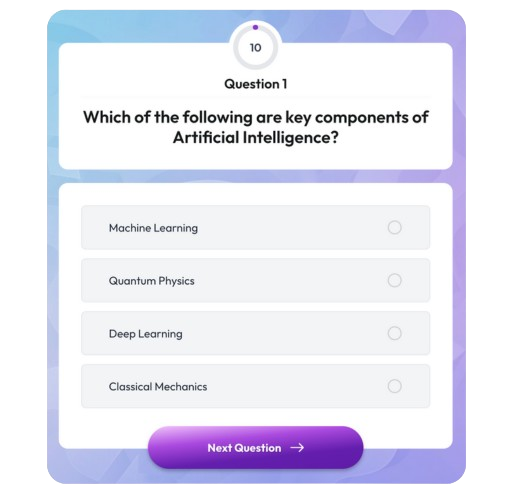
Everything You Need for Interactive Learning
Transform your static content into dynamic quizzes and assessments with our AI-powered tools. No more manual question creation.
Multiple Content Sources
Your knowledge lives everywhere. Now, so can your quizzes. Whether your material is in a detailed PDF report, a live webpage, or simple pasted text, our AI is ready to transform it into an assessment tool in seconds.
URL Content Quiz Builder
Don't just link to content—assess it. Point our AI to any URL, from a single blog post to a multi-page guide. It intelligently crawls, comprehends context, and generates precise questions that reflect the core information on the page.
Smart MCQs & Questions
Our AI crafts challenging questions with plausible distractors and provides automatic explanations for correct answers to reinforce learning.
Interactive Polls
Engage your audience in real-time. Instantly create live polls to gauge understanding or gather opinions during a presentation or lesson.
Export Results
Turn quiz results into actionable insights. Download detailed performance reports, track individual and group progress, and analyze response patterns.
Collaboration
Invite colleagues to a shared workspace. Co-create quizzes, manage a central library of assessments, and set permissions to streamline your workflow.
Revolutionizing Learning with AI
The traditional process of creating assessments is a major hurdle for today's fast-paced learning environments. Manually drafting questions, ensuring they cover key topics, and creating varied formats is tedious work that steals valuable time from educators and trainers. Often, the end result is a simple quiz that only scratches the surface of true comprehension.
Quizzify changes the game. Our platform leverages advanced AI that goes beyond keyword matching. It reads and digests your source material—be it a dense research paper or a simple webpage—with human-like understanding. By analyzing context, hierarchy, and key concepts, Quizzify crafts meaningful questions that challenge learners and accurately measure their grasp of the material.
Who Uses quizzify?
-
Educators who need to save hours on lesson prep and create more effective assessments that improve student retention.
-
Corporate Trainers tasked with verifying employee knowledge, ensuring compliance, and maximizing the impact of training programs.
-
Content Creators looking to transform static content like blog posts and guides into interactive experiences that captivate their audience.
How It Works
Provide Your Content
Simply drag and drop any PDF, paste text directly, or enter a URL. From a single article to a full textbook chapter, your content is our starting point.
AI Performs a Deep Analysis
In seconds, our AI reads and understands your material. It identifies core concepts, critical facts, and the relationships between them to find the most valuable information for assessment.
Your Quiz is Instantly Generated
A complete, relevant quiz is created automatically. Our system generates a variety of question types, including multiple-choice with intelligent distractors, to ensure a robust test of knowledge.
Review, Customize, and Share
You have the final say. Effortlessly edit, add, or delete questions. When you're ready, share your quiz with a simple link, embed it on your site, or export it for your LMS.
Explore Our AI in Action
Browse a live gallery of examples and preview the quality of our AI-generated questions firsthand. Discover what's possible for your content.
إعداد المعارض اتراثية والثقافية
إعداد المعارض الثقافية والتراثية
a
pulmology
Nursing
https://www.hsag.co.za Open Access Health SA Gesondheid ISSN: (Online) 2071-9736, (Print) 1025-9848 Page 1 of 8 Original Research Read online: Scan this QR code with your smart phone or mobile device to read online. Authors: Lindiwe Gumede1 Pauline B. Nkosi2 Maureen N. Sibiya3 Affiliations: 1Department of Medical Imaging and Radiation Sciences, Faculty of Health Sciences, University of Johannesburg, Johannesburg, South Africa 2Department of Radiography, Faculty of Health Sciences, Durban University of Technology, Durban, South Africa 3Faculty of Innovation and Engagement, Mangosuthu University of Technology, Durban, South Africa Corresponding author: Lindiwe Gumede, lindiweg@uj.ac.za Dates: Received: 08 Mar. 2023 Accepted: 25 Oct. 2023 Published: 31 Jan. 2024 How to cite this article: Gumede, L., Nkosi, P.B. & Sibiya, M.N., 2024, ‘Allopathic medicine practitioners’ experiences with nondisclosure of traditional medicine use’, Health SA Gesondheid 29(0), a2381. https://doi.org/10.4102/ hsag.v29i0.2381 Copyright: © 2024. The Authors. Licensee: AOSIS. This work is licensed under the Creative Commons Attribution License. Introduction The focal role in establishing a therapeutic relationship between allopathic medicine practitioners (AMPs) and patients is of effective communication between the two (Pasca 2020). The lack of good communication between AMPs and patients during consultations can discourage disclosure. Therefore, AMPs must have good verbal and nonverbal communication skills to interact with patients. These include active listening, enquiring, communicating, and inspiring others to speak (Jahan & Siddiqui 2019). This is also true for patients who use both traditional medicine (TM) and allopathic medicine (AM) (Gall et al. 2019). When working with various patients, cross-cultural communication, which is part of cultural competence, is frequently required (Jahan & Siddiqui 2019). To prevent communication breakdowns between patients who use TM and AMPs, AMPs must adapt their consultation communication to the patient’s specific requirements. According to a recent study, patients who use both TM and AM may not disclose their use of TM because of poor communication between patients and AMPs, a lack of awareness of the potential interaction between TM and AM, and AMPs incorrectly judging the use of TM (Agarwal 2020). Allopathic medicine practitioners are more likely to overlook serious health issues caused by the negative interaction of TM and AM, as well as a breakdown in the connection between patients (who use both TM and AM) and AMPs, because of a lack of proper communication (Bauer & Guerra 2014). Studies suggest that AMPs must probe patients to encourage disclosure and increase the rate of disclosure of TM use (Thandar et al. 2019; Van der Geest & Hardon 2006). Background: A pertinent issue impacting patient treatment outcomes is the nondisclosure of traditional medicine (TM) use to Allopathic medicine practitioners (AMPs). For years, TM has been a controversial practice, with patients often using it alongside allopathic medicine without disclosing their use. It is imperitive to learn and understand the experiences of AMPs regarding the disclosure of TM use in Gauteng province to enable them to provide the best possible treatment outcomes for patients who use TM. Aim: This study aimed to explore the experiences of AMPs regarding non-disclosure of TM use in Gauteng province. Setting: This study was conducted in four district hospitals where outpatient care and services are rendered in Gauteng Province. Methods: An interpretive phenomenological analysis (IPA) design was followed. Fourteen purposefully sampled AMPs participated in face-to-face, one-on-one, and semi-structured interviews. Interpretive phenomenological analysis in Atlas.ti was conducted. Results: Three themes emerged: bedside manner of AMPs; stigmatising TM use; and individual belief systems. The belief of patients’ disclosure hesitancy because of fear of judgment by the AMPs underpinned these themes. Conclusion: Allopathic medicine practitioners are aware that patients who use TM could feel guilty and stigmatised. They acknowledged that patients use TM because of cultural and ethnic reasons, which should not be disregarded. Contribution: The study highlighted that patients do not disclose their TM use because of AMPs’ attitudes, stigmatising TM use, and their prejudices against the cultural beliefs of patients. Allopathic medicine practitioners should establish good communication with patients by providing patient-centred communication to facilitate disclosure of TM use. Keywords: traditional medicine; Allopathic medicine practitioners; non-disclosure; patient treatment outcomes; consultation; stigmatising; belief systems; cultural and ethnic reasons. Allopathic medicine practitioners’ experiences with non-disclosure of traditional medicine use Page 2 of 8 Original Research https://www.hsag.co.za Open Access Over the last decade, there has been little change in the rate of TM use disclosure to AMPs (Foley et al. 2019). However, rates of disclosure of TM use vary according to population demographics and TM classification. A study conducted in Malaysia reveals that patient disclosure was motivated by multiple benefits, including the possibility of receiving advice from AMPs regarding the continuance of TM use or receiving more information about the TM they use (Kelak, Cheah & Safii 2018). The lack of disclosure regarding TM usage holds significance, especially in understanding how AMPs are pivotal guardians in ensuring their patients’ overall health awareness (Foley et al. 2019). According to Johny, Cheah and Razitasham (2017), AMPs tend to be business-oriented and lack human connection with TM patients, which hinders disclosure. Several articles have addressed grounds for non-disclosure of TM use (Agyei- Baffour et al. 2017; Mokhesi & Modjadji 2022; Stubbe 2018). Motivation for non-disclosure may include, but is not limited to, failure of AMPs to inquire about TM use, AMPs reprimanding patients for using TM, and that AMPs have limited knowledge of TM and therefore they would not benefit from disclosing their TM use (Mwaka, Abbo & Kinengyere 2020). Despite documented evidence of barriers to patients’ disclosure of TM use to AMPs, there is a paucity of research examining AMPs’ experiences with nondisclosure of TM use. Therefore, it is important to encourage AMPs to inquire about the patient’s use of TM (Stubbe 2018). The use of TM is common in South Africa and therefore AMPs need to be knowledgeable to better manage their patients for better outcomes (Zingela, Van Wyk & Pieterse 2019). Patients may believe that their TM use is confidential; therefore, AMPs might not be aware that they are using TM and AM concurrently. To ensure patient safety, a thorough investigation of patients’ disclosure of TM use as well as the reasons for non-disclosure is required (Mokhesi & Modjadji 2022). Currently, existing patient–AMP communication does not allow AMPs to link TM and AM in practice; thus, the development of workable methods to guide the process is required (Wardle, Sibbritt & Adams 2018). These methods could assist AMPs in comprehending patients’ non-disclosure, allowing them to enhance treatment and communication with patients who use TM. Several studies have examined the impact of involving patients in healthcare decisions. For example, Krist et al. (2017) found that when patients are involved in decision-making, they have a better understanding of their treatment options and are more likely to make informed choices. Similarly, Bombard et al. (2018) argue that involving patients in healthcare decisions can improve communication between patients and healthcare providers, leading to better service delivery and governance. However, despite these findings, there is still a need for further research to explore the implications of non-disclosure or disclosure on treatment outcomes and the provision of care by healthcare providers (Foley et al. 2019). Purpose This study explored the experiences of AMPs regarding the disclosure of TM use in Gauteng province. Research methods and design Research design and context A qualitative, interpretive phenomenological research approach guided by hermeneutics was followed to explore the lived experiences of AMPs when consulting with patients who use TM (Rodriguez & Smith 2018; Smith 2004). The chosen design was deemed appropriate for this study because it allowed the researcher to begin comprehending the variety of factors of non-disclosure of TM that can affect AMPs based on their perspective and experience, revealing concealed meaning rather than making inferences. The study was guided by a constructivist paradigm, which took a relativist ontology approach and incorporated various intangible mental concepts that were derived from the contextual and experiential knowledge of the AMPs (Guba & Lincoln 1994). The study was conducted at selected district hospitals in the Gauteng province. Four district hospitals were selected for this study because they promote primary health care and serve as a gateway to specialised care. These hospitals are where most patients with chronic illnesses and potential TM users are managed. This study was inspired by the main researcher’s prior experience as a radiographer, who saw several difficulties faced by AMPs when dealing with patients who might be using TM and not disclosing TM use to them. Population and sampling Population in research is the entire group of individuals with similar characteristics from whom data will be collected (Polit & Beck 2017). The study population were AMPs working in the outpatient departments (OPDs), in the district hospitals in the Gauteng Province. A non-probability, purposive sampling described by Polit and Beck (2017), was adopted to select AMPs in the OPD from multiple sites. The researcher selected participants based on ...
Tets
Hahhwh
إعداد المعارض اتراثية والثقافية
إعداد المعارض الثقافية والتراثية
Le saviez vous 2
La Caraibe: C'est l'ensemble formé par les Grandes Antilies, les Petites Antilles, ins Bahamas, le Sud Floride, les Régions Côtières de l'Amérique du Sud Statut Politique des Pays de la Caraibe Les pays de la Caraïbe n'ont pas tous le même statut politique. On distingue Jamaïque Les pays à statut indépendant des Grandes Antilles La République Dominicaine, Haiti, Cuba Les États indépendants des Petites Antilles Trinidad et Tobago, la Grenade, les lles Barbade, la Dominique, Ste Lucie, St Vincent, St Kitts et Nevis, Antigua et Barbuda Baher Les pays à statut de DOM (Département d'Outre Mer), TOM (Territoire d'Outre Mes Martinique, is Guadeloupe, is Guyane Française et la partie Nurd de St Martin tais qu Les pays à statut d'État associés des USA lles Vierges Américaine et Porto Rico (San Juan) Les pays colonisés par l'Angleterre ou encore des possessions britanniques les lles Vie Britanniques, Anguilla, Cayman, Iles Trucks and Calicots, Iles Cayman Montserrat. Les pays cólonisés par la Hollande qui sont encore des possessions hollandaises comme Cur Aruba, Bonaire, St Marteen, St Eustache, Saba Production des Pays de la Caribe: Los pays de la Caraibe produisant surtout la badute, le cuivre, le tabac, le cacao, la figus banan sucre Economie des pays de la Caraibe: onomie des pays de la Caraïbe repose le plus souvent sur un seul produit. C'est le cas de de la République Dominicaine dont l'économie repose sur le sucre, la Martinique sur la figue bar de la Jamaïque sur la bauxite. NB L'Economie Caralbéenne est une économie extravertle parce qu'elle est tournée vers l'extér Unité de la Caraibe Tous les pays de la Caraibe possèdent les caractéristiques du sous développement. La popu caraibe est majoritairement noire (95% noire ou métissée). Les pays de la Caraibe sont souvent frappés de cyclones Le climat caraibéen est tropical Les paysans y pratiquent en général une agriculture de subsistance Les éléments de la diversité de la Caralbe La religion, la langue, la culture et la race.
geo
geography
Theo midterm 10 review
Key Terms & Definitions 1. Covenant – A solemn agreement between God and His people that involves mutual commitments. 2. Contract – A legal agreement between people that outlines obligations, unlike a covenant which involves God. 3. Inerrancy – The belief that the Bible, in matters of faith and salvation, is free from error. 4. Genesis – The first book of the Bible; tells the story of Creation, the Fall, and the Patriarchs. 5. Creation – God’s act of bringing the universe and all living things into existence. 6. Leviticus – A book of the Bible containing laws and priestly rituals for Israel. 7. Exodus – The book of the Bible telling of Israel’s deliverance from Egypt and the giving of the Law. 8. Caleb and Joshua – Leaders of Israel who trusted God and led the Israelites into the Promised Land. 9. Psalms – A collection of sacred songs and prayers in the Bible, often attributed to King David. Senses of Scripture 10. Allegorical Sense – Reading Scripture as it points to Christ or God’s plan. 11. Moral Sense – Reading Scripture to learn how to live a good, ethical life. 12. Anagogical Sense – Reading Scripture as it relates to our ultimate destiny in Heaven. 13. The Sabbath – The day of rest and worship, established by God after Creation. 14. Tower of Babel – Story of humanity’s pride leading to the confusion of languages and dispersion of people. 15. Abraham – First patriarch; received God’s covenant promising land, descendants, and blessing. 16. Isaac – Son of Abraham; father of Jacob and Esau. 17. A Type – A person or event in Scripture that prefigures Christ or future events. 18. Circumcision – Physical sign of the covenant with Abraham and his descendants. 19. Joseph – Jacob’s son, sold into slavery, later became a leader in Egypt. 20. Manna – Bread from Heaven provided by God to the Israelites in the desert. 21. Moses – Prophet who led Israel out of Egypt, received the Ten Commandments. 22. The Chosen People – The Israelites, God’s special covenant people. 23. The Tribe of Levi – The priestly tribe of Israel, responsible for Temple worship. 24. Samuel – Prophet and last judge of Israel; anointed Saul and David as kings. 25. King David – Second king of Israel; united the tribes, established Jerusalem as capital. 26. King Saul – First king of Israel; later rejected by God for disobedience. 27. King Solomon – Son of David; built the Temple, known for wisdom. 28. Old Testament – The first part of the Bible; contains God’s covenant with Israel. 29. The Number 40 – Symbolizes trial, testing, or preparation in Scripture (e.g., 40 days of flood, 40 years in desert). 30. Deuteronomy – Book of laws and speeches by Moses to prepare Israelites for the Promised Land. 31. The Temple – Holy place in Jerusalem where God’s presence dwelt and sacrifices were offered. 32. Samson – Judge of Israel with extraordinary strength, known for Nazarite vow. 33. The Passover Lamb – Symbol of deliverance; foreshadows Christ’s sacrifice. 34. Theophany – Appearance of God to humans (e.g., burning bush). 35. Elijah – Prophet of God who defended the worship of Yahweh in Israel. 36. Rachel – Jacob’s beloved wife; mother of Joseph and Benjamin. 37. Jacob – Son of Isaac; later named Israel; father of the twelve tribes. 38. Israel – Name given to Jacob; also refers to the people of God descended from him. 39. Tabernacle – Portable sanctuary used by Israelites during the Exodus. 40. Tradition – Teachings of the Church passed down orally from the apostles. 41. Canon – Official list of inspired Scripture books. 42. Esau – Jacob’s brother; sold his birthright for a meal. 43. Lamech – Descendant of Cain; associated with violence in Genesis. 44. Prophets – People called by God to speak His word and guide His people. 45. Aaron – Brother of Moses; first high priest of Israel. 46. Joshua – Successor to Moses; led Israel into the Promised Land. 47. Rahab – Woman of Jericho who helped Israelite spies; included in Jesus’ genealogy. 48. Ark of the Covenant – Sacred chest holding the Ten Commandments; symbol of God’s presence. 49. Throne of David – Symbol of the Davidic kingdom and God’s covenant with David. 50. Queen of Sheba – Visited Solomon to witness his wisdom and wealth. 51. Gentiles – Non-Jewish people. 52. Rehoboam – Son of Solomon; his harsh rule led to the division of Israel. 53. Jeroboam – First king of the northern kingdom of Israel after the split. 54. Yahweh – The personal name of God revealed to Moses. 55. Protoevangelium – First gospel; God’s promise of a Savior after the Fall (Genesis 3:15). 56. Moriah – Mount where Abraham was to sacrifice Isaac; site of the Temple. 57. Mount Sinai – Mountain where Moses received the Law. 58. Apostasy – Rejection of God and the faith. Concepts to Understand Three Spiritual Senses of Scripture Allegorical – Points to Christ or God’s plan. Moral – Shows how to live rightly. Anagogical – Points to ultimate destiny and Heaven. Books of the Law / Torah / Pentateuch Torah – Hebrew word for “Law”; first five books. Pentateuch – Greek for “five books”; Genesis, Exodus, Leviticus, Numbers, Deuteronomy. Four Genres of Old Testament Writings Law History Wisdom Prophecy Deuterocanonical Books – Books included in Catholic Old Testament but not in Protestant versions. Salvation History – God’s plan of saving humanity revealed over time through covenants. Covenant Mediators – Individuals chosen to represent God and communicate His covenant (e.g., Adam, Noah, Abraham, Moses, David). 1. Covenant – A solemn agreement between God and His people. Example: God’s promise to Abraham that he would have many descendants. 2. Contract – Legal agreement between people, not involving God. Example: A lease agreement to rent an apartment. 3. Inerrancy – The Bible is free from error in faith and morals. Example: The story of Creation in Genesis teaches God made everything, which is considered true in faith. 4. Genesis – First book of the Bible. Example: Includes Creation, Adam & Eve, Noah’s Ark. 5. Creation – God brings the universe into existence. Example: God creating the world in seven days. 6. Leviticus – Book of laws for Israel. Example: Instructions for sacrifices and purity laws. 7. Exodus – Israel leaves Egypt and receives God’s Law. Example: Crossing the Red Sea and receiving the Ten Commandments. 8. Caleb and Joshua – Trusted God and led Israel into the Promised Land. Example: Spies who encouraged the Israelites to enter Canaan. 9. Psalms – Sacred songs or prayers. Example: Psalm 23, “The Lord is my shepherd…” Senses of Scripture 10. Allegorical Sense – Shows how Scripture points to Christ. Example: Isaac carrying wood for sacrifice prefigures Jesus carrying the cross. 11. Moral Sense – Shows how to live rightly. Example: The Good Samaritan teaches love of neighbor. 12. Anagogical Sense – Points to Heaven or our ultimate destiny. Example: The New Jerusalem in Revelation symbolizes eternal life. 13. The Sabbath – Day of rest and worship. Example: Jewish people rest on Saturday; Christians often on Sunday. 14. Tower of Babel – People try to reach Heaven, God confuses languages. Example: Story in Genesis 11 explaining why people speak different languages. 15. Abraham – Patriarch of Israel. Example: Trusted God to leave Ur and go to Canaan. 16. Isaac – Son of Abraham, father of Jacob. Example: Nearly sacrificed by Abraham but saved by God. 17. A Type – Person or event that foreshadows Christ. Example: Jonah in the whale represents Jesus in the tomb. 18. Circumcision – Sign of covenant with Abraham. Example: Abraham circumcising his son Isaac. 19. Joseph – Jacob’s son, became leader in Egypt. Example: Forgave his brothers who sold him into slavery. 20. Manna – Bread from Heaven. Example: Israelites ate it while wandering in the desert. 21. Moses – Led Israelites out of Egypt. Example: Parted the Red Sea. 22. The Chosen People – Israel, God’s covenant people. Example: Israelites following God’s Law in the Promised Land. 23. Tribe of Levi – Priestly tribe. Example: Aaron, Moses’ brother, was from this tribe. 24. Samuel – Prophet, anointed Saul and David. Example: Warned Israel against kingship but obeyed God’s plan. 25. King David – United Israel, made Jerusalem the capital. Example: Defeated Goliath. 26. King Saul – First king of Israel, disobeyed God. Example: Failed to completely destroy the Amalekites as commanded. 27. King Solomon – Built the Temple, known for wisdom. Example: Judged the two women claiming the same baby. 28. Old Testament – First part of the Bible. Example: Includes Genesis, Exodus, Psalms, Isaiah. 29. Number 40 – Symbolizes trial or testing. Example: 40 days of rain in Noah’s flood; 40 years in desert. 30. Deuteronomy – Book of Moses’ speeches. Example: Reminds Israelites to obey God’s Law before entering Canaan. 31. The Temple – Holy place in Jerusalem. Example: Built by Solomon as the dwelling place of God’s presence. 32. Samson – Judge with great strength. Example: Destroyed the Philistine temple by pushing its pillars. 33. Passover Lamb – Symbol of deliverance. Example: Blood of lamb saved Israelites in Egypt; points to Jesus. 34. Theophany – God appears to humans. Example: Burning bush to Moses. 35. Elijah – Prophet defending worship of God. Example: Called down fire from Heaven on Mt. Carmel. 36. Rachel – Jacob’s wife, beloved. Example: Mother of Joseph and Benjamin. 37. Jacob – Later named Israel, father of twelve tribes. Example: Wrestled with God and received the new name. 38. Israel – Name for Jacob and the people of God. Example: Israelites wandering in the desert. 39. Tabernacle – Portable sanctuary in de...
a
pulmology
Nursing
https://www.hsag.co.za Open Access Health SA Gesondheid ISSN: (Online) 2071-9736, (Print) 1025-9848 Page 1 of 8 Original Research Read online: Scan this QR code with your smart phone or mobile device to read online. Authors: Lindiwe Gumede1 Pauline B. Nkosi2 Maureen N. Sibiya3 Affiliations: 1Department of Medical Imaging and Radiation Sciences, Faculty of Health Sciences, University of Johannesburg, Johannesburg, South Africa 2Department of Radiography, Faculty of Health Sciences, Durban University of Technology, Durban, South Africa 3Faculty of Innovation and Engagement, Mangosuthu University of Technology, Durban, South Africa Corresponding author: Lindiwe Gumede, lindiweg@uj.ac.za Dates: Received: 08 Mar. 2023 Accepted: 25 Oct. 2023 Published: 31 Jan. 2024 How to cite this article: Gumede, L., Nkosi, P.B. & Sibiya, M.N., 2024, ‘Allopathic medicine practitioners’ experiences with nondisclosure of traditional medicine use’, Health SA Gesondheid 29(0), a2381. https://doi.org/10.4102/ hsag.v29i0.2381 Copyright: © 2024. The Authors. Licensee: AOSIS. This work is licensed under the Creative Commons Attribution License. Introduction The focal role in establishing a therapeutic relationship between allopathic medicine practitioners (AMPs) and patients is of effective communication between the two (Pasca 2020). The lack of good communication between AMPs and patients during consultations can discourage disclosure. Therefore, AMPs must have good verbal and nonverbal communication skills to interact with patients. These include active listening, enquiring, communicating, and inspiring others to speak (Jahan & Siddiqui 2019). This is also true for patients who use both traditional medicine (TM) and allopathic medicine (AM) (Gall et al. 2019). When working with various patients, cross-cultural communication, which is part of cultural competence, is frequently required (Jahan & Siddiqui 2019). To prevent communication breakdowns between patients who use TM and AMPs, AMPs must adapt their consultation communication to the patient’s specific requirements. According to a recent study, patients who use both TM and AM may not disclose their use of TM because of poor communication between patients and AMPs, a lack of awareness of the potential interaction between TM and AM, and AMPs incorrectly judging the use of TM (Agarwal 2020). Allopathic medicine practitioners are more likely to overlook serious health issues caused by the negative interaction of TM and AM, as well as a breakdown in the connection between patients (who use both TM and AM) and AMPs, because of a lack of proper communication (Bauer & Guerra 2014). Studies suggest that AMPs must probe patients to encourage disclosure and increase the rate of disclosure of TM use (Thandar et al. 2019; Van der Geest & Hardon 2006). Background: A pertinent issue impacting patient treatment outcomes is the nondisclosure of traditional medicine (TM) use to Allopathic medicine practitioners (AMPs). For years, TM has been a controversial practice, with patients often using it alongside allopathic medicine without disclosing their use. It is imperitive to learn and understand the experiences of AMPs regarding the disclosure of TM use in Gauteng province to enable them to provide the best possible treatment outcomes for patients who use TM. Aim: This study aimed to explore the experiences of AMPs regarding non-disclosure of TM use in Gauteng province. Setting: This study was conducted in four district hospitals where outpatient care and services are rendered in Gauteng Province. Methods: An interpretive phenomenological analysis (IPA) design was followed. Fourteen purposefully sampled AMPs participated in face-to-face, one-on-one, and semi-structured interviews. Interpretive phenomenological analysis in Atlas.ti was conducted. Results: Three themes emerged: bedside manner of AMPs; stigmatising TM use; and individual belief systems. The belief of patients’ disclosure hesitancy because of fear of judgment by the AMPs underpinned these themes. Conclusion: Allopathic medicine practitioners are aware that patients who use TM could feel guilty and stigmatised. They acknowledged that patients use TM because of cultural and ethnic reasons, which should not be disregarded. Contribution: The study highlighted that patients do not disclose their TM use because of AMPs’ attitudes, stigmatising TM use, and their prejudices against the cultural beliefs of patients. Allopathic medicine practitioners should establish good communication with patients by providing patient-centred communication to facilitate disclosure of TM use. Keywords: traditional medicine; Allopathic medicine practitioners; non-disclosure; patient treatment outcomes; consultation; stigmatising; belief systems; cultural and ethnic reasons. Allopathic medicine practitioners’ experiences with non-disclosure of traditional medicine use Page 2 of 8 Original Research https://www.hsag.co.za Open Access Over the last decade, there has been little change in the rate of TM use disclosure to AMPs (Foley et al. 2019). However, rates of disclosure of TM use vary according to population demographics and TM classification. A study conducted in Malaysia reveals that patient disclosure was motivated by multiple benefits, including the possibility of receiving advice from AMPs regarding the continuance of TM use or receiving more information about the TM they use (Kelak, Cheah & Safii 2018). The lack of disclosure regarding TM usage holds significance, especially in understanding how AMPs are pivotal guardians in ensuring their patients’ overall health awareness (Foley et al. 2019). According to Johny, Cheah and Razitasham (2017), AMPs tend to be business-oriented and lack human connection with TM patients, which hinders disclosure. Several articles have addressed grounds for non-disclosure of TM use (Agyei- Baffour et al. 2017; Mokhesi & Modjadji 2022; Stubbe 2018). Motivation for non-disclosure may include, but is not limited to, failure of AMPs to inquire about TM use, AMPs reprimanding patients for using TM, and that AMPs have limited knowledge of TM and therefore they would not benefit from disclosing their TM use (Mwaka, Abbo & Kinengyere 2020). Despite documented evidence of barriers to patients’ disclosure of TM use to AMPs, there is a paucity of research examining AMPs’ experiences with nondisclosure of TM use. Therefore, it is important to encourage AMPs to inquire about the patient’s use of TM (Stubbe 2018). The use of TM is common in South Africa and therefore AMPs need to be knowledgeable to better manage their patients for better outcomes (Zingela, Van Wyk & Pieterse 2019). Patients may believe that their TM use is confidential; therefore, AMPs might not be aware that they are using TM and AM concurrently. To ensure patient safety, a thorough investigation of patients’ disclosure of TM use as well as the reasons for non-disclosure is required (Mokhesi & Modjadji 2022). Currently, existing patient–AMP communication does not allow AMPs to link TM and AM in practice; thus, the development of workable methods to guide the process is required (Wardle, Sibbritt & Adams 2018). These methods could assist AMPs in comprehending patients’ non-disclosure, allowing them to enhance treatment and communication with patients who use TM. Several studies have examined the impact of involving patients in healthcare decisions. For example, Krist et al. (2017) found that when patients are involved in decision-making, they have a better understanding of their treatment options and are more likely to make informed choices. Similarly, Bombard et al. (2018) argue that involving patients in healthcare decisions can improve communication between patients and healthcare providers, leading to better service delivery and governance. However, despite these findings, there is still a need for further research to explore the implications of non-disclosure or disclosure on treatment outcomes and the provision of care by healthcare providers (Foley et al. 2019). Purpose This study explored the experiences of AMPs regarding the disclosure of TM use in Gauteng province. Research methods and design Research design and context A qualitative, interpretive phenomenological research approach guided by hermeneutics was followed to explore the lived experiences of AMPs when consulting with patients who use TM (Rodriguez & Smith 2018; Smith 2004). The chosen design was deemed appropriate for this study because it allowed the researcher to begin comprehending the variety of factors of non-disclosure of TM that can affect AMPs based on their perspective and experience, revealing concealed meaning rather than making inferences. The study was guided by a constructivist paradigm, which took a relativist ontology approach and incorporated various intangible mental concepts that were derived from the contextual and experiential knowledge of the AMPs (Guba & Lincoln 1994). The study was conducted at selected district hospitals in the Gauteng province. Four district hospitals were selected for this study because they promote primary health care and serve as a gateway to specialised care. These hospitals are where most patients with chronic illnesses and potential TM users are managed. This study was inspired by the main researcher’s prior experience as a radiographer, who saw several difficulties faced by AMPs when dealing with patients who might be using TM and not disclosing TM use to them. Population and sampling Population in research is the entire group of individuals with similar characteristics from whom data will be collected (Polit & Beck 2017). The study population were AMPs working in the outpatient departments (OPDs), in the district hospitals in the Gauteng Province. A non-probability, purposive sampling described by Polit and Beck (2017), was adopted to select AMPs in the OPD from multiple sites. The researcher selected participants based on ...
examen
si
ultrasound
practice quiz
Tets
Hahhwh
hacheur
kkkkkkkkkk
aad
physics and chemistry
work and energy
Physics
advt
1 - Introduction to Data Visualization and Visualization techniques - CO: 1 1 - Overview of data visualization Understand 2 - Data Abstraction - Task Abstraction Apply 3 - Analysis: Four Levels for Validation Understand 4 - Visualization Techniques Understand 5 - Scalar and point techniques Apply 6 - Vector visualization techniques Apply 2 - Visual Analytics - CO: 1 1 - Visual Variables Understand 2 - Networks and Trees Apply 3 - Tables Apply 4 - Map Color and Other Channels Apply 5 - Manipulate View Apply 3 - Visualization Tools - CO: 1 1 - Fundamentals of R Apply 2 - Visualization using R library Apply 3 - Visualization using R library generate quiz quetion for this practise for my exam give many number of question
ntic
for exam
Prompt Engneering
Prompt and Context Engineering Tutorial for Beginners: A Comprehensive Guide to Effective AI Communication Panaversity YouTube Class Playlist llm_share Key Takeaways With 46.59B visits, ChatGPT accounts for more than 83% of total traffic among the top 10 chatbots. The second most-used chatbot, DeepSeek at 2.74B visits, has barely 6% of ChatGPT’s traffic. While traffic is concentrated, the list includes a mix of U.S., Chinese, and European players. How LLM Works How LLMs Work: Top 10 Executive-Level Questions Understand the Power of Prompts: Context Engineering for Agentic AI Developers, Image and Video Generation, UX/UI Design and UI Development To understand the power of LLMs and prompt engineering go through these tutorials: Complete Guide to Context Engineering for AI Agents Nano Banana Tutorial Google's Veo 3: A Guide With Practical Examples UX Design by Prompting UI Development by Prompting Which is the best LLM? See how leading models stack up across text, image, vision, and beyond. This page gives you a snapshot of each Arena: https://lmarena.ai/leaderboard Use these Prompt Engineering Tools to Learn https://platform.openai.com/chat/ https://aistudio.google.com/ https://console.anthropic.com/ Prompt Coach" Here’s a reusable “Prompt Coach” prompt you can keep handy. You’ll paste this into ChatGPT (or any LLM), then just drop in your messy idea, and it will rewrite it into a polished, effective prompt for you: Copy Paste this in your LLM: You are my Prompt Coach. I will give you a rough or unclear prompt. Your task is to: 1. Clarify it 2. Add missing context 3. Structure it for best results 4. Suggest 2–3 alternative versions (different styles: simple, detailed, structured) Here’s my rough prompt: [INSERT YOUR PROMPT HERE] Table of Contents What is Prompt Engineering? Understanding Large Language Models Essential Configuration Settings Fundamental Prompting Techniques Advanced Prompting Strategies Best Practices for Effective Prompts Common Pitfalls and How to Avoid Them Hands-On Examples Testing and Iteration Resources and Next Steps Mixture-of-Experts (MoE) and Prompt Engineering The 6-Part Prompting Framework What is Prompt Engineering? Prompt engineering is the art and science of crafting instructions that guide AI language models to produce desired outputs. Think of it as learning to communicate effectively with AI systems to achieve specific goals. Why is it important? You don't need to be a programmer to use AI effectively Good prompts can dramatically improve AI performance It's an iterative skill that improves with practice It's becoming essential for productivity in many fields Prompt engineering vs. context engineering Prompt engineering = crafting the instruction you give the model. Context engineering = curating the information the model can see when following that instruction. Quick contrast Aspect Prompt engineering Context engineering Goal Tell the model how to behave and what to produce Give the model the facts/examples it should rely on Levers Wording, structure, roles, constraints, output schema, few-shot examples Retrieval (RAG), documents, knowledge bases, tools/APIs, memory, state across turns Typical changes “Be concise. Return valid JSON with fields X/Y/Z.” “Attach the company glossary, latest policy PDF, and retrieved passages for this query.” Failure mode Vague instructions → messy/incorrect format Missing/irrelevant info → hallucinations/outdated answers Ownership UX/prompt designers, app devs Data/ML/platform teams (pipelines, indexing, chunking, evals) How they work together Start with a good prompt: clear task, constraints, and an output contract (e.g., JSON schema). Then ground it with context: supply only the most relevant passages, tables, and tool results. The prompt guides behavior; the context supplies knowledge. You usually need both. Concrete examples Invoice → JSON extractor Prompt engineering: “Extract fields {vendor, date, total}. Return JSON only. If a field is missing, use null.” Context engineering: Provide a few labeled examples and attach the vendor’s invoice spec retrieved via embeddings. Policy Q&A bot Prompt engineering: “Answer using the attached passages; if unsure, say ‘Not in policy.’ Cite section IDs.” Context engineering: RAG over your policy repo (chunking, metadata filters like department=HR, freshness boosts), plus a recency cache for updates. Agentic workflow Prompt engineering: Tool-use instructions and function signatures. Context engineering: Feed tool responses (DB rows, API payloads) back into the context window each step; maintain short-term memory/state. Practical tips Keep prompts short, specific, and testable; define output schemas. Prefer few-shot examples only when they generalize; otherwise move them into retrieval. For context: optimize chunking, ranking, deduping, and token budgets; log what was retrieved for each answer. Add citations and “answer only from context” instructions when correctness matters. Evaluate both layers separately: prompt A/B tests and retrieval quality (precision/recall, groundedness). One-liner: Prompt engineering is how you ask; context engineering is what you show. Combine them for reliable, scalable LLM apps. Understanding Large Language Models How LLMs Work (The Basics) Large Language Models are prediction engines that: Take text input (your prompt) Predict the next most likely word/token Continue this process to generate complete responses Base predictions on patterns learned from training data Key Concept: Autocompletion LLMs don't "understand" in the human sense—they're sophisticated autocomplete systems. Your prompt sets up the context for what should come next. Essential Configuration Settings Before diving into prompt techniques, understand these key parameters that control AI behavior: Temperature (0-1) Low (0-0.3): Focused, consistent, deterministic responses Medium (0.4-0.7): Balanced creativity and consistency High (0.8-1.0): Creative, diverse, but potentially unpredictable When to use: Temperature 0: Math problems, factual questions Temperature 0.7: Creative writing, brainstorming Temperature 0.9: Poetry, experimental content Output Length/Token Limits Controls maximum response length Higher limits = more computational cost Set appropriately for your task needs Top-K and Top-P (Nucleus Sampling) Top-K: Limits choices to top K most likely tokens Top-P: Limits choices based on cumulative probability Work together with temperature to control randomness Recommended starting points: Conservative: Temperature 0.1, Top-P 0.9, Top-K 20 Balanced: Temperature 0.2, Top-P 0.95, Top-K 30 Creative: Temperature 0.9, Top-P 0.99, Top-K 40 Fundamental Prompting Techniques 1. Zero-Shot Prompting The simplest approach—just ask directly without examples. Example: Classify this movie review as positive, negative, or neutral: "The film was visually stunning but the plot felt rushed." When to use: Simple, well-defined tasks When the model has clear knowledge of the domain Quick one-off requests 2. One-Shot Prompting Provide a single example to guide the response format. Example: Translate English to French: English: "Hello, how are you?" French: "Bonjour, comment allez-vous?" English: "Where is the library?" French: 3. Few-Shot Prompting Provide multiple examples to establish a clear pattern. Example: Convert customer feedback to structured data: Feedback: "Great service, but food was cold" JSON: {"service": "positive", "food": "negative", "overall": "mixed"} Feedback: "Amazing experience, will definitely return" JSON: {"service": "positive", "food": "positive", "overall": "positive"} Feedback: "Terrible food and rude staff" JSON: Best practices: Use 3-5 examples for most tasks Include diverse examples Mix up the classes in classification tasks Ensure examples are high-quality and consistent 4. System Prompting Set overall context and behavior guidelines. Example: You are a helpful travel guide. Provide practical, accurate information about destinations. Always include: - Key attractions - Local customs to be aware of - Budget considerations - Best time to visit User: Tell me about visiting Tokyo. 5. Role Prompting Assign a specific character or expertise to the AI. Example: Act as an experienced software architect. I need help designing a scalable web application for 1 million users. What architecture patterns should I consider? Effective roles: Subject matter expert (doctor, lawyer, teacher) Creative roles (writer, designer, poet) Analytical roles (data analyst, consultant) Communication styles (friendly tutor, formal advisor) 6. Contextual Prompting Provide specific background information relevant to the task. Example: Context: You're writing for a tech blog aimed at beginners who have never coded before. Write a 200-word explanation of what an API is, using simple language and practical examples. Advanced Prompting Strategies Chain of Thought (CoT) Prompting Encourage step-by-step reasoning for complex problems. Example: Solve this step by step: If I was 6 when my sister was half my age, how old is my sister when I'm 40? Let me think through this step by step: When to use: Math problems Logical reasoning Complex analysis Multi-step processes Best practices: Use "Let's think step by step" or similar phrases Set temperature to 0 for consistent reasoning Extract final answers separately from reasoning Self-Consistency Generate multiple reasoning paths and select the most common answer. Process: Ask the same question multiple times with different phrasings Compare the answers Choose the most frequently occurring result Example: Question: If a store offers a 20% discount on a $50 item, what is the final price? Generate 3 different reasoning paths for this question and select the most consistent answer. Path 1: To find the final price, calculate the discount: 20% of $50 is 0.20 × 50 = $10. Subtract this from the ori...
Bim
jojo
fvytfytf
cyhgc cftgcfty
Hi
Svt
Bio
Quiz
Bedroom 2. Toothbrush 3. Sunflower 4. Basketball 5. Raincoat 6. Snowman 7. Firefighter 8. Notebook 9. Grandmother 10. Football 11. Airport 12. Waterfall 13. Cupcake 14. Bookstore 15. Haircut 16. Mailbox 17. Keyboard 18. Skateboard 19. Pancake 20. Backpack 21. Playground 22. Sunshine 23. Starfish 24. Windmill 25. Snowflake 26. Laptop 27. Headphones 28. Earthquake 29. Blackboard 30. Classroom
zakażenia szpitalne
Zakażenia szpitalne – definicje, podział, zasięg i przyczyny ich powstawania. Drogi szerzenia zakażeń szpitalnych, warunki sprzyjające ich transmisji, grupy ryzyka. Podstawowe pojęcia i metody profilaktyki zakażeń szpitalnych. Higiena rąk. Przygotowanie roztworu dezynfekcyjnego. Dezynfekcja i sterylizacja. Rekomendacje dotyczące środków ochrony osobistej. Rodzaje izolacji, pojęcie reżimu sanitarnego. Zasady izolacji. Higiena szpitalna. Postępowanie z brudną bielizną. Postępowanie z odpadami medycznymi- Segregacja, przechowywanie i utylizacja Zasady pobierania i transportu materiału do badań mikrobiologicznych. Podział i charakterystyka zakażeń szpitalnych. Mechanizm i sposoby postępowania w zakażeniu krwi, zakażeniu ogólnoustrojowym, szpitalnym zapaleniu płuc, zakażeniu dróg moczowych i zakażeniu miejsca operowanego. Ekspozycja zawodowa – definicja, rodzaje, procedury postępowania. Przepisy prawne poruszane a w szczególności najważniejsze elementy w nich zawarte. Definicje najczęściej używane jak również zawarte w Ustawie z dnia 5 grudnia 2008 r. o zapobieganiu oraz zwalczaniu zakażeń i chorób zakaźnych u ludzi. Akty prawne USTAWA z dnia 5 grudnia 2008 r. o zapobieganiu oraz zwalczaniu zakażeń i chorób zakaźnych u ludzi (Dz. U. z 2025 poz. 1675) Rozporządzenie Ministra Zdrowia z dnia 10 grudnia 2019 r. w sprawie zgłaszania podejrzeń i rozpoznań zakażeń, chorób zakaźnych oraz zgonów z ich powodu Dz.U. 2023 Poz. 1045 Rozporządzenie Ministra Zdrowia z dnia 6 czerwca 2013 r. w sprawie bezpieczeństwa i higieny pracy przy wykonywaniu prac związanych z narażeniem na zranienia ostrymi narzędziami używanymi przy udzielaniu świadczeń zdrowotnych (Dz.U. z 2013 r. poz. 696) Rozporządzenie Ministra Zdrowia z dnia 25 marca 2022 r. w sprawie chorób zakaźnych powodujących powstanie obowiązku hospitalizacji Dz.U. 2023 poz. 668 Rozporządzenie Ministra Zdrowia z dnia 5 października 2017 r. w sprawie szczegółowego sposobu postępowania z odpadami medycznymi poz. 1975 Rozporządzenie Ministra Zdrowia z dnia 23 grudnia 2011 r. w sprawie listy czynników alarmowych, rejestrów zakażeń szpitalnych i czynników alarmowych oraz raportów o bieżącej sytuacji epidemiologicznej szpitala (Dz.U. z 2024 poz. 335) Rozporządzenie Ministra Zdrowia z dnia 22 kwietnia 2005 r. w sprawie szkodliwych czynników biologicznych dla zdrowia w środowisku pracy oraz ochrony zdrowia pracowników zawodowo narażonych na te czynniki Dz.U. 2005 nr 81 poz. 716
TEHNOLOGIE
tehno
repaso ingles
hola
Capitolul 1
POO
Sc1006 part1
ah
circuiti combinatori
https://2025.aulaweb.unige.it/mod/resource/view.php?id=47725 https://2025.aulaweb.unige.it/mod/resource/view.php?id=47726 https://2025.aulaweb.unige.it/mod/resource/view.php?id=47727 https://2025.aulaweb.unige.it/mod/resource/view.php?id=47728 This quiz is designed as practice and exam preparation for a Computer Science course, with a specific focus on digital logic and combinational circuits. The questions assess the understanding of fundamental concepts in Boolean logic, starting from basic logic gates and progressing to the design and analysis of complex logical networks. The quiz covers both theoretical and practical aspects, including the distinction between combinational and sequential circuits, the construction of truth tables, the synthesis of logic networks, and the simplification of Boolean functions using Karnaugh maps. The quiz includes questions on essential digital components such as: Basic logic gates 1-bit Full Adder ALU (Arithmetic Logic Unit) Decoders and Encoders Priority Encoder Multiplexers and Demultiplexers Look-Up Tables (LUTs) The objective of the quiz is to evaluate the student’s ability to: interpret and construct truth tables analyze and design combinational logic circuits understand the operation of fundamental digital building blocks apply logic simplification and circuit synthesis techniques The level of difficulty is appropriate for a basic to intermediate Computer Science exam and may include multiple-choice questions, true/false questions, and logic design problems.
POS
e
Amt technician
1st test
historia tema 4
4.1. LA RESTAURACIÓN: EL SISTEMA CANOVISTA La Restauración fue un sistema político ideado por Antonio Cánovas del Castillo, cuyo principal objetivo era acabar con la inestabilidad política y garantizar el orden y la continuidad de la monarquía. Para ello, se restauró la dinastía borbónica con Alfonso XII como rey y se estableció un sistema basado en la alternancia pacífica de partidos. La base legal del sistema fue la Constitución de 1876, que se caracterizaba por ser flexible y duradera. En ella se establecía una monarquía constitucional con soberanía compartida entre el rey y las Cortes. La Constitución recogía una amplia declaración de derechos individuales, aunque estos derechos quedaban supeditados a leyes posteriores, lo que permitía limitar su aplicación real. En un principio se estableció el sufragio censitario, es decir, solo podían votar los ciudadanos con cierto nivel de renta, aunque en 1890 se implantó el sufragio universal masculino. El funcionamiento del sistema se apoyaba en el bipartidismo y el turnismo. Los dos partidos dinásticos eran el Partido Conservador, liderado por Cánovas, y el Partido Liberal, dirigido por Sagasta. Ambos partidos se comprometían a respetar la monarquía y la Constitución, y se turnaban en el poder de manera pactada. Cuando uno de ellos se desgastaba, el rey llamaba al otro para formar gobierno y después se convocaban elecciones. Este turno de partidos no era fruto de elecciones libres, sino que se aseguraba mediante el fraude electoral y el caciquismo. Los caciques eran personajes influyentes a nivel local que manipulaban el voto para garantizar el resultado deseado por el gobierno. Gracias a este sistema, el Partido Conservador gobernó entre 1875 y 1881. Posteriormente, Sagasta formó el primer gobierno liberal y, más tarde, Cánovas volvió al poder en 1884. Tras la muerte de Alfonso XII en 1885, se temió que el sistema político pudiera desestabilizarse. Para evitarlo, se firmó el Pacto del Pardo, por el cual conservadores y liberales acordaron mantener el turno pacífico de partidos. Durante la regencia de María Cristina de Habsburgo-Lorena (1885-1902), el Partido Liberal gobernó durante más tiempo y llevó a cabo importantes reformas, como la Ley de Asociaciones (1887), la abolición de la esclavitud (1888), la implantación del jurado, el nuevo Código Civil (1889) y el sufragio universal masculino (1890). En la última década del siglo XIX se mantuvo el turnismo, pero el sistema empezó a mostrar signos de agotamiento. En 1897 Cánovas fue asesinado y el excesivo personalismo de los líderes provocó divisiones internas y la progresiva descomposición de los partidos dinásticos. 4.2. LA CUESTIÓN COLONIAL Y LA CRISIS DE 1898. OPOSICIÓN AL SISTEMA Uno de los principales problemas de la Restauración fue la cuestión colonial, especialmente en Cuba. Tras la Paz de Zanjón en 1878, que puso fin a la Guerra de los Diez Años, España se comprometió a introducir reformas en la isla, pero muchas de ellas no se cumplieron. Esto provocó nuevos conflictos, como la Guerra Chiquita (1879) y, finalmente, el Grito de Baire en 1895, que dio inicio a la Guerra de Independencia cubana. La situación se agravó con la intervención de Estados Unidos, que tenía importantes intereses económicos en Cuba. En 1898 estalló la guerra hispano-estadounidense, en la que España fue rápidamente derrotada. La guerra terminó con la Paz de París, por la cual España perdió sus últimas colonias: Cuba, Puerto Rico y Filipinas. Este hecho supuso un duro golpe para el prestigio internacional del país. La derrota de 1898 provocó una grave crisis política y moral en España. Se puso de manifiesto el atraso del país y la necesidad de llevar a cabo reformas profundas para modernizar la vida política, social y cultural. En este contexto surgieron movimientos como el Regeneracionismo, que defendía la necesidad de “regenerar” España, y la Institución Libre de Enseñanza, que promovía una educación moderna y laica. Frente al sistema de la Restauración existió una oposición constante. El carlismo, aunque fue derrotado definitivamente en 1876, mantuvo cierta presencia política. Los republicanos estaban divididos y carecían de fuerza suficiente para gobernar. También surgieron los nacionalismos periféricos, especialmente en Cataluña y el País Vasco, que reclamaban mayor autonomía. Por último, el movimiento obrero, dividido entre anarquistas y socialistas, fue perseguido en muchas ocasiones y no logró una representación parlamentaria significativa.
Jfj
History
O regime fascista em Itália
1. O Regime Fascista em Itália A Itália em crise A Itália, no decorrer da 1.ª Grande Guerra, sofreu consideráveis perdas humanas e materiais. Mas, apesar de fazer parte do grupo dos países vencedores, não tinha recebido grandes recompensas. Por isso, continuava a reivindicar territórios vizinhos (Fiúme, Dalmácia) que lhe tinham sido prometidos pelos Aliados. Por outro lado, nos inícios da década de 1920, o país atravessava uma grave crise económica e financeira. A agricultura e a indústria tinham perdido importância, a inflação e o desemprego eram elevados. O défice do Estado aumentava. A Itália era, então uma Monarquia Parlamentar. Entre junho de 1919 e fevereiro de 1922, o país foi dirigido por quatro governos. Por isso, a instabilidade política levou ao descrédito do regime liberal, muito criticado por um partido da extrema-direita, o Partido Nacional Fascista. Mussolini alcança o poder Face à incapacidade dos governos para resolver a crise, o descontentamento atingiu todas as camadas sociais: ● os camponeses , à espera de uma reforma agrária, apoderaram-se das terras; ● os operários , desencadearam greves e ocuparam fábricas; ● as classes médias e a burguesia , preocupadas com a insegurança e a agitação nas ruas, temiam que se implantasse em Itália um regime semelhante ao da Rússia (comunismo).A situação foi aproveitada por Mussolini, fundador do Partido Nacional Fascista. Mussolini prometeu repor a ordem em Itália e satisfazer reivindicações das classes sociais. De imediato, organizou grandes comícios de exaltação nacional e sedes dos sindicatos e dos atacou as partidos de esquerda. O Partido Nacional Fascista foi ganhando adeptos e visto como a única força capaz de salvar o país. Em 1922, perto de 30 000 “camisas negras” avançaram sobre Roma. O rei Vitor Manuel III, receoso de uma guerra civil, convidou Mussolini a formar governo. Durante 2 anos, os fascistas perseguiram e eliminaram os opositores. Nas eleições de 1924, Mussolini, após uma campanha de grande intimidação, conseguiu a maioria absoluta dos votos. De seguida, instaurou uma ditadura fascista. Caraterísticas do Fascismo Mussolini estabeleceu, em Itália, uma ditadura fascista. Este regime, que vigorou entre 1925 e 1945, tinha como caraterísticas: 1. Concentração de poderes no chefe do governo: ●Mussolini dispunha dos poderes executivo e legislativo (o rei e o parlamento tornaram-se figuras simbólicas); Duce, que se torna objeto de culto. 2. Estado totalitário: ● a administração pública é controlada e todos se submetem ao ● os partidos políticos foram proibidos, apenas se admitindo a existência do Partido Nacional Fascista (partido único); ● foi criada uma Polícia Política (OVRA – Organização para a Vigilância e Repressão do Antifascismo); ● foi estabelecida a censura e controlada a imprensa, a rádio e o cinema; as liberdades fundamentais foram anuladas em nome do princípio “Tudo no Estado, nada contra o Estado, nada fora do Estado”. 3.Nacionalismo – o regime fascista fazia apelo aos valores nacionais, em torno dos quais todos os italianos deviam estar unidos; 4.Corporativismo – os operários e patrões associaram-se em corporações, controladas pelo governo, pelo que os sindicatos livres e as greves foram proibidas e os salários controlados. A obra do Fascismo Mussolini procurou fazer da Itália uma potência económica. Para isso, com vista a tornar o país autossuficiente, tomou as seguintes medidas: ● Desenvolvimento da agricultura – aumento da produção do trigo, através da “batalha do trigo” e da conquista de terras pantanosas; ● Construção de grandes obras públicas – lançamento das primeiras autoestradas, eletrificação das vias férreas, construção de centrais hidroelétricas e de edifícios públicos; ● Desenvolvimento da produção nacional – criação de indústrias (siderúrgica, armamento); proteção dos produtos italianos, através da aplicação de taxas alfandegárias sobre os produtos importados.Mas, Mussolini procurou, também, criar um Império e afirmar-se internacionalmente. Neste sentido: ● conquistou a Etiópia (1936); ● interveio na Guerra Civil de Espanha (1936-1939); ● participou na 2.ª Guerra Mundial (1939-1945).
examen
Cotizacion internacional Precio estimado de una mercancia de acuerdo a una negociacion con fines de exportacion Embalaje Tecnica para que el producto llegue sin daños a su dstino final utilizando el material adecuado dependiendo la mercancia Oferta Cantidad de bienes o servicios que se ponen a la venta Demanda Cantidad de bienes y servicios que desean consumir los consumidores Logistica inernacional Proceso de actividades coonectados que inicia con el abastecimiento de materia prima en determinado pais poara finalizar con la entrega del producto final al cliente en el pais destino Carta porte Documento legal que ampara al transportista en el cual se especifica todos los datos relevantes de la mercancia que se importa T-mec Tratado internacional entre mexico estados unidos y canada Inconterms Termino de comercio internacional en el cual especifica los riesgos, obligaciones y responsabilidades entre las partes negociadoras Quien rige a los inconterms Camara de comercio internacional Ultima version de inconterms 2020 Pedimento Documento que comprueba la legal estancia de la mercancia en territorio nacional que se presenta ante el sat para desmostrar que se han pagado las contribuciones de la mercancia por importacion y exportacion Aduanas maritimas que se encuentran en tamaulipas Tampico y altamira Naviera Empresa que utiliza mercantes propios arendados que se dedican al transporte maritimo de pasajeros o mercancia Siglas anam Agencia nacional de aduanas de mexico Conocimiento de enbarque Documento de transporte maritimo internacional escandalizadp qie contiene la declaracion general de las mercancias transportadas Agente aduanal Persona fisica autorizada ante la secretaria de hacienda y credito publico para promover el despacho de mercancia mediante una patente en los diferentes regimenes aduaneros previstos en la ley
Prawo karne
/Users/adrianwasilewski/Downloads/Prawo karne.pdf
histoire
SCSC
Common and civil law
Civil law is said to be codified as opposed to common law which is said to uncodified. When we say that something is codified, we basically mean that it is written down somewhere, that the rules are all collected together somewhere. The UK constitution is said to be uncodified because all the laws with which the state operates are not collected in a single book. In contrast, the US has the America’s Constitution book – their constitution is codified. Do bear in mind that the laws of England & Wales don’t just exist in the minds of people – they are written down, such as when an Act is passed by Parliament, or when the Court hands down a decision. The Act and the decision are written down. However, they are not all found somewhere collectively, and this is why the common law is said to be uncodified. A final point on this, the UK constitution can sometimes be said to not exist at all. As you should have gathered by now, everything is up for debate, but most agree that the UK constitution exists, it’s just not codified. Moving on to the second difference between common law and civil law, have a look at the second row of the table. Judicial precedents are said to be binding in common-law jurisdictions. This means that like cases should be treated alike. This was mentioned in my previous video called ‘What is the Common Law?’ if you spotted it. Lower Courts have to follow upper Courts’ decisions, and matters which were dealt with one specific way, if another case arises with the same facts and/or legal issues, that also must be dealt with similarly. Judicial precedent is not so important in civil-law jurisdictions because the decisions themselves have not been reached purely through the judges’ own scholarship and interpretation. The judges’ role in civil-law jurisdictions is to establish the facts of the case and to apply the provisions of the applicable code. Although they use their expertise, they are not considered to be as creative as common-law judges. The judges’ role in common-law jurisdictions is to create the law to some extent, and to interpret the statutes passed by Parliament when those are in play in cases. Their role is therefore active and creative, as opposed to civil-law judges’ more passive and technical role. This is why judicial precedent is considered to be more important in common-law countries. Finally, it should be clear by now that common-law jurisdictions are more case-law reliant, and also operate very much on custom and practice. In contrast, civil-law jurisdictions are more reliant on legislation/constitution.
test
rr
finance
finance
tema 5
lml
Accounting on cash and bank reconciliation
1. Define Cash. 2. Distinguish items that are reported as cash. 3. Define fraud and internal control. 4. Identify the principles of internal control activities. 5. Explain the applications of internal control principles to cash receipts and cash disbursements. 6. Describe the operation of a petty cash fund. 7. Indicate the control features of a bank account. 8. Prepare a bank reconciliation. 9. Explain the reporting of cash.
Ladies Night
Thanks for coming last night. I have two questions for you....
n
b
LINGUAGEM
1 LINGUAGEM E COMUNICAÇÃO POLICIAL MILITAR MÓDULO 1 AULA 1 - INTRODUÇÃO Antes de abordar os temas desta disciplina, é fundamental apresentarmos uma visão geral das relações entre a linguística textual e a produção de textos, tanto orais quanto escritos. Isso se faz necessário para compreendermos as bases teóricas que sustentam as perspectivas da comunicação e da construção e estruturação de textos, uma vez que é por meio dessa vertente da linguística que se concebem as estruturas da comunicação e da linguagem. É praticamente impossível tratar as teorias de produção e compreensão textual sem considerar os princípios da Linguística Textual, pois é por via dela que se vê oferecer as ferramentas para que entenda como os textos são construídos, como os sentidos são estabelecidos e como os interlocutores interagem por meio da linguagem. A título de exemplo, podemos citar, como pontos que exploram essa relação, temas fundamentais para que um texto seja tratado como tal, e não como um simples amontoado de palavras sem sentido, quais sejam, o detalhamento de mecanismos que garantem a ligação interna das partes de um texto (coesão) e a sua unidade de sentido (coerência); os fatores como a intencionalidade (a intenção do produtor), a aceitabilidade (a expectativa do receptor), a situacionalidade (o contexto da comunicação), a informatividade (o grau de novidade das informações) e a intertextualidade (relação com outros textos) que abarcam os fatores de textualidade, cruciais para a construção e recepção de textos eficazes Além disso, é na linguística textual que residem as categorizações dos gêneros textuais, ajdando-nos a entender que os textos não são unidades isoladas, mas, sim, inseridos em formas de comunicações específicos (notícia, e-mail, conto, receita, etc.), cada um com suas características e finalidades comunicativas; e dentro da atividade policial estamos e somos ladeados de vários desses gêneros. Outra questão importante é entender que o texto é um evento comunicativo, um espaço de interação social no qual o produtor e o receptor constroem sentidos juntos, levando em conta o contexto e suas intenções, o que, no universo da linguística rextual, encontramos nominado como Enfoque Sociointeracionista, o que não se faz necessário mergulhar tão profundamente para entender, já pela nomenclatura, do que ele trata. 2 Compreender e conhecer, portanto, algumas questões desse segmento dos estudos linguísticos é, sem dúvida, o ponto de partida ideal para quem busca aprimorar as habilidades de comunicação e produção textual, seja no âmbito acadêmico, profissional ou pessoal. Desde o seu aparecimento nos idos de 1960, até hoje, a Linguística Textual percorreu um longo caminho evolutivo, ampliando e modificando a cada passo seu universo de preocupações. Em um primeiro momento assumiu uma postura de inclinação gramatical (análise transfrática), o que reverberou certa inquietude em seus operadores posto que a essência a que se destinava um texto estava voltada a um plano secundário ou coadjuvante. Ou seja, a mensagem estava fadada ao segundo plano em relação à correção da escrita. Em seus estudos sobre essa vertente, Schmidt (1978, p. 5) ressalta que já em 1968, Hartmann, alemão que figura como um dos fundadores da linguística do texto, assim se reportou sobre os problemas agregados pela vertente transfrática: “Se desejarmos praticar e desenvolver a ciência da linguagem em plenitude e diferenciação adequada a seus objetos, é preciso partir da real situação objeto no domínio da realidade lingüística. O ponto de partida de uma fenomenologia do objeto lingüístico localiza-se na textualidade do sinal lingüístico original”. Ou seja, o ponto situacional representa a origem da mensagem, sendo o ponto de partida essencial para qualquer ação comunicativa. É esse ponto que direciona o fluxo da comunicação, e ele se baseará primária e prioritariamente no conteúdo que está sendo expresso, seja de forma oral ou escrita, mesmo que a estrutura do texto apresente falhas. Seguidamente, essa vertente linguística adotou caracteres pragmático discursivos para depois se transformar em disciplina com forte tendência sócio cognitivista, relacionada com o processamento sócio-cognitivo de textos escritos e falados, ou seja, fenômenos, teorias ou abordagens que reconhecem a interdependência entre o que pensamos (cognição) e como somos influenciados pelo ambiente social em que vivemos (social). Olson (1995, pp. 269 e 270) postula haver a necessidade de quatro fatores que considera essenciais como condição de existência de uma cultura escrita geral, quais sejam: a) O suporte de fixação e retenção dos textos, que poderiam ter como meio principal para sua materialização o próprio texto escrito com a função de armazenamento, arquivamento, adicionação, ou até mesmo substituição ou abandono 3 de informações quando do surgimento de novos dados que permitam assim a base para a criação de novos textos; b) A necessidade de existência de “instituições específicas” para a condução dos operadores textuais a outras “instituições”, embasando-se especificamente na importância da existência de outros núcleos de convivência social específica, como a igreja, a família, o ambiente profissional e, notadamente, a escola, que desempenha o importante papel formativo, apresentando-nos e fazendo-nos confiar, além dos outros segmentos dimensionais da educação, à prática da escrita como elemento identificador de conhecimentos específicos. Isso faz ressaltar que na sociedade ora vigente, ainda que estejamos perpassados por ferramentas e implmentos tecnológicos, o indivíduo que não possui o domínio da escrita ou não consegue ao menos firmar o seu nome, ainda é considerado iletrado, resguardando se, no entanto, o proposto por Marcuschi (2001, p. 19) ao lembrar que: [...] deve-se ter imenso cuidado diante da tendência à escolarização do letramento, que sofre de um mal crônico ao supor que só existe um letramento. O letramento não é o equivalente à aquisição da escrita. Existem “letramentos sociais” que surgem e se desenvolvem à margem da escola, não precisando por isso serem depreciados. Levando-se em consideração que a o letramento, no campo pedagógico, é a capacidade de usar a leitura e a escrita em diferentes propósitos e contextos sociais, o letramento social, que trata Marecuschi (2021), acompanha o contexto dessa capacidade, regulando, orientando, conduzindo as diversas formas comunicativas sociais. c) A produção escrita como fundamento à existência de “instituições”, em que a abrangência de um texto constitui íntima relação e relevância para com as instituições e as práticas as quais referenciam, quais sejam: “a religião, a lei, os negócios, a ciência e a literatura”. Se assim não ocorre, o texto caracterizar-se-á como limitado no que tange ao sentido e significado cognitivo; e d) A existência do caráter evolutivo de uma metalinguagem oral, ligada à “linguagem mental”, classificada por esse estudioso como a característica de maior relevância, posto que é por via da metalinguagem que se permite aos operadores da fala e da escrita referenciarem-se e interpretarem outras produções escritas e as suas características de conteúdos. É inegável a importância de tais fatores no universo composicional de textos, posto que se observa, como pretendemos abordar mais adiante, a necessidade de correlação entre o que, o porquê, para que ou para quem, e, principalmente, como escrever, uma vez que em todos os itens acima listados e lastreados nos estudos de 4 Olson (1995, pp. 270 e 274), revelam-se possibilidades de ocorrências de erros por vieses diversos, principalmente pela forte tendência em se inferir linhas da oralidade na escrita. Não por isso, esse autor postula a mudança ocorrida na própria cultura de como se passou a observar as alterações de produções linguísticas dos indivíduos depois da aplicabilidade dos textos, valendo-se, para sedimentar seu posicionamento, das seguintes teorias: I) Teoria de nexo entre a “escrita e o pensamento”, como o da modalidade que confere à linguagem escrita a capacidade de influenciar “as formas e os usos da língua”, pelo fato de possibilitar uma amostra palpável (perceptível) da língua oral. Essa representação possibilitou ainda a percepção de diferenças entre os turnos escritos e falados, resguardando-se as relações de forma, vocabulário e “gêneros” diversos; II) Na “teoria do meio”, o linguista em questão chama a atenção para os aspectos léxicos e sintáticos presentes nas vertentes comunicativas, oral e escrita, e acrescenta que “escrever é, em essência, um processo mais consciente que falar... um discurso espontâneo é, geralmente, escrito”; III) Na vertente teórica das habilidades mentais, postula que as teorias relacionadas ao meio e à modalidade são transpostas pelas habilidades com suporte nas atividades de leitura e da escrita. Estas, quando adquiridas, possibilitam inclusive a identificação da forma materializada das palavras e sons, no que concerne às atividades faladas e auditivas, como também a possibilidade de identificação particular de textos, de discursos e suas análises, indo mais além, pois hodiernamente já se tem como razoável a incorporação na oralidade de conteúdos trazidos pela escrita; IV) A capacidade de observação e reflexão das características da linguagem, ou seja, a metalinguagem, constitui fator preponderante e suplantador aos atos da audição e oralidade, e da escrita, que se constituem como atividades primárias e secundárias, respectivamente, pa...
Reklamstrategi
I want to upload myself
SEO Process Management
i want answers that will answer the quizes
Тест
тест
Marketing
-Потребите на луѓето се од биолошки, географски и од општествено-историски карактер. Обемот и структурата на потребите зависи од многу фактори: - достигнатиот степен на економски развој; - социјалната средина во која се живее; - природните услови - навиките, вкусот, модата итн. -Потребите ја изразуваат состојбата на организмот или на социјалната ситуација и упатуваат на нарушена биолошка или социјална рамнотежа. -Потребата е недостаток или вишок на нештата во организмот или средината која го поттикнува организмот на активност за да ја постигне рамнотежата. -Во теоријата на маркетингот постојат различни класификации на потребите. Најчесто се класифицираат во две групи:13 1. Основни потреби – потреби за одржување на живот. 2. Потреби на стандард – потреби за комфорно живеење, користење на технички достигнувања, културен живот и сл. -Според носителите на потребите, тие се делат на:14 1. Индивидуални човечки потреби, кои се групираат на биолошки и психолошки потреби. 2. Општествени потреби, кои се јавуваат кај човекот како општествено битие, како што се: потребите за организирање, планирање, комуникација, образование итн. -Во маркетингот значајна е поделбата на потребите во зависност од редоследот на нивното задоволување според Маслов. 1. На основата на пирамидата се наоѓаат физиолошките потреби односно биолошки или основни потреби. Без нивно задоволување човекот не може да опстои во живот. Тука спаѓаат потребите за храна, вода, пијалаци, воздух, спиење и сл. 2. Потреби за сигурност – потреби за безбедност и заштита дома, на училиште, на работа и сл. 3. Емоционално врзување – општествени потреби за љубов, пријателство, другарство и сл. 4. Потреби за почитување – признание, самопочитување, статус. 5. Потреба за знаење – разбирање, учење на нови работи, спознавање. 6. Естетски потреби – потреби за убаво. 7. Самоактуелизација – постигнување максимум во животот, самодокажување, самопотрврдување, самореализација. *Успешното идентификување на потребите е основа за успешна сегментација на пазарот. Компаниите тогаш ќе можат поефикасно да ги насочат и приспособат своите маркетиншки напори на потребите на сегментите. *Мотив е внатрешна движечка сила која го поттикнува човекот кон определена активност со крајна цел да се воспостави рамнотежа. Познавањето на мотивите на потрошувачите објаснува зошто купувачите донеле одлука да купат одреден производ, некоја марка на производ или услуга. Мотивите на потрошувачите се дефинираат како непосредни поттикнувачи на акција, односно на купување одредени производи или услуги. *Мотивите на купувањето најчесто се класифицираат во две групи: - рационални мотиви, - емоционални мотиви. *Рационални или како што се нарекуваат економски мотиви на купувањето се таков вид мотиви кои во донесувањето на одлуката за купување поаѓаат од одредени економски причини како што се: квалитет, цена, сигурност, трајностна производот и сл. Во оваа група мотиви спаѓаат:15 - начин на користење на производот, - ефикасност во користењето или употребата, - сигурност на помошна услуга, - можност за зголемување на заработувачката, - зголемување на продуктивноста на трудот, - економичност во набавката и користењето. *Емоционалните мотиви настануваат како резултат на личните, субјективните критериуми во донесувањето на одлуката за купување и изборот се прави врз основа на елементи кои не произлегуваат од логичкото однесување на купувачите. Тука спаѓаат: - задоволување одредени чувства (вид, слух, мирис, вкус), - одржување на видот, - самозаштита, - одмор и рекреација, - достоинство, - општествено признание, - љубопитност и сл. Мотивацискиот процес започнува во моментот кога потрошувачот станува свесендека има одредена потреба. Мотивацискиот процес има три етапи: - етапа на појава на потреба и создавање мотив, - етапа на однесување на потрошувачите, - етапа на купување и задоволување на потребите. *Купувањето е сложен процес затоа што човекот не се однесува рационално во одредени ситуации, односно врз неговата одлука за купување влијаат голем бројобјективни и субјективни фактори, односно стимуланси. Основни фактори се: поединецот, неговото семејство, неговата потесна околина, припадноста во одредена општествена класа, културна, општествено- економска средина и сл. *Реакцијата на купувачите се состои од избор на производ, марка на производ, се избира место на набавка, време и износ на набавка *Процесот на донесување на одлука покажува и кои активности се преземаат при донесување на решенија и како внатрешните и надворешните сили влијаат на размислувањата, оценката и дејствувањето на потрошувачите. *Процесот на донесување одлука за купување поминува низ пет фази:17 Препознавање на потреба; Прибирање информации; Оцена на различни алтернативи; Одлука за купување; Посткуповен процес. Препознавањето на потребата настанува како резултат на воочување на разликата меѓу посакуваната состојба и вистинската состојба доволна да го поттикне и да го активира процесот на одлучување.18 Потребата може да биде предизвикана од:19 - Внатрешни поттикнувачи (глад, жед и сл.). - Надворешни поттикнувачи (фактори и ситуации што дејствуваат однадвор). Прибирање информации Втора фаза во процесот на купување е кога купувачот е предизвикан да бара повеќе информации. Прибирањето на информациите вклучува ментални и физички активности на потрошувачите. Потрошувачите пребаруваат повеќе извори за да ги добијат потребните информации за избор на производ со кој
fejlődéslélektan
psychology
PSY
psychlogy
sp
Individuálny plán prijímateľa sociálnej služby;Individuálny plán je dokument vypracovaný podľa potrieb, schopností a cieľov prijímateľa sociálnej služby s cieľom podporiť jeho sebestačnosť, dôstojnosť a sociálne začlenenie. Prijímateľ sociálnej služby;Prijímateľ sociálnej služby je fyzická osoba odkázaná na pomoc z dôvodu nepriaznivej sociálnej situácie, zdravotného postihnutia alebo dovŕšenia dôchodkového veku podľa zákona č. 448/2008 Z. z. Odborné činnosti v sociálnych službách;Odborné činnosti sú činnosti zamerané na odbornú pomoc a rozvoj prijímateľa, napríklad sociálne poradenstvo, sociálna rehabilitácia, ošetrovateľská starostlivosť či pracovná terapia. Obslužné činnosti v sociálnych službách;Obslužné činnosti zabezpečujú základné životné potreby prijímateľa, napríklad ubytovanie, stravovanie, pomoc pri hygiene a sebaobsluhe. Ďalšie činnosti v sociálnych službách;Ďalšie činnosti dopĺňajú odborné a obslužné činnosti a podporujú kvalitu života prijímateľa, napríklad záujmové, kultúrne a voľnočasové aktivity. Podporné služby;Podporné služby sú doplnkové sociálne služby, ktoré podporujú samostatný život osoby a jej zotrvanie v prirodzenom prostredí. Sociálne služby krízovej intervencie;Sociálne služby krízovej intervencie poskytujú okamžitú a krátkodobú pomoc osobám v akútnej sociálnej kríze, najmä pri ohrození života, zdravia alebo bývania. Sociálne služby na podporu rodín s deťmi;Tieto služby sú zamerané na podporu rodiny, ochranu dieťaťa a predchádzanie vzniku nepriaznivej sociálnej situácie v rodine. Sociálne služby pre osoby s ŤZP, seniorov a dlhodobo chorých;Ide o služby určené osobám odkázaným na pomoc inej osoby z dôvodu zdravotného postihnutia, dlhodobej choroby alebo dôchodkového veku. Sociálne služby s použitím telekomunikačných technológií;Sú to sociálne služby poskytované na diaľku prostredníctvom technických zariadení s cieľom zvýšiť bezpečnosť a dostupnosť pomoci. Integrovaná posudková činnosť;Integrovaná posudková činnosť je komplexné posúdenie sociálneho a zdravotného stavu osoby na určenie stupňa odkázanosti na sociálnu službu. Hodnotenie kvality v sociálnych službách;Hodnotenie kvality je systematické posudzovanie podmienok, procesov a výsledkov sociálnych služieb s cieľom zvyšovať ich úroveň. Financovanie sociálnych služieb;Financovanie sociálnych služieb je viaczdrojové a zahŕňa verejné zdroje, úhrady prijímateľov a ďalšie príjmy. Kvalifikačné predpoklady v sociálnych službách;Kvalifikačné predpoklady sú zákonom stanovené požiadavky na vzdelanie, odbornú spôsobilosť a prax pracovníkov v sociálnych službách. Ďalšie vzdelávanie v sociálnych službách;Ďalšie vzdelávanie je kontinuálny proces zvyšovania odbornej spôsobilosti zamestnancov sociálnych služieb. Komunita;Komunita je skupina ľudí spojená spoločným priestorom, vzťahmi, záujmami alebo hodnotami a pocitom spolupatričnosti. Druhy komunít;Rozlišujeme územné, záujmové, sociálne, profesijné, kultúrne a virtuálne komunity. Komunitná sociálna práca a komunitné plánovanie;Komunitná sociálna práca je metóda zameraná na rozvoj komunity a komunitné plánovanie je proces plánovania sociálnych služieb podľa potrieb obyvateľov. Spiritualita v sociálnych službách;Spiritualita v sociálnych službách zahŕňa existenciálnu, hodnotovú, vzťahovú a transcendentnú dimenziu a je súčasťou holistického prístupu k prijímateľovi.
Psychologie 1
Affective disorder
QCM for Algebra
.
Commerce 1
Lesson 1: Introduction to Prime Entry Books This lesson introduces the basic idea of prime entry books and explains why they are an essential part of the accounting process. Students learn that business transactions are not recorded directly in ledger accounts first. Instead, they are initially recorded in special books called prime entry books to ensure accuracy, organization, and proper classification of transactions 1077da78-fc31-483d-ac99-2dffda6… . The lesson explains the necessity of prime entry books, highlighting problems that arise when transactions are posted straight to the ledger, such as confusion, errors, and lack of supporting evidence. Prime entry books help record transactions chronologically and according to their nature before transferring them to ledger accounts 1077da78-fc31-483d-ac99-2dffda6… . Students are introduced to source documents, which are the written evidence of business transactions. The lesson covers what source documents are, why they are important, and the key details they contain, such as date, amount, parties involved, description, and authorization 1077da78-fc31-483d-ac99-2dffda6… . The relationship between prime entry books and source documents is emphasized, showing that transactions are recorded in prime entry books based on source documents, making accounting records reliable and verifiable 1077da78-fc31-483d-ac99-2dffda6… . By the end of this lesson, students should be able to: Understand what prime entry books are Explain why prime entry books are used Identify source documents and their purposes Recognize that all transactions are first recorded in prime entry books before posting to ledger accounts 1077da78-fc31-483d-ac99-2dffda6…
tarea
fdgdgfd
grile matematica
grile
Biochemie
.
Jaja
ნნ
JHJH
MGHMVB
Enseignement scientifique
ENSEIGNEMENT SCIENTIFIQUE 2 Maths Structure cristalline Cubique simple : atome uniquement aux 8 sommets du cube Cubique à face centrée : atome aux 8 sommets + centre de chacune des 6 faces aux cubes Maille élémentaire Une maille : plus petite unité répétitive qui construit tout le cristal Paramètre de maille (a) : longueur d’une arête du cube Permet de calculer la taille et le volume de la maille Formule Compacité : fraction du volume de la maille ocupée réellement par les atomes : c=(volume total des atomes dans la maille )/(volume total de la maille) Nombre d’atomes : sommet=1/8 ;face=1/2 ;arête= 1/4 ;centre de la maille= 1 Masse volumique : ρ= (masse totale des atomes dans la maille)/(volume de la maille )=(masse d^' un atome×nombre d^' atome)/( 〖paramètre de la maille〗^3 ) Rayon atomique : cubique simple=a=2r ;cubique face centrée=a=2√2r Physique – Chimie L'abondance des éléments chimiques -L’hydrogène est l’élément le + abondant dans l’univers (75% de la masse) - L’hélium représente environ 25% de la masse de l’Univers - Sur Terre : - 94 éléments chimiques naturels existent -24 éléments ont été crées artificiellement - Les éléments sont inégalement répartis dans l’Univers - La Terre est principalement constitués de : Carbone, Hydrogène, Oxygène, Azote B. La radioactivité et ses applications - Radioactivité : Propriété qu'ont certains noyaux atomiques de se transformer spontanément en émettant divers rayonnements. - Radioactivité : spontanée, aléatoire, inéluctable, dépend uniquement du noyau et de sa demi-vie - Découverte par Henri Becquerel, étudiée par Marie Curie - Application : - médicales : imagerie ; traitement des cancers et datation - Les rayonnements peuvent endommager les cellules : Port de protection obligatoire et durée d’exposition limitée C. Les réactions de fissions et fusion - La fusion nucléaire : réaction entre deux noyaux légers ; se produit au cœur des étoiles ; des noyaux d’hydrogène fusionnent pour former de l’hélium ; libère une très grande quantité d’énergie - La fission nucléaire : concerne des noyaux lourds ; provoquée par l’impact de neutrons ; le noyau se casse en deux noyaux plus légers ; utilisée dans les centrales nucléaires pour produire de l’électricité D. Origines de notre exposition à la radioactivité - Radioactivité naturelle : Présente dans les roches, les airs, le sol et d’origine terrestre et cosmique - Radioactivité artificielle : Due aux activités humaines, principalement médicale mais aussi industrielle et énergétique SVT La cellule et ses échanges La cellule : un milieu où ont lieu de très nombreuses réactions chimiques. La membrane : limite l’intérieur de la cellule et contrôle les échanges avec le milieu extérieur. Le fonctionnement de la cellule nécessite un apport constant en énergie. La cellule échange en permanence des molécules essentielles : Glucose (C₆H₁₂O₆) et Dioxygène (O₂) pour la respiration cellulaire. Les déchets de la respiration et les sous-produits sont éliminés : Dioxyde de carbone (CO₂) et eau (H₂O). Des toxiques de l’environnement (alcool, solvants, métaux lourds, fumée de cigarette, protoxyde d’azote…) peuvent pénétrer la cellule et perturber son fonctionnement. Variétés et propriétés générales des cellules Les cellules ont des tailles très variées : Bactéries : ~0,5 µm Jaune d’œuf : quelques centimètres Tous les êtres vivants sont constitués de cellules. L’invention du microscope a permis de découvrir les cellules. L’invention du microscope électronique a permis d’explorer l’intérieur de la cellule et de comprendre le lien entre molécules et organites. Les êtres vivants peuvent être : Unicellulaires : constitués d’une seule cellule Pluricellulaires : constitués de plusieurs cellules Chaque cellule contient : Une membrane entourant le cytoplasme Des organites, par exemple : Noyau : contient l’ADN, support de l’information génétique Les molécules sont formées par assemblage d’atomes.
Russian
Russian test
C1 Advanced Unit 1
To test learner's prior knowledge of the subject studied
predlozky
spanish
grammer
Here is a comprehensive list of common grammar mistakes: 1. “First come, First Serve”: It should be “First come, First Served.” 2. “I could mind less”: The correct version is “I couldn’t care less.” 3. “I regardless”: The correct word is “regardless.” 4. “I” as the final say in a sentence: Incorrect. It should be “Karlee talked to Brandon and me.” 5. “Me” as the first word in a sentence: Incorrect. It should be “Brandon and I met at Starbucks this morning.” 6. “Shoe-in”: The correct term is “shoo-in.” 7. “Emigrated to”: It should be “emigrated from” or “moved to.” 8. Misuse of punctuation: Punctuations should not be used for plurals or decades. 9. “Prostrate disease”: The correct term is “prostate.” 10. “Skillful deception”: The right phrase is “sleight of hand.” 11. “Sharpened in”: It should be “honed in” or “homemade.” 12. “Bedeviled breath”: The correct phrase is “bated breath.” 13. “Bit of psyche”: It should be “peace of mind.” 14. “Wet your appetite”: The correct version is “whet your appetite.” 15. “Make due”: It should be “make do.” 16. “Do tirelessness”: The correct term is “due diligence.” 17. “Crested my advantage”: The right phrase is “aroused my curiosity.” 18. “Must of, should have, would of, and could of”: It should be “must have, should have, would have, and could have.” 19. “Per state or per say”: The correct term is “per se.” 20. “All the unexpected”: The correct phrase is “all of a sudden” or “suddenly.” 21. “The main year commemoration”: The correct version is “the first anniversary.” 22. “More regrettable comes to more terrible”: The correct phrase is “worse comes to worst.” 23. “Unthaw”: The correct term is “thaw.” 24. “Heated water tank”: It should be “hot water tank” or “water heater.” 25. “Boldface lie”: The correct phrase is “bald-faced lie.” 26. “Chock it up”: The correct phrase is “chalk it up.” 27. “Through some serious hardship”: The correct phrase is “through the wringer.” 28. Subject and pronoun difference: Be careful with pronoun choices in sentences. 29. “Given free rule”: The correct phrase is “given free rein.” 30. “Nip it in the butt”: The correct phrase is “nip it in the bud.” 31. “Tie me over”: The correct phrase is “tide me over.” 32. “Toe the line”: The correct phrase is “tow the line.” 33. “Chalk full”: The correct phrase is “chock-full.” 34. “Throws of energy”: The correct phrase is “throes of passion.” 35. “A quiet point”: The correct phrase is “a moot point.” 36. Misuse of “really”: Use “really” appropriately in sentences. 37. “Expresso”: The correct term is “espresso.” 38. “Jive with the facts”: The correct phrase is “jibe with the facts.” 39. “For-tay” for strong point: The correct pronunciation is “forte.” 40. “Eccetera”: The correct pronunciation is “et cetera.” 41. “Profound cultivated”: The correct term is “deep-seated.” 42. “Concentrate retribution”: The correct phrase is “exact revenge.
50
IGNEOUS ROCKS 1. What is the main way igneous rocks are formed? a) By heat and pressure on existing rocks b) From layers of sediment cemented together c) From the cooling and solidification of molten rock d) From the remains of plants and animals Answer: c 2. What is the name for molten rock found beneath the Earth's surface? a) Lava b) Magma c) Sediment d) Obsidian Answer: b 3. What is the name for molten rock that erupts onto the Earth's surface? a) Magma b) Granite c) Lava d) Pumice Answer: c 4. Which of these is an igneous rock that forms from lava cooling quickly? a) Granite b) Basalt c) Limestone d) Marble Answer: c 5. Igneous rocks that form from magma cooling slowly underground usually have... a) No crystals b) Large, visible crystals c) Layers or fossils d) A glassy texture Answer: b 6. Which igneous rock is light in colour, has large crystals, and is often used for kitchen worktops? a) Basalt b) Pumice c) Granite d) Obsidian Answer: c 9. Which of these is a dark-coloured, fine-grained igneous rock that forms from lava? a) Granite b) Sandstone c) Basalt d) Slate Answer: c 11. What do we call an igneous rock that forms below the Earth's surface? a) Extrusive b) Sedimentary c) Metamorphic d) Intrusive Answer: d 12. What do we call an igneous rock that forms on the Earth's surface from lava? a) Intrusive b) Extrusive c) Metamorphic d) Clastic Answer: b 13. Which property is MOST useful for identifying an igneous rock? a) The presence of fossils b) Its crystal size and texture c) If it fizzes in acid d) If it splits into layers Answer: b 14. Which of these pairs are BOTH igneous rocks? a) Granite and Basalt b) Limestone and Chalk c) Marble and Slate d) Sandstone and Conglomerate Answer: a 16. What is the main process that creates the different types of igneous rocks? a) Erosion b) Cooling rate c) Compression d) Cementation Answer: b 17. Which feature would you NOT expect to find in an igneous rock? a) Crystals b) Gas bubbles c) Fossils d) A glassy surface Answer: c 18. Scoria is a dark, vesicular rock. What does "vesicular" mean? a) Very heavy b) Containing fossils c) Full of holes from gas bubbles d) Made of fine sand Answer: c 19. Where would you most likely find a new igneous rock forming? a) At the bottom of a river b) Near an active volcano c) In a desert d) On a mountain peak made of older rock Answer: b 20. Which statement about igneous rocks is TRUE? a) They are always light in colour. b) They can help us understand what happens inside the Earth. c) They are the only type of rock that contains crystals. d) They always form on the surface. Answer: b 21. What is the scientific name for a rock that has formed from cooled magma or lava? a) Sedimentary Rock b) Igneous Rock c) Metamorphic Rock d) Fossil Rock Answer: b 22. If you find a rock with very tiny crystals that you can barely see, where did it MOST LIKELY form? a) Deep inside the Earth, cooling very slowly b) On the Earth's surface, cooling very quickly c) At the bottom of a lake d) Under great heat and pressure Answer: b 24. Why does obsidian have a smooth, glassy texture? a) It cooled very slowly, allowing huge crystals to form. b) It cooled so fast that crystals did not have time to form. c) It was formed under tremendous pressure. d) It is made from the shells of sea creatures. Answer: b 27. How are granite and basalt SIMILAR? a) They are the same colour. b) They both form from lava on the surface. c) They are both igneous rocks. d) They both have very large crystals. Answer: c 28. How are granite and basalt DIFFERENT? a) Granite forms underground, basalt forms on the surface. b) Granite is igneous, basalt is sedimentary. c) Granite has no crystals, basalt has large crystals. d) Granite is always darker than basalt. Answer: a 29. What is the most common intrusive igneous rock found in the continental crust (the land part of Earth's crust)? a) Basalt b) Obsidian c) Granite d) Gabbro Answer: c 30. If magma cools and crystallises to form rock, the different minerals in the magma form the rock's... a) Layers b) Fossils c) Crystals d) Cement Answer: c SEDIMENTARY ROCKS 1. How are MOST sedimentary rocks formed? a) Cooling of lava b) Heat and pressure c) Cementation of layers of sediment d) Melting of minerals Answer: c 2. What is the process called when wind, water, or ice break down rocks into smaller pieces? a) Erosion b) Deposition c) Weathering d) Compaction Answer: c 3. What is the name for small pieces of rock, sand, shell, or other material that have been moved and dropped in a new place? a) Magma b) Crystals c) Sediment d) Minerals Answer: c 4. What is the process called when sediment is dropped and builds up in layers? a) Weathering b) Erosion c) Deposition d) Crystallisation Answer: c 5. Over a very long time, layers of sediment get squashed together. What is this process called? a) Cementation b) Compaction c) Melting d) Erosion Answer: b 6. What is the process called when minerals dissolved in water glue the sediment grains together? a) Compaction b) Cementation c) Weathering d) Deposition Answer: b 7. Which of these rocks is a sedimentary rock? a) Granite b) Slate c) Sandstone d) Marble Answer: c 8. What is the main material that Limestone is made from? a) Mud b) Shells c) Sand grains d) Plant remains Answer: b 9. Which rock is made from compacted mud or clay and often splits into thin layers? a) Chalk b) Shale c) Conglomerate d) Sandstone Answer: b 10. What is the main material that sandstone is made from? a) Mud b) Shells c) Sand grains d) Plant remains Answer: c 11. Chalk is a type of limestone. What is it mostly made from? a) Sand from deserts b) Tiny skeletons of sea creatures c) Pebbles from rivers d) Mud from lakes Answer: b 12. Which sedimentary rock often contains fossils? a) Granite b) Basalt c) Limestone d) Obsidian Answer: c 13. Why are sedimentary rocks the main type of rock where fossils are found? a) They form at very high temperatures. b) They are the hardest rocks. c) They form in layers where dead plants/animals can be buried and preserved. d) They are the only transparent rocks. Answer: c 14. What might you find in coal, which is a sedimentary rock? a) Fish bones b) Dinosaur footprints c) Preserved plant material d) Seashells Answer: c 15. What feature of many sedimentary rocks is easiest to see with your eyes? a) Crystals b) Layers or strata c) Gas bubbles d) A glassy surface Answer: b 16. What is the name for the visible layers in rocks like sandstone? a) Crystals b) Strata c) Veins d) Fossils Answer: b 17. Which of these is an organic sedimentary rock (formed from living things)? a) Conglomerate b) Shale c) Coal d) Rock Salt Answer: c 19. Which of these pairs are BOTH sedimentary rocks? a) Granite and Basalt b) Limestone and Sandstone c) Marble and Slate d) Obsidian and Pumice Answer: b 20. Where would sedimentary rocks like sandstone MOST LIKELY form? a) In a volcano b) At the bottom of the sea or a lake c) Deep underground under great pressure d) Flowing out as lava Answer: b 21. What is the correct order for the formation of a sedimentary rock like sandstone? a) Deposition → Weathering → Compaction → Erosion b) Weathering → Erosion → Deposition → Compaction & Cementation c) Melting → Cooling → Crystallisation d) Heat → Pressure → Bending Answer: b 22. Which rock is soft, white, and can be used to write on a blackboard? a) Flint b) Chalk c) Shale d) Conglomerate Answer: b 27. What does the grain size in a clastic sedimentary rock (like conglomerate, sandstone, shale) tell you? a) How hot it was when it formed b) How fast the water or wind was moving when it was deposited c) What colour it will be d) How many fossils it contains Answer: b (Fast-moving water carries larger grains, slow-moving carries finer grains.) 28. Which sedimentary rock is the finest-grained (has the smallest particles)? a) Conglomerate b) Sandstone c) Shale d) Breccia Answer: c 30. Which of these statements about sedimentary rocks is TRUE? a) They are always formed underwater. b) They give us clues about past environments on Earth. c) They are the main type of rock in the Earth's mantle. d) They never contain minerals. Answer: b METAMORPHIC ROCKS 1. How are metamorphic rocks formed? a) From cooling magma or lava b) From layers of sediment pressed together c) From existing rocks changed by intense heat and/or pressure d) From evaporated seawater Answer: c 2. What does the word "metamorphic" mean? a) To melt b) To settle c) To change form d) To crystallise Answer: c 4. Which of these is a metamorphic rock? a) Granite b) Sandstone c) Slate d) Limestone Answer: c 5. What does shale (a sedimentary rock) change into when it is put under heat and pressure? a) Marble b) Slate c) Quartzite d) Gneiss Answer: b 6. What does limestone (a sedimentary rock) change into when it is heated? a) Slate b) Marble c) Schist d) Gneiss Answer: b 7. What does sandstone (a sedimentary rock) change into when it is under great heat and pressure? a) Marble b) Slate c) Quartzite d) Granite Answer: c 8. Which feature is common in many metamorphic rocks? a) Gas bubbles b) Fossils c) Visible layers or bands d) A glassy texture Answer: c 9. What is the name for the wavy layers or bands of minerals seen in rocks like gneiss? a) Strata b) Fossils c) Foliation d) Crystals Answer: c 10. Which metamorphic rock has very obvious, often light and dark, banding? a) Slate b) Marble c) Gneiss d) Quartzite Answer: c 11. Which metamorphic rock is known for splitting easily into flat, thin sheets and is often used for roofing tiles? a) Marble b) Slate c) Gneiss d) Schist Answer: b 12. Which metamorphic rock is often polished and used for sculptures, floors, and kitchen worktops? a) Slate b) Quartzite c) Marble d) Schist Answer: c 13. Which of these is a non-foliated (not banded) metamorphic rock? a) Slate b) Schist c) Gneiss d) Marble Answer: d 14. What is the parent rock of the metamorphic rock gneiss? a) Limestone b) Shale c) Granite d) Sandstone Answer: c (Com...
pie diabetico
vb n
Curs 1
Istoricul utilizării materialelor Prima eră, sau era inițială: Grog - primul om din știința materialelor 8000 î.e.n. - Ciocanul din cupru 6000 î.e.n. - Producerea mătăsii Utilizarea lucrurilor așa cum au fost găsite, sau cu modificări minime A doua eră 5000 î.e.n. - Producerea sticlei Modificarea lucrurilor folosind căldura sau chimicalele pentru îmbunătățirea proprietăților 3500 î.e.n. - Epoca bronzului 1000 î.e.n. -Epoca fierului Un gol din punct de vedere al dezvoltării capacităților științifice A treia eră, sau era finală 1729 - Conductivitatea electrică a metalelor Înțelegerea și producerea unor materiale noi 1866 - Microstructura oțelului 1866 - Descoperirea polimerilor 1871 - Tabelul periodic al elementelor 1959 - Circuitul integrat 1960 - Diamantul artificial 1986 - Supraconductorii de temperatură înaltă Istoria prezentată pe scurt a științei materialelor implică existența a trei ere Clasificarea materialelor Clasificarea fizică a materialelor în funcție de stare Materialele pot fi caracterizate prin structura (modul de alcatuire din particule, organizarea interna a acestora) si prin proprietati. Fotografie a trei probe de discuri subțiri din oxid de aluminiu, care au fost plasate pe o pagină tipărită pentru a demonstra diferențele lor în caracteristicile transmitanței luminii. 25 Nanoscală • Sisteme atomice și moleculare • Steructuri electronice și cuantice Microscală • Sisteme microelectromencanice • Microstructura materialelor Macroscală • Sisteme inginerești • Materiale masive și structuri din componente asamblate Scala meterialelor: sisteme și structuri 26 Analiza structurii materialelor În funcție de scara de examinare, structura analizată poate fi: • macrosctructura • microstructura • structura fină / reticulară • atomică • nucleară 27 Analiza materialelor – scara de mărire • S tructura macroscopic ă pus ă î n eviden ță cu microscopul stereo, cu lupa sau cu ochiul liber; • S tructura microscopic ă - microscopul metalografic optic cu m ăriri de p â n ă la 2000 de ori , sau cu cel electronic până la sute de mii de ori; • S tructura fin ă sau reticular ă - modul cum sunt a ș eza ț i atomii î n re ț eaua cristalin ă - microscopie electronic ă , ionic ă sau difrac ție de radiații X; • S tructura atomic ă - modul î n care sunt alc ă tui ț i atomii; • S tructura nuclear ă se refer ă la par ț ile constitutive ale nucleului. 28 Analiza macroscopică Analiza macroscopică precede analizei microscopice. Se realizează pe suprafețe mari și permite punerea în evidență a comportării materialului în timpul prelucrarilor, sau în timpul încercărilor mecanice. 29 Dupa modul de rupere, in general materialele pot fi: fragile (se rup fara deformatii plastice insemnate in regiunea de rupere) ductile ( ruperea este insotita de aparitia unor puternice deformatii plastice in regiunea de rupere ). 30 Suprafețe de rupere Un tip de rupere este ruperea la oboseală (rupere în serviciu) - are loc sub acțiunea unor sarcini variabile mici. O suprafață de rupere la oboseală prezintă trei zone: • zona amorsei de rupere = constituie un concentrator de tensiuni • zona de propagare stabilă a microstructurii (lisă / netedă) • zona de rupere finală / de propagare instabilă a microfisurilor 31 Structura microscopică Structura microscopică a materialelor descrie modul de alcătuire a materialelor din faze sau asocieri de faze și face obiectul analizei microscopice. Analiza microscopică poate fi: • optică (calitativa sau cantitativa); • electronică (prin baleiaj sau prin transmisie).
Changement climatique
SVT
python
make quiz in polish language based on this whole site: https://eo-agh.github.io/python1-materials/
Ka
Alles was die Berufsschule betrifft, stell diese Fragen bitte
Python
Sự khác biệt chính giữa thông dịch (interpreter) và biên dịch (compiler) là gì? A. Thông dịch tạo ra mã đối tượng trung gian, biên dịch thì không. B. Biên dịch thực thi từng dòng code, thông dịch thực thi toàn bộ chương trình. C. Thông dịch phát hiện lỗi cú pháp của toàn bộ chương trình trước khi chạy. D. Thông dịch dịch và thực thi từng dòng, lỗi dòng nào báo dòng đó; Biên dịch dịch toàn bộ trước khi chạy. Answer: D Trong Python, kiểu dữ liệu nào sau đây là Mutable (có thể thay đổi)? A. str B. tuple C. list D. int Answer: C Kết quả của đoạn mã print(3 + 4 * 2 ** 2) là gì? A. 28 B. 19 C. 100 D. 144 Answer: B Điều gì xảy ra khi bạn cố gắng gán giá trị mới cho một phần tử của tuple (ví dụ: t[0] = 3)? A. Tuple được cập nhật giá trị mới. B. Một tuple mới được tạo ra tự động. C. Chương trình báo lỗi TypeError. D. Giá trị không thay đổi nhưng không báo lỗi. Answer: C Đoạn mã s = "abcdefgh"; print(s[4:1:-2]) sẽ in ra kết quả nào? A. "ec" B. "ed" C. "db" D. "ca" Answer: A Giá trị của biến x sau khi thực hiện lệnh x = int(3.9) là gì? A. 9 B. 4 C. 3 D. Báo lỗi TypeError Answer: C Khi một biến được định nghĩa bên trong hàm có tên trùng với biến toàn cục, biến đó được gọi là gì? A. Biến toàn cục mới. B. Biến tham chiếu. C. Biến cục bộ (Local variable) che khuất biến toàn cục. D. Biến hằng số. Answer: C Kết quả của biểu thức logic not (True and False) là gì? A. TRUE B. FALSE C. Error D. None Answer: A Phương thức nào được sử dụng để thêm một phần tử vào cuối danh sách L và thay đổi chính danh sách đó? A. add(x) B. append(x) C. L + [x] D. push(x) Answer: B Sự khác biệt chính giữa L.sort() và sorted(L) là gì? A. sort() trả về list mới, sorted(L) thay đổi list gốc. B. sort() thay đổi list gốc, sorted(L) trả về list mới và giữ nguyên list gốc. C. Không có sự khác biệt về mặt dữ liệu. D. sort() chỉ dùng cho số, sorted(L) dùng cho chuỗi. Answer: B Lệnh break trong vòng lặp có tác dụng gì? A. Thoát khỏi chương trình ngay lập tức. B. Bỏ qua lần lặp hiện tại. C. Thoát khỏi vòng lặp chứa nó (innermost loop). D. Khởi động lại vòng lặp. Answer: C Kết quả của đoạn code: L1 = [1, 2]; L2 = L1; L2.append(3); print(L1) là gì? A. [1, 2] B. [1, 2, 3] C. [1, 2] và [1, 2, 3] D. Báo lỗi Answer: B Hàm __init__ trong một class có vai trò gì? A. Khởi tạo các biến của class (class variables). B. Xóa đối tượng khi không dùng đến. C. Khởi tạo một đối tượng (instance) mới của class. D. Chuyển đổi đối tượng thành chuỗi. Answer: C Trong lập trình hướng đối tượng với Python, tham số self đại diện cho điều gì? A. Class cha. B. Class hiện tại. C. Instance (đối tượng) cụ thể đang gọi phương thức. D. Biến toàn cục của module. Answer: C Đoạn code d = {'a': 1, 'b': 2}; print(d.get('c', 3)) sẽ in ra gì? A. KeyError B. None C. 3 D. 0 Answer: C Chế độ mở file nào cho phép ghi đè nội dung mới lên file cũ nếu file đó đã tồn tại? A. r' B. a' C. w' D. r+' Answer: C Nếu một hàm trong Python không có lệnh return, nó sẽ trả về giá trị gì mặc định? A. 0 B. FALSE C. None D. Error Answer: C Mục đích chính của câu lệnh assert trong lập trình là gì? A. Xử lý ngoại lệ người dùng nhập sai. B. Kiểm tra các điều kiện tiên quyết để đảm bảo chương trình chạy đúng giả định. C. Thay thế cho câu lệnh if. D. Tối ưu hóa hiệu năng. Answer: B Lệnh L.pop() thực hiện thao tác gì trên danh sách L? A. Xóa phần tử đầu tiên. B. Xóa phần tử cuối cùng và trả về giá trị đó. C. Xóa tất cả phần tử. D. Trả về phần tử cuối cùng nhưng không xóa. Answer: B Loại dữ liệu nào sau đây KHÔNG thể dùng làm key (khóa) trong dictionary? A. int B. string C. tuple (chứa số) D. list Answer: D Với x = 15 và y = 8, giá trị của biểu thức x > 10 and y < 10 là: A. TRUE B. FALSE C. None D. Error Answer: A Vòng lặp for i in range(5, 11, 2): sẽ duyệt qua các giá trị nào? A. 5, 6, 7, 8, 9, 10 B. 5, 7, 9, 11 C. 5, 7, 9 D. 6, 8, 10 Answer: C Khối finally trong cấu trúc try...except được thực thi khi nào? A. Chỉ khi có lỗi xảy ra. B. Chỉ khi không có lỗi. C. Luôn luôn thực thi, bất kể có lỗi hay không. D. Chỉ khi khối else chạy. Answer: C Điểm khác biệt giữa biến class (Class variable) và biến instance (Instance variable) là gì? A. Biến class là duy nhất cho từng đối tượng. B. Biến class được chia sẻ chung cho mọi đối tượng của class đó. C. Biến class là hằng số không thể đổi. D. Biến class chỉ dùng được trong __init__. Answer: B Phương thức đặc biệt __str__ trong class dùng để làm gì? A. Khởi tạo đối tượng. B. So sánh hai đối tượng. C. Trả về chuỗi đại diện cho đối tượng khi dùng print(). D. Tính kích thước bộ nhớ của đối tượng. Answer: C Tại sao lệnh x[0] = "y" gây lỗi nếu x = "hello"? A. Do lỗi cú pháp. B. Do biến chưa được khai báo. C. Do chuỗi (string) là kiểu dữ liệu bất biến (immutable). D. Do chỉ mục vượt quá giới hạn. Answer: C Kiểm thử hộp đen (Black box testing) dựa trên yếu tố nào? A. Cấu trúc mã nguồn bên trong. B. Đặc tả đầu vào và đầu ra mong đợi mà không cần xem mã nguồn. C. Từng dòng lệnh cụ thể. D. Hiệu năng phần cứng. Answer: B Kiểm thử hộp trắng (Glass box testing) tập trung vào điều gì? A. Giao diện người dùng. B. Các đường dẫn thực thi (nhánh, vòng lặp) trong mã nguồn. C. Dữ liệu ngẫu nhiên. D. Tài liệu hướng dẫn. Answer: B Hàm nào trong module csv dùng để đọc file CSV và trả về mỗi dòng là một dictionary? A. reader B. writer C. DictReader D. parse Answer: C Hàm input() trong Python 3 luôn trả về dữ liệu kiểu gì? A. int B. float C. str D. Tùy nội dung nhập. Answer: C Trong đoạn mã def f(y): x = 1; x += 1, biến x có phạm vi (scope) là gì? A. Global B. Local (cục bộ trong f) C. Built-in D. Enclosing Answer: B Lệnh print("a" + 3) sẽ sinh ra lỗi gì? A. SyntaxError B. ValueError C. TypeError D. NameError Answer: C Cách nào sau đây tạo ra một bản sao (clone) thực sự của list L để tránh side effects? A. L_copy = L B. L_copy = L[:] C. L_copy = L.clone() D. L_copy = copy(L) Answer: B Hàm range(5) tạo ra dãy số nào? A. 0, 1, 2, 3, 4, 5 B. 1, 2, 3, 4, 5 C. 0, 1, 2, 3, 4 D. 1, 2, 3, 4 Answer: C Cú pháp đúng để kiểm tra key 'John' có trong dictionary grades hay không là gì? A. has_key('John') B. 'John' in grades C. contains('John') D. exist('John', grades) Answer: B Phương thức nào dùng để nối toàn bộ phần tử của một list khác vào cuối list hiện tại? A. append() B. add() C. insert() D. extend() Answer: D Từ khóa raise trong Python được dùng để làm gì? A. Định nghĩa hàm mới. B. Tăng giá trị biến. C. Kích hoạt (ném ra) một ngoại lệ. D. Bỏ qua lỗi. Answer: C Cơ chế kế thừa (Inheritance) cho phép class con làm gì? A. Chỉ sử dụng tên của class cha. B. Kế thừa các thuộc tính và phương thức của class cha. C. Thay đổi mã nguồn gốc của class cha. D. Chỉ kế thừa hàm __init__. Answer: B Sau khi thực hiện del(a[1]) trên danh sách a = [1, 2, 3], danh sách a sẽ như thế nào? A. [1, 2] B. [1, 3] C. [2, 3] D. [1, None, 3] Answer: B Khối except ValueError: sẽ bắt lỗi trong trường hợp nào? A. Lỗi chia cho 0. B. Lỗi truy cập index sai. C. Lỗi giá trị không hợp lệ (ví dụ int("abc")). D. Lỗi cú pháp. Answer: C Để gọi phương thức khởi tạo của class cha từ class con, ta dùng lệnh nào? A. __init__(self) B. super().__init__() hoặc ClassCha.__init__(self, ...) C. __init__() Answer: B Biểu thức lambda x: x+1 trả về loại đối tượng nào? A. Một số nguyên. B. Một hàm (function). C. Một chuỗi. D. Một mã lỗi. Answer: B Giá trị float('nan') đại diện cho điều gì? A. Số 0. B. Vô cực. C. Not a Number (Không phải số). D. Chuỗi rỗng. Answer: C Khi mở file với chế độ 'a' (append), con trỏ file nằm ở vị trí nào? A. Đầu file. B. Cuối file. C. Ngẫu nhiên. D. File bị xóa trắng. Answer: B Hiện tượng Alias (bí danh) xảy ra khi nào? A. Hai biến cùng tham chiếu đến một đối tượng mutable trong bộ nhớ. B. Khi copy giá trị số. C. Khi đổi tên file. D. Khi tạo class mới. Answer: A Sự khác biệt giữa (1,) và (1) là gì? A. (1,) là tuple, (1) là số nguyên. B. (1,) là số nguyên, (1) là tuple. C. Giống nhau. D. (1,) là list. Answer: A Kiểm thử hồi quy (Regression testing) nhằm mục đích gì? A. Kiểm thử chương trình lần đầu. B. Đảm bảo các thay đổi/sửa lỗi mới không làm hỏng các tính năng cũ đã hoạt động. C. Kiểm thử giao diện. D. Kiểm thử ngẫu nhiên. Answer: B Phương thức nào trả về danh sách các key trong dictionary? A. items() B. values() C. keys() D. list() Ans...
ITC
Peopleware
msp
Caracteristicile generale ale sistemului serviciilor publice Sistemele, indiferent de natura lor, prezintă anumite caracteristici, între care amintim: 1. Structura sistemului care reflectă modul de organizare a acestuia, respectiv descrierea subsistemelor şi a relaţiilor ce se stabilesc între ele. În cazul sistemelor tehnice structura este definită odată cu proiectarea sistemului, ea putând suferi modificări ulterioare, odată cu dezvoltarea, modernizarea acestuia. În cazul sistemelor vii structura este definită de informaţia genetică, ea putând fi eventual modificată prin accident. În baza informaţiei genetice, după concepţie, sistemele vii evoluează o durată prenatală într-un mediu suport, se nasc, se dezvoltă, se reproduc, îmbătrânesc şi mor. Structura sistemelor quasi-vii este iniţial proiectată şi se modifică ulterior, ori de câte ori realizarea obiectivelor finale sau satisfacerea restricţiilor impun acest lucru. 2. Eficacitatea arată gradul de satisfacere a finalităţii sistemului. De exemplu, dacă obiectivul unui sistem tehnic este reglarea automată a presiunii sau temperaturii, atunci eficacitatea este definită ca fiind precizia cu care se realizează reglarea acestora, cu alte cuvinte abaterea de la valoarea prescrisă. În cazul sistemelor quasi-vii, obiectivul fiind de natură economică sau socială, eficacitatea este definită de abaterea relativă sau absolută de la valoarea dorită a unui indicator economic sau social. 3. Eficienţa este raportul matematic dintre rezultatele (realizările) sistemului şi consumul de resurse ocazionat de funcţionarea sistemului (exemplu: randamentul unui motor este raportul fluxului de energie produs şi fluxului de energie consumat). În cazul în care rezultatele (efecte) şi resursele (cheltuielile) pot fi exprimate ca valori financiare, se vorbeşte de eficienţă economică (exemplu: rentabilitatea). 4. Robusteţea este proprietatea sistemului de a funcţiona normal în condiţiile prezenţei unor perturbaţii generate de mediul exterior, în limita unor restricţii. 5. Ultrafiabilitatea este definită ca fiind acea capacitate a sistemului de a-şi menţine eficacitatea în condiţiile în care o parte din structura acestuia îşi pierde funcţionalitatea (se defectează). Ultrafiabilitatea se realizează de obicei prin creşterea complexităţii sistemului, respectiv, prin introducerea de elemente (subsisteme) şi relaţii suplimentare (de rezervă) care să intre înfuncţiune atunci când celelalte se defectează. (exemplu: navetele spaţiale; reactoarele nucleare – CANDU de la Cernavodă etc.). 6. Adaptabilitatea este proprietatea de a modifica automat funcţionalitatea şi/sau structura în vederea menţinerii (maximizării) eficacităţii (eficienţei) în condiţiile unui mediu variabil (turbulent). De regulă, sistemele vii şi sistemele quasi-vii sunt sisteme adaptabile (exemplu: transportul aerian). 7. Autoadaptarea este proprietatea sistemului de a acumula experienţă şi de a o folosi pentru creşterea eficienţei şi/sau eficacităţii cu care funcţionează. Sistemele vii sunt autoinstruibile. 8. Interdependenţa se defineşte prin faptul că cel puţin o ieşire a unui sistem poate fi utilizată ca intrare a altui sistem, cel puţin la nivelul unor fluxuri de informaţii. Interdependenţa presupune, în primul rând, anumite legături între sisteme. Legătura dintre sistem şi mediu este cunoscută sub denumirea de interfaţă. În cazul sistemelor vii interdependenţa presupune adoptarea unor reguli generale prin instruire şi educare: reguli lingvistice, alfabet, convenţii de notaţii, definiţii logice şi matematice etc. În al doilea rând, interdependenţa presupune existenţa unor canale de comunicaţie dintre interfeţele sistemelor interconectate. Prin definiţie, subsistemele unui sistem se bucură de proprietatea de conectivitate. Interoperativitatea este definită ca fiind acea proprietate ca mai multe sisteme interconectate să funcţioneze ca un sistem unic. Prin definiţie, subsistemele unui sistem sunt interoperabile. Sinergia este acea capacitate a elementelor şi/sau subsistemelor unui ansamblu interconectat şi interoperabil, de a produce mai mult împreună decât separat. Cu alte cuvinte putem spune că sinergia este acea stare în care se poate afirma că sistemul este mai mare, mai eficace şi mai eficient decât suma subsistemelor componente. Sinergia poate fi realizată în condiţiile în care există: - compatibilitate între obiectivele sistemelor; - posibilitatea utilizării în comun a unor resurse.
DERECHO INTERNACIONAL PRIVADO
DERECHO INTERNACIONAL PRIVADO ESPAÑOL
Media Power and Political Communication
Perfect 👍 — Kahoot needs **short, punchy, scannable points**. Here is a **compressed, quiz-ready version** of your MAJO 201 notes, with **media theories kept as a separate topic**, and **everything trimmed to essentials**. You can copy-paste these directly into **Kahoot AI Quiz Maker**. --- # **MAJO 201 – Media Power & Political Communication (Kahoot Notes)** --- ## **1. Political Communication** * Uses **language & symbols** to persuade. * Simplifies complex political ideas. * Builds political identity and loyalty. * Relies on mass & digital media. --- ## **2. Communication Technology** * Enables mass reach & speed. * Allows targeted political messaging. * Supports two-way interaction. * Central to modern campaigns. --- ## **3. The Fourth Estate** * Media acts as a **watchdog**. * Holds government accountable. * Promotes transparency. * Informs citizens. * Supports democracy. --- ## **4. Journalists in a Democracy** * Investigate corruption. * Fact-check leaders. * Give voice to diverse groups. * Monitor all branches of power. * Serve the public interest. --- ## **5. Political Systems & Media** * **Totalitarian:** Full state control. * **Authoritarian:** Limited freedom. * **Democratic:** Free & independent press. --- ## **6. Public Opinion** * Guides policy decisions. * Legitimizes government actions. * Expresses public dissatisfaction. * Influences elections. --- ## **7. Elections & Polling** * Polls measure public opinion. * **Bandwagon effect:** Support the winner. * **Strategic voting:** Vote to block others. --- ## **8. Election Communication** * Manifestos & campaign ads. * Debates & rallies. * Media coverage & fact-checking. * Voter education. * Social media campaigning. --- ## **9. Political Public Relations** * Press releases. * Press conferences. * Spin & image management. * Photo opportunities. * Strategic leaks. --- ## **10. Political Entertainment (Politainment)** * Politics + entertainment. * Includes satire, memes, music. * Engages youth. * Simplifies issues. * Can trivialize politics. --- ## **11. Political Satire** * Uses humour & exaggeration. * Critiques leaders & policies. * Encourages critical thinking. * Engages disengaged citizens. --- ## **12. Media Bias** * Selection bias. * Framing bias. * Partisan bias. * Agenda-setting bias. * Influences public perception. --- # **MEDIA THEORIES (QUIZ-READY)** ## **13. Agenda-Setting** * Media tells us **what to think about**. ## **14. Framing** * Media shapes **how issues are understood**. ## **15. Priming** * Media influences how leaders are evaluated. ## **16. Uses & Gratifications** * Audiences choose media to meet needs. ## **17. Two-Step Flow** * Opinion leaders influence others. ## **18. Cultivation** * Long-term exposure shapes worldview. ## **19. Social Responsibility** * Media freedom + ethical duty. ## **20. Libertarian Theory** * Free press, minimal state control. ## **21. Authoritarian Theory** * Media supports the state. ## **22. Hegemony** * Media reinforces dominant power. --- ## **23. Walter Lippmann** * Media creates “pictures in our heads”. * Media constructs political reality. * People rely on media to understand politics. --- ### 🔥 This format is ideal for: * Multiple choice questions * True/False * Fill-in-the-blank * Matching theories to definitions If you want, I can: ✔ Convert this into **actual Kahoot questions** ✔ Write **MCQs + correct answers** ✔ Trim it EVEN MORE if Kahoot flags length Just say the word 😊
DIRITTO INTERNAZIONALE PRIMA PARTE
diritto
simple linear regression
Simple linear regression
statistica
Statistic
Math C
Math
hume
about david hume
Verité
Introduction : L’idée de nature nous est familière : nous pouvons parler d’aimer la nature ou de la nature profonde d’une personne, de même que nous distinguons ce qui est naturel de ce qui ne l’est pas. La nature est d’abord une évidence pour nous, mais si nous cherchons à définir ce que nous pouvons entendre par « nature », nous sommes vite confrontés à la polysémie de ce mot. Quel est le point commun entre les différents sens que recouvre ce terme ? La recherche de ce point commun correspond à ce qu’on appelle en philosophie l’essence : quelle est alors l’essence de la nature ? Puisqu’il est dans la nature de l’homme de modifier son environnement, est-il pertinent de distinguer la nature de son inverse : la culture ou l’artifice ? La difficulté à répondre invite à soulever un nouveau problème : le concept désigne-t-il une réalité objective, ou est-il avant tout normatif ? Nous commencerons par essayer de définir le concept de nature par opposition à celui de culture : la nature désigne l’ensemble de ce qui existe indépendamment de l’action des hommes. Puis nous verrons comment, en tant qu’objet de connaissance, la nature est également l’objet d’un désir de maîtrise de la part des hommes. Enfin, nous nous interrogerons sur les enjeux écologiques et nous nous demanderons si l’on peut penser une nature dénaturée. Penser la nature La nature est l’ensemble des réalités matérielles existant indépendamment de l’humain, c’est-à-dire ce que nous pouvons observer tout autour de nous mais qui n’est pas le résultat d’une production des hommes. Cette définition correspond à la fois à la compréhension commune (la nature renvoie au monde plus ou moins sauvage tel qu’il existe hors de l’intervention humaine) et à celle de la philosophie. Elle suppose l’existence d’un monde non naturel, qui se distingue et s’oppose à la nature : la culture. Nature et cosmos Les philosophes antiques pensaient la nature comme un tout englobant l’ensemble de ce qui existe. Alors que le concept d’environnement renvoie à l’idée d’un milieu, à la fois cadre de vie et ressource vitale, celui de nature implique une totalité plutôt qu’un rapport de contenant à contenu. L’idée grecque de cosmos véhicule aussi celle d’un ordre, d’une harmonie qui présiderait à l’organisation de la totalité. En tant que « tout » organisé, la nature désigne également la source de la vie. Elle est le principe de développement des êtres vivants. Par extension, la nature d’une chose signifie aussi son essence, c’est-à-dire ce qu’elle est profondément, ce qui constitue son être indépendamment des accidents qui peuvent en modifier l’aspect. Le rapport de la philosophie antique à la nature n’est donc pas un rapport d’opposition (naturel / non naturel). Au contraire, les différentes écoles philosophiques grecques ont en commun l’idée que la nature constitue un modèle auquel on peut se conformer. Héraclite estimait ainsi que « La voie de la sagesse est de parler et d’agir en écoutant la nature », et Marc Aurèle, dans les Pensées pour moi-même, affirmait : « Rien n’est mal qui est selon la nature ». Réflexion Les stoïciens (dont faisait partie Marc Aurèle) ont particulièrement insisté sur cette idée : s’interrogeant sur la meilleure manière de vivre, ils se sont efforcés de distinguer les tendances naturelles des hommes, par oppositions à des tendances non naturelles. Ainsi, par exemple, manger pour se nourrir est naturel, alors que manger par gourmandise ne l’est pas. Pour vivre une vie bonne et philosophique, les hommes devraient suivre leurs besoins naturels et se tenir à distance de ce qui s’en écarte. Nature et domination Socrate a hérité des philosophes présocratiques la compréhension de la nature comme d’un cosmos : la nature est le principe premier de toute chose. Définition Présocratiques : Les philosophes présocratiques sont des penseurs qui ont précédé Socrate, et dont Héraclite fait partie. Seuls des fragments de leurs textes nous sont parvenus ; de ce fait, on connaît assez mal leur enseignement. Dans le Gorgias de Platon, Socrate (dont Platon était le disciple) rappelle cette conception harmonieuse de la nature : « Certains sages disent […] que le ciel, la terre, les dieux et les hommes forment ensemble une communauté, qu’ils sont liés par l’amitié, l’amour de l’ordre, le respect de la tempérance et le sens de la justice. C’est pourquoi le tout du monde, ces sages […] l’appellent cosmos ou ordre du monde ». Mais cette définition ne suffit pas à déterminer le sens que l’on donne à la nature. Réflexion Dans le Gorgias, Socrate discute avec Calliclès qui, partant d’une même définition de la nature, en tire des règles d’existence différentes. Pour Calliclès, suivre la nature ne signifie pas mener une vie simple, comme le pensent les stoïciens, ni s’efforcer de se rendre maître de ses désirs, comme le pense Socrate. Il élargit la définition en développant le concept de justice naturelle : « […] la justice consiste en ce que le meilleur ait plus que le moins bon, et le plus fort que le moins fort. Partout il en est ainsi, c’est ce que la nature enseigne, chez toutes les espèces animales, chez toutes les races humains et dans toutes les cités ! » Platon, Gorgias. Selon Calliclès, la nature n’est pas seulement un principe d’harmonie et d’unité, elle est aussi une justification de la domination et de la force. À retenir On voit que l’idée de nature, même si elle correspond à une définition précise, n’est jamais neutre : elle porte toujours en elle un système de valeurs. Nature et lois physiques Dans le texte de Platon, Calliclès distingue d’une part le monde de la nature, où chacun est libre de suivre ses pulsions et d’accroître sa propre puissance, et d’autre part, la société qui soumet les hommes à des lois. Cette distinction renvoie à une autre compréhension de la nature : la distinction du « naturel » et de l’« artificiel ». La culture, l’art et la technique appartiennent à un monde proprement humain, contrairement à ce qui relève de la nature. Exemple On peut ainsi définir l’art comme ce qui cherche à imiter la nature, ce qui signifie implicitement que l’art n’est justement pas une production de la nature, il est « artificiel ». Réflexion Aristote propose de distinguer les choses qui existent par la nature de celles qui existent par d’autres causes, auxquelles il donne le nom d’« art ». Pourtant, contrairement à Calliclès, Aristote ne fait pas de la nature le domaine de la pure liberté, mais un univers régi par des lois au même titre que la société, comme celles du mouvement, de la naissance et de la mort, que l’observation peut déceler. Si la nature peut nous apparaître comme sauvage et dépourvue de rationalité humaine, elle est pourtant un monde avant tout physique, c’est-à-dire régi par les lois de la physique. Par rapport au monde artificiel des créations humaines, la nature est justement ce qui peut être compris à travers des lois scientifiques. Au XVIIIe siècle, en appui de cette théorie, Kant définira la nature ainsi : « La nature, c’est l’existence des choses, en tant qu’elle est déterminée selon des lois universelles. » Kant, Prolégomènes, 1783. À retenir On peut donc comprendre la nature comme un tout, mais un tout régi par un ensemble cohérent de lois. Utiliser la nature La conception unitaire et harmonieuse de la nature n’est pas antithétique avec une approche scientifique et utilitaire. Mais, alors que les Anciens s’attachaient davantage à sa dimension harmonieuse, la modernité a vu dans la nature le terrain où exercer non seulement nos connaissances, mais également notre action. La conception mécaniste : se rendre maître de la nature La conception scientifique de la nature a trouvé, en philosophie, une expression dans le mécanisme. Définition Mécanisme : Le mécanisme est une conception qui interprète les phénomènes matériels selon des relations de cause à effet. La nature de manière générale, mais aussi un corps vivant, peuvent ainsi être compris comme un ensemble de mécanismes répondant les uns aux autres. Si l’on voit dans la nature avant tout un ensemble de causalités régies par des lois physiques, on peut suspendre toute pensée éthique et avoir à la nature un rapport avant tout utilitaire : la nature est en effet ce qui nous fournit des ressources pour vivre et on peut donc la rationaliser, l’exploiter afin d’en obtenir le plus possible. Certains dénoncent dans cette approche une vision anthropocentrique de la nature : l’homme ne se conçoit pas seulement comme une partie de la nature, il s’octroie vis-à-vis d’elle une position de maîtrise et de domination. Réflexion : Il s’agit, en tout cas pour l’humanité moderne, de s’affranchir de la domination de la nature, ainsi que l’exprime Descartes : « [Ces connaissances] m’ont fait voir qu’il est possible de parvenir à des connaissances qui soient fort utiles à la vie, et qu’au lieu de cette philosophie spéculative, qu’on enseigne dans les écoles, on peut en trouver une pratique, par laquelle connaissant la force et les actions du feu, de l’eau, de l’air, des astres, des cieux et de tous les autres corps qui nous environnent, aussi distinctement que nous connaissons les divers métiers de nos artisans, nous les pourrions employer en même façon à tous les usages auxquels ils sont propres et ainsi nous...
менеджмент
1. Формирование и развитие управления сестринским делом как научной дисциплины. 2. Сущность и роль деятельности медсестра-менеджера. 3. Научные принципы и методы управления сестринским делом
Supply chain
# EXTENSIVE REVISION NOTES – PURCHASING & SUPPLY CHAIN MANAGEMENT (MCQ ORIENTED) ⚠️ This document is a **VERY DETAILED, IN-DEPTH REVISION**, designed for **serious exam preparation** (40 MCQs or more). It explains **ALL key terms, concepts, processes, steps, logic, and links between topics**, exactly how examiners expect. --- ## 1. CORE DEFINITIONS (ABSOLUTELY FUNDAMENTAL) ### Supply Chain A **supply chain** is the entire network of organizations, people, activities, information, and resources involved in moving a product or service from **raw material suppliers to final customers**. It includes: * Suppliers and suppliers of suppliers * Manufacturers * Warehouses * Distributors and retailers * Final customers ➡ A supply chain is **end-to-end**. --- ### Supply Chain Management (SCM) Supply Chain Management is the **strategic coordination and integration** of all supply chain activities in order to: * Reduce total costs * Improve service level * Increase speed and flexibility * Improve customer satisfaction ➡ SCM focuses on **global optimization**, not local optimization. --- ### Procurement Procurement is the **global and strategic process** of acquiring goods and services. It includes: * Identifying needs * Analyzing markets * Selecting suppliers * Negotiating contracts * Managing supplier relationships ➡ Procurement = strategy + process + relationships. --- ### Purchasing Purchasing is a **part of procurement**. It focuses on the **transactional and operational** side: * Ordering * Receiving * Invoicing * Payment ➡ Purchasing = execution. --- ### Sourcing Sourcing is the activity of: * Searching for suppliers * Evaluating suppliers * Selecting the most suitable ones ➡ Sourcing answers: *“From whom should we buy?”* --- ## 2. ACTIVITIES IN PURCHASING (QUESTION 1 – FULL DETAIL) Purchasing activities are structured and sequential: 1. **Understanding internal needs** * Who needs the product or service? * For what purpose? * Required quantity and timing 2. **Analyzing current purchases** * What do we already buy? * From which suppliers? * At what cost? 3. **Market and supplier analysis** * Supplier availability * Market competitiveness * Risk level 4. **Supplier selection** * Evaluation using criteria and methods 5. **Request for quotation/proposal (RFQ/RFP)** * Formal request sent to suppliers 6. **Negotiation** * Price * Delivery terms * Payment terms * Contract clauses 7. **Contracting** * Legal agreement 8. **Order placement & follow-up** * Ensure delivery on time 9. **Supplier performance evaluation** * Quality * Cost * Delivery * Service --- ## 3. ACTIVITIES IN SUPPLY CHAIN MANAGEMENT (QUESTION 2 – EXPANDED) Supply Chain Management includes **strategic, tactical, and operational activities**: ### Strategic level * Network design * Make or Buy decisions * Supplier strategy ### Tactical level * Demand planning * Inventory policy * Capacity planning ### Operational level * Purchasing * Manufacturing * Warehousing * Transportation * Order fulfillment ➡ SCM integrates **purchasing + production + logistics + IT**. --- ## 4. THE SCOR MODEL (QUESTION 3 – FULL EXPLANATION) The **SCOR Model** is a reference framework that describes how supply chains work. ### SCOR processes: ### 1. PLAN Purpose: balance demand and supply. Includes: * Demand forecasting * Sales & Operations Planning (S&OP) * Capacity planning * Budgeting ### 2. SOURCE Purpose: obtain materials and services. Includes: * Supplier selection * Contract management * Purchase orders * Supplier monitoring ### 3. MAKE Purpose: transform inputs into finished goods. Includes: * Production planning * Manufacturing * Quality control * Maintenance ### 4. DELIVER Purpose: move products to customers. Includes: * Warehousing * Inventory management * Transportation * Order picking ### 5. RETURN Purpose: manage reverse flows. Includes: * Returns * Repairs * Recycling * Disposal ### 6. ENABLE Purpose: support all other processes. Includes: * IT systems * KPIs * Risk management * HR & training --- ## 5. PURCHASING PROCESS STEPS (QUESTION 4 – VERY IMPORTANT) 1. **Need identification** * Define what is really needed 2. **Need specification** * Translate needs into technical or functional terms 3. **Supplier sourcing** * Identify potential suppliers 4. **Supplier selection** * Evaluate and rank suppliers 5. **Consultation** * RFQ / RFP / Tendering 6. **Negotiation** * Price, lead time, quality, risks 7. **Contracting** * Formal agreement 8. **Ordering** * Purchase order issuance 9. **Performance evaluation** * Continuous monitoring --- ## 6. SUPPLIER SELECTION CRITERIA (QUESTION 5 – DETAILED) Supplier selection uses **multi-criteria evaluation**: ### Economic criteria * Price * Cost structure * Total cost ### Technical criteria * Product quality * Technology * Capacity ### Logistical criteria * Lead time * Reliability * Flexibility ### Financial criteria * Financial health * Credit risk ### Strategic criteria * Innovation * Long-term partnership ### CSR criteria * Environmental practices * Social responsibility --- ## 7. TOTAL COST OF OWNERSHIP – TCO (QUESTION 6 – FULL) TCO measures **all costs incurred during the life cycle** of a product or service. ### Pre-acquisition costs * Market research * Supplier evaluation ### Acquisition costs * Purchase price * Transport * Customs ### Post-acquisition costs * Maintenance * Energy * Training * End-of-life ➡ TCO ≠ Price. --- ## 8. MAKE OR BUY DECISION (QUESTION 7 – DEEP ANALYSIS) Make or Buy determines whether an activity should be: * Performed internally (Make) * Outsourced (Buy) ### Key decision factors * Cost comparison * Core competencies * Quality requirements * Risk exposure * Strategic control * Capacity constraints --- ## 9. SUPPLY CHAIN FLOWS (QUESTION 8 – VERY IMPORTANT) ### 1. Physical flows Movement of goods from suppliers to customers. ### 2. Information flows Orders, forecasts, inventory data. ### 3. Financial flows Payments, invoices, credits. All flows must be **synchronized**. --- ## 10. THE KRALJIC MATRIX (QUESTION 9 – FULL) The Kraljic Matrix classifies purchases based on: * Supply risk * Profit impact ### Categories **Non-critical items** * Low risk, low impact * Simplify process **Leverage items** * Low risk, high impact * Negotiate price **Bottleneck items** * High risk, low impact * Secure supply **Strategic items** * High risk, high impact * Partnership --- ## 11. WAREHOUSING SAFETY (QUESTION 10 – DETAILED) Warehouse safety aims to: * Prevent accidents * Protect workers * Ensure operational continuity ### Safety measures * Risk assessments * Training programs * PPE usage * Equipment maintenance * Clear procedures Safety is part of **ENABLE** in SCOR. --- ## 12. COMMON MCQ CONFUSIONS * Procurement vs Purchasing * Price vs TCO * Logistics vs Supply Chain * SCOR Deliver vs Source * Make or Buy vs Outsourcing --- ## FINAL STUDY STRATEGY 1. Understand concepts first 2. Memorize definitions 3. Practice MCQs 4. Focus on differences ---
management
management
Ma
Biology
glycémie
CUE : Régulation de la glycémie Glycémie : du grec glukus=doux (douceur du sucre) et haima= sang -Emie: sang Glyc: glucose Glycémie correspond aux taux de glucose dans le sang. Homéostasie glucidique : -Besoin en énergie : continu (le cerveau n’utilise que le glucose) -Prise alimentaire contenant des substrat énergétiques : discontinue -Besoin d’une régulation fine : stockage/ déstockage de l’énergie par des tissus spécialisés I)Les tissus impliqués dans la régulation de la glycémie Après un bol alimentaire, nous allons digérer les nutriments puis absorber notamment les glucides. Le glucose ainsi absorbé provoque une augmentation de la glycémie. Ce glucose peut ensuite être utilisé par différents organes et systèmes du corps. Certains, comme le cerveau et les hématies (globules rouges), utilisent exclusivement le glucose comme source d’énergie. En revanche, ils ne sont pas capables de stocker ni de libérer du glucose : ils utilisent simplement celui disponible pour couvrir leurs besoins immédiats. Il est donc nécessaire que d’autres organes puissent capter et libérer le glucose afin de maintenir une glycémie stable. Mais avant même cette étape, il faut un organe central capable de détecter la glycémie et de réguler la libération hormonale nécessaire au maintien de l’équilibre : c’est le pancréas. Le pancréas est au cœur de la régulation glycémique. Il libère plusieurs hormones – notamment l’insuline et le glucagon – qui agiront ensuite sur différents organes cibles, principalement : • Le foie, • Les muscles, • Le tissu adipeux. Ces organes sont responsables du stockage, de la libération ou de l’utilisation du glucose, permettant ainsi de maintenir la glycémie dans des limites normales. A) Le Foie Le foie est irrigué par deux systèmes : • Un système veineux, principalement la veine porte, • Un système artériel, issu de l’aorte via l’artère hépatique. La veine porte reçoit le sang provenant de l’estomac, de l’intestin, de la rate et du pancréas. Au niveau du tube digestif, les nutriments issus de la digestion passent dans le sang. Ce sang riche en nutriments rejoint ensuite le foie via la veine porte. Après un repas, la concentration en glucose (glycémie) dans la veine porte peut dépasser 0,8 à 1 g/L, ce qui est normal. Le foie reçoit donc un sang particulièrement riche en glucose. L’une des fonctions essentielles du foie est alors de filtrer et réguler ce sang ; Il capte et stocke le glucose en excès sous forme de glycogène, ce qui fait diminuer la glycémie. L’artère hépatique provient d’une ramification de l’aorte. Elle apporte au foie : • Du sang oxygéné, • Une glycémie normale, autour de 1 g/L. • Si la glycémie artérielle diminue, le foie peut : • Déstocke le glucose qu’il contient (glycogénolyse), • Produire de nouvelles molécules de glucose (néoglucogenèse). Le foie possède trois capacités majeures pour maintenir une glycémie stable : 1. Stockageduglucoseenexcès. 2. Déstockageduglucoseencasdebesoin. 3. Productiondeglucoselorsquelesréservessontinsuffisantes. 1)Stockage Au niveau du foie, le glucose est stocké sous une forme compacte appelée glycogène. Le glycogène correspond à du glucose polymérisé, c’est-à-dire un enchaînement de nombreuses molécules de glucose associées entre elles. La synthèse du glycogène à partir du glucose s’appelle : ➡ glycogénogenèse. Avantages du stockage sous forme de glycogène 1. Compactageduglucose Le fait d’associer de nombreuses molécules de glucose entre elles permet au foie de stocker beaucoup plus de glucose dans un espace réduit. → Cela augmente considérablement sa capacité de réserve. 2. Dégradationrapide Le glycogène peut être hydrolysé rapidement (cassé en glucose) par l’hépatocyte. → Cette dégradation facile permet de libérer du glucose rapidement lorsque la glycémie baisse. 2)Déstockage et libération : glycogénolyse En réponse à une diminution de la glycémie : la glycogénolyse = dégradation du glycogène. La glycogénolyse va permettre au foie de produire du glucose qui est attaché à des groupements phosphate, appelé glucose-phosphate. Dans le foie, il y a un élément très singulier et très caractéristique : le foie exprime une phosphatase, c’est-à-dire une enzyme capable de retirer les groupements phosphate. Ainsi, le glucose-phosphate, sous l’action de cette enzyme, va perdre ses groupements phosphate et se retrouver sous forme de glucose libre dans l’hépatocyte. Comme il ne possède plus de groupement phosphate, il va pouvoir traverser les membranes plasmiques et se retrouver dans le compartiment sanguin. En résumé, le déstockage du foie correspond à la glycogénolyse hépatique, qui va permettre la conversion du glycogène en glucose-phosphate ; celui-ci subira l’action d’une phosphatase, et le glucose produit pourra réintégrer le compartiment sanguin et augmenter la glycémie. 3)La néoglucogenèse (environ 90%) -Synthèse de nouvelles molécules de glucoses à partir de composés non glucidiques : - À partir de glycérol (suite à hydrolyse de TG=lipolyse) - À partir d’acides aminés glucoformateur (Ala, Val) - À partir de lactate (=molécule libéré lors d’un exercice physique intense) B)Le muscle -Capable de dégrader ce glycogène, mais il n’y a pas d’expression de la phosphatase. Ainsi, lorsque le glycogène va être dégradé en glucose-phosphate, ce glucose ne pourra pas quitter le myocyte et donc ne pourra pas augmenter la glycémie dans l’organisme. En revanche, le muscle sera capable d’utiliser ce glucose-phosphate pour réaliser la glycolyse, c’est-à-dire la dégradation du glucose afin de produire des molécules qui vont lui fournir de l’énergie via le cycle de Krebs et produire du lactate à partir du pyruvate . Le muscle est donc un organe capable de stocker du glucose grâce à la glycogénogenèse (sous forme de glycogène), mais également de dégrader le glycogène par glycogénolyse. Cependant, le glucose-phosphate formé restera dans la cellule musculaire, et c’est le myocyte qui pourra utiliser ce glucose comme source d’énergie. C)Le tissu adipeux Le tissu adipeux stocke les graisses sous forme de triglycérides, c’est-à-dire des acides gras associés à du glycérol. Le glucose, dans l’adipocyte (cellule du tissu adipeux), va être dégradé par les mécanismes de glycolyse cellulaire. Cette glycolyse va fournir des intermédiaires métaboliques qui seront ensuite capables de former des acides gras. Ces acides gras pourront se complexer avec une molécule de glycérol pour former les triglycérides, que l’on appelle TG.Le fait d’être en mesure de créer de nouveaux lipides sous forme de triglycérides correspond à la lipogenèse. Lorsque la quantité à stocker est importante, l’organisme peut soit augmenter la taille des adipocytes, soit augmenter le nombre d’adipocytes, ce qui correspond à l’hyperplasie adipocytaire D)Le rein En condition physiologique - Au niveau du néfron tout le glucose filtré est réabsorber - Il réalise 10% de la néoglucogénèse. -En cas d’une glycémie supérieur à 1,8g/L: glucose excrété dans l’urine; -Intérêt des bandelettes urinaires pour detecter la précense du glucose (glycosurie) signe de diabète. II)Régulation hormonale de la glycémie Organe au centre de la régulation : le pancréas, qui va agir à distance en libérant des molécules dans le sang. Ces molécules vont agir sur des tissus cibles : foie, muscle et tissu adipeux. La régulation de la glycémie est avant tout une régulation hormonale. Hormone : molécule libérée par une glande endocrine dans le sang. Deux hormones importantes pour la régulation glycémique, libérées par le pancréas : o Insuline (hormone hypoglycémiante) o Glucagon (hormone hyperglycémiante) Ce système a une action rapide, permettant une régulation rapide de la glycémie. A)Mise en évidence de l’importance du pancréas Lorsque qu’on retire le pancréas, on observe une élévation de la glycémie : c’est à dire que le pancréa est en mesure de libérer une hormone qui va diminuer le taux de glucose sanguin: donc libéré des molécules hypoglycémiantes. B)L’insuline :hormone hypoglycémiante -Hormone polypeptidique c’est une petite hormone avec plusieurs acides aminé associé les un avec les autres , elle est maturé en différentes étapes: Tout d’abord le pancréa va produire la préproinsuline , qui elle , va être clivée en proinsuline qui elle va être maturé soit en insuline soit en peptide C: Le pancréas est une glande qui peut libérer des enzymes dans le compartiment digestif, au niveau du duodénum : c’est sa fonction exocrine. Il est également capable de libérer des hormones dans le compartiment sanguin : c’est sa fonction endocrine. En résumé, le pancréas est une glande mixte (amphicrine), car il possède à la fois des effets endocrines et exocrines. L’insuline va être synthétisée et produite au niveau des îlots de Langerhans dans le pancréas, où l’on retrouve des cellules B (bêta) responsables de la synthèse et de la libération de l’insuline dans le sang. B.1)L’insuline: sécrétion par la cellule B Les cellules B vont être stimulées lorsque la glycémie augmente. On retrouve sur leur membrane un transporteur du glucose : GLUT2. Cette élévation de la glycémie entraîne une entrée plus importante de glucose dans la cellule bêta des îlots de Langerhans. L’augmentation de la concentration en glucose dans la cellule va conduire à un phénomène d’exocytose, c’est-à-dire la libération de l’insuline stockée dans des vésicules de sécrétion. Ainsi, une élévation de la glycémie provoque un afflux de glucose dans la cellule bêta pancréatique. Cet afflux déclenche l’exocytose de...
Sales management
Sales management modules 2,8,10,11,12
1. Mitarbeitergrundregelung
1. Der Gast ist der Ernstfall : Khách hàng là ưu tiên hàng đầu Tất cả khách hàng phải được đối xử bình đẳng; không được phép phân biệt đối xử. Việc đáp ứng nhu cầu của khách hàng luôn phải được đặt lên hàng đầu. Alle Kunden sind gleich zu behandeln; eine differenzierte Behandlung ist unzulässig. Die Berücksichtigung der Kundenbedürfnisse hat dabei stets oberste Priorität. 2. Respekt gegen deinen Kollegen / Kolleginnen: Tôn trọng đồng nghiệp Tuổi tác của đồng nghiệp không quan trọng. Sự tôn trọng luôn là nguyên tắc cao nhất và áp dụng cho tất cả mọi người. Das Alter der Kolleginnen und Kollegen ist unerheblich. Respekt ist stets oberstes Gebot und gilt für alle gleichermaßen. 3. Arbeitszeiten / Pausen / Ruhezeiten: Thời gian làm việc / Nghỉ giải lao / Thời gian nghỉ ngơi Mỗi nhân viên phải có mặt tại cửa hàng trước giờ làm 15 phút, mặc đầy đủ và đúng trang phục làm việc. Công ty tuân theo các quy định pháp luật về Luật Thời gian Lao động. Các quy định này phải được tuân thủ, trừ những trường hợp đặc biệt không thể lường trước để duy trì hoạt động của cơ sở. Jeder Mitarbeiter muss 15 Minuten vor Beginn seiner Schicht ordnungsgemäß in Arbeitskleidung im Laden erscheinen. Wir unterliegen die folgende gesetzliche Bestimmung des Arbeitszeitgesetzes. Diese Bestimmungen sind einzuhalten, soweit nicht in unvorhersehbaren außergewöhnlichen Einzelfällen der Betrieb nicht anders aufrecht gehalten werden kann. Arbeitszeitgesetz: Luật Thời gian Lao động (ArbZG): §3 Arbeitszeit der Arbeitnehmer: Thời gian làm việc: Thời gian làm việc trong ngày không được vượt quá 8 giờ. Có thể kéo dài đến 10 giờ nếu trong vòng 6 tháng hoặc 24 tuần, trung bình không vượt quá 8 giờ/ngày. Die werktägliche Arbeitszeit der Arbeitnehmer darf acht Stunden nicht überschreiten. Sie kann auf bis zu zehn Stunden nur verlängert werden, wenn innerhalb von sechs Kalendermonaten oder innerhalb von 24 Wochen im Durchschnitt acht Stunden werktäglich nicht überschritten werden. §4 Ruhepausen: Nghỉ giải lao: Ít nhất 30 phút đối với ca làm từ trên 6 đến 9 giờ von mindestens 30 Minuten bei einer Arbeitszeit von mehr als sechs bis zu neun Stunden 45 phút đối với ca làm trên 9 giờ Nghỉ giải lao có thể chia thành nhiều lần, mỗi lần ít nhất 15 phút. von 45 Minuten bei einer Arbeitszeit von mehr als neun Stunden insgesamt zu unterbrechen. Die Ruhepausen können in Zeitabschnitte von jeweils mindestens 15 Minuten aufgeteilt werden §5 Ruhezeit: Thời gian nghỉ: Sau khi kết thúc ca làm, người lao động phải có ít nhất 11 giờ nghỉ liên tục. Theo quy định của EU, người lao động phải được nghỉ ít nhất 1 ngày mỗi tuần, ngày nghỉ có thể linh hoạt. Do đó, nhân viên có thể làm việc tối đa 12 ngày liên tiếp nếu ngày nghỉ được bố trí phù hợp. Do yêu cầu công việc, nhân viên có thể được phân công làm ca gãy (Teildienst) trong 50% thời gian làm việc. Die Arbeitnehmer müssen nach Beendigung der täglichen Arbeitszeit eine ununterbrochene Ruhezeit von mindestens elf Stunden haben. EU-weit müssen Arbeitgeber ihren Angestellten mindestens in jeder Woche einen freien Tag gewähren. Variabel ist jedoch, auf welchen Tag dieser Ruhetag gelegt wird. Es muss nicht immer der letzte Tag der Woche sein. Dies bedeutet, dass Arbeitnehmer in der Europäischen Union zur Arbeit an bis zu 12 Tagen am Stück verpflichtet werden können, wenn der Arbeitgeber die Ruhetage entsprechend an den Anfang der ersten und das Ende der zweiten Arbeitswoche legt. Aufgrund betrieblicher Anforderungen kann der Mitarbeiter an 50% des Arbeitstages auch im sogenannten Teildienst eingesetzt werden. 4. Krankmeldungen / Arbeitsverhinderung / Zuspätkommen: Báo ốm / Không thể đi làm / Đi trễ Mọi trường hợp nghỉ làm, đi trễ và thời gian dự kiến đều phải báo ngay lập tức bằng điện thoại cho quản lý hoặc trưởng ca. Thông báo qua email, SMS, WhatsApp hoặc các hình thức khác không được chấp nhận. Theo yêu cầu, nhân viên phải nêu rõ lý do không thể làm việc. Nếu nhân viên không đến làm theo lịch mà không báo trước, có thể bị sa thải ngay lập tức. Jede Arbeitsverhinderung, jedes Zuspätkommen sowie die voraussichtliche Dauer sind unverzüglich und telefonisch an den Betriebsleiter oder mindestens den Schichtleiter zu melden. Benachrichtigungen per E-Mail, SMS, WhatsApp oder ähnliche Kommunikationsmittel sind nicht ausreichend. Auf Verlangen sind die Gründe für die Arbeitsunfähigkeit mitzuteilen. Erscheint ein Mitarbeiter trotz Eintragung im Dienstplan nicht zur Arbeit, kann dies eine fristlose Kündigung zur Folge haben. 5. Bestellung / Bonieren / Ware: Đặt món / In hóa đơn / Hàng hóa Mọi đơn hàng nhận được ở bất kỳ vị trí nào đều phải được nhập hóa đơn ngay lập tức. Nhà bếp và quầy chỉ được xuất hàng khi có hóa đơn hợp lệ. Thu tiền hoặc giao hàng không có hóa đơn được xem là hành vi gian lận và có thể dẫn đến sa thải ngay lập tức. Alle an jeder Stelle entgegengenommenen Bestellungen müssen unverzüglich und ausnahmslos boniert werden. In der Küche sowie an der Theke darf Ware ausschließlich gegen Vorlage eines Bons herausgegeben werden. Ohne ordnungsgemäßen Bon ist die Herausgabe von Ware untersagt. Das Kassieren von unbonierter Ware oder die Ausgabe von Ware ohne Bon stellt einen Betrug dar und kann zur sofortigen, fristlosen Kündigung führen. 6. Börsen / Kellner-Geldbeutel / Rücksäcke: Ví tiền / Túi đựng tiền / Ba lô Nhân viên làm việc với tiền mặt có trách nhiệm đặc biệt đối với ví tiền của mình. A) Anketten von Börsen / Verlust der Börse: Móc khóa ví / Mất ví: Ví tiền luôn phải được móc khóa. Nếu vẫn bị mất, nhân viên tự chịu trách nhiệm thiệt hại. Mitarbeitern Ihre Börse gestohlen oder verloren wurde. Börsen sind immer anzuketten. Bei Verschwindet dennoch eine Börse, so trägt der Mitarbeiter den Verlust. B) Börsendifferenzen: Chênh lệch tiền: Nhân viên đồng ý bù các khoản thiếu hụt có thể xác định rõ là do mình gây ra, hoặc khoản đó sẽ được trừ vào lương. Nếu thừa tiền có lợi cho nhân viên, CôCô sẽ hoàn trả lại. Der Mitarbeiter erklärt sich damit einverstanden, dass bei der Tagesabrechnung auftretende etwaige Fehlbeträge, die eindeutig ihm zugeordnet werden können, nachentrichtet oder im Rahmen der Lohnabrechnung als Vorschuss behandelt werden, Etwaige Zählfehler zugunsten des Mitarbeiters wird CôCô diesem natürlich wieder auszahlen. C) Börsen Kontrolle Rücksäcke: Kiểm tra ví và túi cá nhân: Để bảo vệ lợi ích của nhân viên trung thực, CôCô có quyền kiểm tra ví tiền, ba lô, túi xách. Người được phép kiểm tra: Giám đốc / Quản lý / Quản lý cơ sở. Um diese im Interesse aller ehrlichen Mitarbeiter herauszufinden, behält sich CôCô vor, die Börsen und deren Inhalt jederzeit zu kontrollieren. Ebenfalls wie bei Rücksäcke / Handtasche. Wer darf kontrollieren? Geschäftsführer / Manager / Betriebsleiter. 7. Kleiderpfand: Tiền đặt cọc đồng phục CôCô cung cấp quần áo / tạp dề làm việc có đặt cọc. Khoản cọc sẽ được trừ vào lương và hoàn trả khi nhân viên trả lại đồng phục. Việc hoàn tiền có thể phụ thuộc vào bảng lương thể hiện khoản cọc đã bị trừ. CôCô stellt den Mitarbeitern Kleidung / Schürze gegen Pfand zur Verfügung. Das Pfand wird bei der Lohnabrechnung einbehalten und dem Mitarbeiter bei Rückgabe erstattet. CôCô behält sich vor, die Erstattung von der Vorlage der Lohnabrechnung abhängig zu machen, auf welcher die Pfandbeträge beim Mitarbeiter abgezogen wurden. 8. Unsachgemäßes Behandeln von Geräten: Sử dụng thiết bị không đúng cách Thiết bị trong cơ sở khá bền nhưng vẫn có thể bị hư hỏng do bất cẩn nghiêm trọng. Trong các trường hợp này, CôCô có quyền yêu cầu nhân viên chịu một phần chi phí sửa chữa hoặc thay mới. Die von uns im Betrieb eingesetzten Geräten sind funktionsgerecht und relativ stabil. Ihr als Mitarbeiter sollte Aufmerksamkeit und gut mit den Geräten behandeln. Trotzdem werden die Geräte Gelegentlich durch grobe Unachtsamkeit der Benutzer zerstört. CôCô behält sich in diesen Fällen vor, den Mitarbeiter an den Reparaturkosten oder gegen neue Geräte zu beteiligen. 9. Personalgetränke / Speisen: Đồ uống / Thức ăn cho nhân viên Nhân viên được giảm giá 50% cho tất cả món ăn, mỗi loại chỉ được 1 phần (khai vị, món chính, tráng miệng). Giảm giá chỉ áp dụng khi nhân viên làm việc trong ngày đó và ăn trước ca, trong giờ nghỉ hoặc sau ca. Do tình trạng lãng phí đồ uống, tất cả nước ngọt, đồ uống nóng và nước pha sẽ bị tính phụ phí và bắt buộc phải có hóa đơn. Xuất hoặc nhận hàng không có hóa đơn được xem là gian lận và có thể bị sa thải ngay lập tức. Alle Mitarbeiter erhalten einen Rabatt in Höhe von 50 % auf alle Speisen. Es ist jedoch nur eine Portion pro Kategorie gestattet (z.B. 1x Vorspeise, 1x Hauptspeise, 1x Dessert). Der Personalrabatt gilt nur, wenn der Mitarbeiter an dem betreffenden Tag arbeitet und entweder vor Beginn d...
arabic
arabic
Episode 4
Around the World in 80 Days: Calcutta Adventure Quiz 1. Where did the policeman stop Phileas Fogg, Passepartout, and Aouda? A. At the temple in Bombay B. At the train station in Calcutta C. At the port in Calcutta D. In the court-room 2. Why was Passepartout arrested? A. For stealing shoes B. For entering a temple while wearing shoes C. For helping Aouda escape D. For trying to leave the country 3. How much bail did the judge require for each man? A. Five hundred pounds B. One thousand pounds C. Two thousand pounds D. Fifteen hundred pounds 4. How long was Passepartout sentenced to prison? A. Seven days B. Ten days C. Fifteen days D. Twenty days 5. What was the name of the ship that would take them from Calcutta to Hong Kong? A. The Bengal B. The Rangoon C. The Calcutta D. The Andaman 6. Why was Detective Fix following Phileas Fogg? A. To protect him from danger B. To arrest him once the proper papers arrived C. To recover stolen money D. To win a bet with the Reform Club 7. What did Detective Fix give to the priests at the temple in Bombay? A. Information about Passepartout B. A warrant for arrest C. Money D. A promise to return 8. Who did Passepartout think Detective Fix might be working for? A. The British police B. The Indian government C. The Reform Club D. The Hong Kong authorities 9. What did Passepartout do while the ship stopped at Singapore? A. He went shopping for mangoes B. He stayed on the ship C. He visited temples D. He talked with Detective Fix 10. How long was Phileas Fogg sentenced to prison? A. Five days B. Seven days C. Ten days D. Fifteen days 11. What did Phileas Fogg and Aouda do during their stop in Singapore? A. They visited local temples B. They took a two-hour trip through the countryside C. They stayed on the ship D. They went to the local court 12. What area did the ship pass through before arriving at Singapore? A. The Bay of Bengal B. The Strait of Malacca C. The Andaman Sea D. The South China Sea 13. What was Detective Fix waiting for? A. The arrest papers to arrive in Calcutta B. Phileas Fogg to commit another crime C. The ship to reach Hong Kong D. Passepartout to reveal Fogg's plans 14. Why did Fix decide to follow them to Hong Kong? A. It was his last chance to arrest Fogg on British ground B. He wanted to visit Hong Kong C. He was ordered to by his superiors D. He was friends with Passepartout 15. What did Passepartout decide to do about his suspicions regarding Detective Fix? A. Confront Fix directly B. Warn Aouda about him C. Report him to the ship's captain D. Not tell Mr. Fogg about his ideas ANSWER KEY 1. B 2. B 3. B 4. C 5. B 6. B 7. C 8. C 9. A 10. B 11. B 12. B 13. A 14. A 15. D
examen frances 1
french
anglais
THE SISKIYOU, JULY 1989 by T. C. Boyle This is the way it begins, on a summer night so crammed with stars the Milky Way looks like a white plastic sack strung out across the roof of the sky. No moon, though—that wouldn’t do at all. And no sound, but for the discontinuous trickle of water, the muted patter of cheap tennis sneakers on the ghostly surface of the road and the sustained applause of the crickets. It’s a dirt road, a logging road, in fact, but Tyrone Tierwater wouldn’t want to call it a road. He’d call it a scar, a gash, an open wound in the body corporal of the forest. But for the sake of convenience, let’s identify it as a road. In daylight, trucks pound over it, big D7 Cats, loaders, wood-chippers. It’s a road. And he’s on it. He’s moving along purposively, all but invisible in the abyss of shadow beneath the big Douglas firs. If your eyes were adjusted to the dark and you looked closely enough, you might detect his three companions, the night disarranging itself ever so casually as they pass: now you see them, now you don’t. All four are dressed identically, in cheap tennis sneakers blackened with shoe polish, two pairs of socks, black tees and sweatshirts, and, of course, the black watchcaps. Where would they be without them? Tierwater had wanted to go further, the whole nine yards, stripes of greasepaint down the bridge of the nose, slick rays of it fanning out across their cheekbones—or better yet, blackface—but Andrea talked him out of it. She can talk him out of anything, because she’s more rational than he, more aggressive, because she has a better command of the language and eyes that bark after weakness like hounds—but then she doesn’t have half his capacity for paranoia, neurotic display, pessimism or despair. Things can go wrong. They do. They will. He tried to tell her that, but she wouldn’t listen. They were back in the motel room at the time, on the unfledged strip of the comatose town of Grants Pass, Oregon, where they were registered under the name of Mr. and Mrs. James Watt. He was nervous—butterflies in the stomach, termites in the head—nervous and angry. Angry at the loggers, Oregon, the motel room, her. Outside, three steps from the door, Teo’s Chevy Caprice (anonymous gray, with the artfully smudged plates) sat listing in its appointed slot. He came out of the bathroom with a crayon in one hand, a glittering, shrink-wrapped package of Halloween face paint in the other. There were doughnuts on the bed in a staved-in carton, paper coffee cups subsiding into the low fiberboard table. “Forget it, Ty,” she said. “I keep telling you, this is nothing, the first jab in a whole long bout. You think I’d take Sierra along if I wasn’t a hundred percent sure it was safe? It’s going to be a stroll in the park, it is.” A moment evaporated. He looked at his daughter, but she had nothing to say, her head cocked in a way that indicated she was listening, but only reflexively. The TV said, “—and these magnificent creatures, their range shrinking, can no longer find the mast to sustain them, let alone the carrion.” He tried to smile, but the appropriate muscles didn’t seem to be working. He had misgivings about the whole business, especially when it came to Sierra— but as he stood there listening to the insects sizzle against the bug zapper outside the window, he understood that “misgivings” wasn’t exactly the word he wanted. Misgivings? How about crashing fears, terrors, night-sweats? The inability to swallow? A heart ground up like glass? There were people out there who weren’t going to like what the four of them were planning to do to that road he didn’t want to call a road. Bosses, under-bosses, heavy machine operators, CEOs, power-lunchers, police, accountants. Not to mention all those good, decent, hard-working and terminally misguided timber families, the men in baseball caps and red suspenders, the women like tented houses, people who spent their spare time affixing loops of yellow ribbon to every shrub, tree, doorknob, mailbox and car antenna in every town up and down the coast. They had mortgages, trailers, bass boats, plans for the future, and the dirt-blasted bumpers of their pickups sported stickers that read Save a Skunk, Roadkill an Activist and Do You Work for a Living or Are You an Environmentalist? They were angry— born angry—and they didn’t much care about physical restraint, one way or the other. Talk about misgivings—his daughter is only thirteen years old, for all her Gothic drag and nose ring and the cape of hair that drapes her shoulders like an advertisement, and she’s never participated in an act of civil disobedience in her life, not even a daylit rally with minicams whirring and a supporting cast of thousands. “Come on,” he pleaded, “just under the eyes, then. To mask the glow.” Andrea just shook her head. She looked good in black, he had to admit it, and the watchcap, riding low over her eyebrows, was a very sexy thing. They’d been married three months now, and everything about her was a novelty and a revelation, right down to the way she stepped into her jeans in the morning or pouted over a saucepan of ratatouille, a thin strip of green pepper disappearing between her lips while the steam rose witchily in her hair. “What if the police pull us over?” she said. “Ever think of that? What’re you going to say—‘The game really ran late tonight, officer’? Or ‘Gee, it was a great old-timey minstrel show—you should have been there.’ ” She was the one with the experience here—she was the organizer, the protestor, the activist—and she wasn’t giving an inch. “The trouble with you,” she said, running a finger under the lip of her cap, “is you’ve been watching too many movies.” Maybe so. But you couldn’t really call the proposition relevant, not now, not here. This is the wilderness, or what’s left of it. The night is deep, the road intangible, the stars the feeblest mementos of the birth of the universe. There are nine galaxies out there for each person alive today, and each of those galaxies features 100 billion suns, give or take the odd billion, and yet he can barely see where he’s going, groping like a sleepwalker, one foot stabbing after the other. This is crazy, he’s thinking, this is trouble, like stumbling around in a cave waiting for the bottom to fall out. He’s wondering if the others are having as hard a time as he is, thinking vaguely about beta carotene supplements and night-vision goggles, when an owl chimes in somewhere ahead of them, a single wavering cry that says it has something strangled in its claws. His daughter, detectable only through the rhythmic snap of her gum, asks in a theatrical whisper if that could be a spotted owl, “I mean hopefully, by any chance?” He can’t see her face, the night a loose-fitting jacket, his mind ten miles up the road, and he answers before he can think: “Don’t I wish.” Right beside him, from the void on his left, another voice weighs in, the voice of Andrea, his second wife, the wife who is not Sierra’s biological mother and so free to take on the role of her advocate in all disputes, tiffs, misunderstandings, misrepresentations and adventures gone wrong: “Give the kid a break, Ty.” And then, in a whisper so soft it’s like a feather floating down out of the night, “Sure it is, honey, that’s a spotted owl if ever I heard one.” Tierwater keeps walking, the damp working odor of the nighttime woods in his nostrils, the taste of it on his tongue—mold transposed to another element, mold ascendant—but he’s furious suddenly. He doesn’t like this. He doesn’t like it at all. He knows it’s necessary, knows the woods are being raped and the world stripped right on down to the last twig and that somebody’s got to save it, but still he doesn’t like it. His voice, cracking with the strain, leaps out ahead of him: “Keep it down, will you? We’re supposed to be stealthy here— this is illegal, what we’re doing, remember? Christ, you’d think we were on a nature walk or something, And here’s where the woodpecker lives, and here the giant forest fern.” A chastened silence, into which the crickets pour all their Orthopteran angst, but it can’t hold. One more voice enters the mix, an itch of the larynx emanating from the vacancy to his right. This is Teo, Teo Van Sparks. Now he’s a voice on the EF! circuit (Eco-Agitator, that’s what his card says), thirty-one years old, a weightlifter with the biceps, triceps, lats and abs to prove it, and there isn’t anything about the natural world he doesn’t know. At least not that he’ll admit. “Sorry, kids,” he says, “but by most estimates they’re down to less than five hundred breeding pairs in the whole range, from BC down to the Southern Sierra, so I doubt—” “Fewer,” Andrea corrects, in her pedantic mode. She’s in charge here tonight, and she’s going to rein them all in, right on down to the finer points of English grammar and usage. If it was just a question of giving out instructions in a methodical, dispassionate voice, that would be one thing— but she’s so supercilious, so self-satisfied, cocky, bossy. He’s not sure he can take it. Not tonight. “Fewer, right. So what I’m saying is, more likely it’s your screech or flammulated or even your great gray. Of course, we’d have to hear its call to be sure. The spotted’s a high-pitched hoot, usually in groups of fours or threes, very fast, crescendoing.” “Call, why don’t you,” Sierra whispers, and the silence of the night is no silence at all but the screaming backdrop to some imminent and catastrophic surprise. “So you can make it call back. Then we’ll know, right?” Is it his imagination, or can he feel the earth slipping out from under him? He’s blind, totally blind, his shoulders hunched in anticipation of...
TSE
TSE
Perivallonots
pdfs
rei
rei exam
Wirtschaft
Economics
APD C3
Achizitia si prelucrarea datelor
USABILIDAD todos los temas
kjioj
KUA P2
1. Je weet wat de functie van een kerk was ten tijde van de 17e eeuw - Godsdienst belijden - Openbare ruimte (ontmoeten, schuilen, ….) - Het bewaren van de orde (‘’Kerk en theater hebben beide een maatschappelijke functie: het bewaren van de orde’’) 2. Je weet hoe een kerk eruit zag ten tijde van de 17e eeuw (interieur) Ideaalbeeld protestantse kerk: - Sober / leeg interieur - Kerkgangers luisteren aandachtig naar de predikant op de preekstoel Oefening lijnperspectief -> niet-realistische standpunten 3. Je kent de functie van de muziek in de kerk ten tijde van de 17e eeuw Een orgel was eigendom van de stad. Organisten waren dus ook in dienst van het stadsbestuur. - Beiaardiers (beiaard = klokkenspel) en organisten verzorgden concerten - Stadsorganisten -> aangesteld voor stadsbestuur Jan Pieterszoon Sweelinck: - Katholiek - Orgeldeskundige - Bij ontvangsten / plechtigheden / e.a. belangrijke gebeurtenissen van stadsbestuur -> muzikale begeleiding - Leider bij ‘collegium musicum’ -> gezelschap van burgers die wat hebben met muziek en ook wel op een bepaald niveau muziek kunnen spelen en bij elkaar komen om samen te musiceren - Dansmuziek -> bewerkingen van Italiaanse madrigalen (= meerstemmig lied met wereldlijke tekst) en eigen werk - Echo-effecten -> de klanken van de orgelklavieren lijken op elkaar te reageren 4. Je weet wat rederijkers/rederijkerskamers zijn en welke functie zij hadden Rederijkers -> gezelschap van mensen (gegoede burgers) die iets met taal hebben (retorica / poëzie / toneel / voordrachten) Uit liefhebberij – organiseren wedstijden Kannekijkers -> ze dronken veel alcohol Rederijkerskamers -> de vereniging Calvinisten zijn sceptisch over deze kamers Duytsche Academie (1617): - Rederijkerskamer - Kwaliteit toneel verbeteren + onderwijs in Nederlandse taal bevorderen - Gerbrand Adriaenszoon Bredero -> een van de leden o Spaanschen Brabander -> waarschuwing lichtgelovigheid (belerende/betweterige boodschap wordt luchtig verpakt) Functies rederijkerskamer (examenvraag) - Het ensceneren van tableau vivants (= levend schilderij) bij belangrijke gebeurtenissen zoals blijde inkomsten, huwelijken, de verwelkoming van een vorst. - Het verzorgen van voorstellingen met een opvoedkundig karakter, op vaste (religieuze) momenten, om die festiviteiten luister bij te zetten. - Het bieden van een platform waar de leden zich in geleerdheid konden onderscheiden van de anderen (d.m.v. bijv. dichtwedstrijden). 5. Je kent de ontwikkeling van de theaterinrichting ten tijde van de 17e eeuw Calvinisten zagen het beroep acteur als oneerbaar - Je voordoen als iemand anders - Gods schepping aantasten (God heeft je geschapen, dus je moet je niet voordoen als iemand anders) Amsterdamse Schouwburg ‘gedoogstatus’ (officieel niet toegestaan, maar wel getolereerd) - Opbrengsten -> oudemannenhuis + weeshuis - Opgericht -> door een gewone man d.m.v spel lessen voor dagelijks leven (ter lering en vermaak) - Opbouw toneelavond: Eerst (serieuze) tragedie opgevolgd door komedie / klucht o Klucht: een grappig toneelstuk met veel misverstanden dat bedoeld is om mensen te laten lachen er zit een morele les in -> ter lering en vermaak klucht gaat over het dagelijks leven en de gewone mens in een klucht worden zaken overdreven o Tragedie: een ernstig toneelstuk waarin het meestal slecht afloopt voor de hoofdpersoon o Spektakelstuk: een toneelstuk met veel actie, speciale effecten en indrukwekkende scènes, zodat het publiek veel te zien heeft - Tragedie -> Aristotelische principes 6. Je kent de Aristotelische principes Eisen van Aristoteles: - Stuk bestaat uit 5 bedrijven - Eenheid van tijd (alles binnen 24 uur) - Eenheid van plaats (alles op of rondom één plaats) - Eenheid van handeling (één hoofdlijn van het verhaal) Het model bevat de volgende achtereenvolgende elementen of fasen: - Proloog en/of stemmingsinleiding - Expositie: kennismaking met de eerste nodige gegevens om het spel te kunnen volgen - Motorisch moment: een feit waardoor het spel op gang komt - Ontwikkeling: leidt tot een climax, die in een crisis het hoogtepunt van dit drama bereikt - Bij tragedie: catastrofe of crisis, de ondergang van de hoofdpersoon - Epiloog of afwikkeling 7. Je weet welke ontwikkelingen voortkwamen uit de komst van een schouwburg 1638 – eerste Nederlandse Schouwburg - Vorm klassiek amfitheater (= ovaal theater met oplopende zitplaatsen (tribune)) - Loges / tribune / staanplaatsen - Classicistische achterwand: middentoneel + zijtonelen - Geen decorwisselingen 1664 – Modernisatie Schouwburg -> Italië als voorbeeld - Elke scène op hetzelfde toneel - Coulissen (kabels/katrollen) + beschilderd achterdoek - Decorwisselingen in nieuwe schouwburg - Kunst en vliegwerk -> spektakelstukken Opening eerste Schouwburg -> Joost van Vondel schrijft Gysbreght van Aemstel (= treurspel over de Tachtigjarige oorlog) - Opening zou Tweede Kerstdag zijn -> uitgesteld tot 3 januari door aanpassingen aan het verhaal - Verhaal: Geschiedenis Amsterdam, plundering 1304 (katholiek) - Parallellen met het verhaal ‘Paard van Troje’ (klassiek) Opkomst Schouwburg -> nieuwe toneelproducties (klassieke thema’s / alledaagse gebeurtenissen / geschiedenis Republiek) 8. Je weet wat een ‘deus ex machina’ is Letterlijk: God uit een machine Het is een verteltechniek waarbij er sprake is van een onverwachte ontknoping / een kunstgreep waarbij vaak opeens een goddelijke persoon ingrijpt in de afloop van het verhaal 9. Je weet welke rol dans had ten tijde van de 17e eeuw in het theater Dans in het theater en in het sociale leven - Danser = oneerbaar beroep (wat leer je ervan?) - Calvinistische kijk op dans: o Dans is zinnelijk -> veroordeeld door predikanten - Dans wordt nooit officieel verboden - Frankrijk / Italië: dans aan het hof - Republiek: aangelegenheid voor burgers Dansles: - Voor de gegoede burgers - Manier om zich in voornaam gezelschap correct te kunnen gedragen Bal: - Gegoede burgers nodigen elkaar thuis uit - Frankrijk / Italië zijn voorbeeld qua dans Dans in het openbaar: - Rondtrekkende gezelschappen dans / toneel -> openbaar - Verwerkt in toneelvoorstellingen o Tussendans o Slotballet o Dansvoorstellingen (verhalend mythologisch of allegorisch) - Vrouwelijke dansers – bijzonder 10. Je kent de houding t.o.v. lachen ten tijde van de 17e eeuw Lachen werd gezien als een beproefd medicijn tegen depressies(verwarde hersenen) / tegenslagen in het leven relativeren - Moppenboekjes waren populair Schouwburg: eerst een tragedie, daarna een komedie / klucht - Gezond - Minder somber naar huis Lachen was voor welgestelde burgers ongepast (op portretten) Frans Hals maakte veel lachende portretten 11. Je kent de theatrale middelen en kan deze toepassen 12. Je weet wat een genrestuk is Een genrestuk is een scène uit het dagelijks leven met een verborgen moraal met een waarschuwing dat je het leven en de dood serieus met nemen. 13. Je weet welke symboliek verborgen zit in diverse voorbeelden van een genrestuk Symboliek: - Hond – trouw, loyaliteit - Rode kous – losbandig leven - Kan – zuinigheid (doceer de verleidingen) - Brood – dagelijks leven, soberheid - Kaars (uit of bijna uit) – vergankelijkheid van het leven - Rommelige kamer – morele wanorde - Citroen – laat meesterschap van de schilder zien - Vat met een opening – lege vaten klinken hol en volle vaten niet - Gekooide vogel – gevangenschap boven vrijheid Voorbeelden - Jan Steen – Dansend stel (1663) o Je kan beter een duurzame relatie hebben dan een oppervlakkig avontuurtje - Jan Steen – In Weelde Sie Toe o Betekenis titel: In rijkdom ziet men toe o Oppassen dat de rijkdom tijdelijk kan zijn o Kinderen worden aan hun lot overgelaten - Vermeer – Muziekles o Muziekles was meer voor mannen o Vrouw achter de piano kijkt naar haar muziekdocent o Een kan staat voor zuinigheid → doceer de verleidingen - Jacob Ochterveld – Een visverkoper aan de deur o Hond staat voor trouw → de moeder is trouw aan haar man - Jan Steen - Het doktersbezoek o Kan / honden o Iemand kon beter worden door te trouwen met de juiste man - Jan Steen - Het ochtendtoilet o Rode kous → losbandig leven o Rode schoenen → huishouden, maar ze zijn rommelig o hond → trouw o voorbeeld van hoe het niet moet 14. Je weet wat een ‘emblemata’ is Emblemata zijn plaatjes met morele spreuk (plaatje met een praatje) Emblemataboeken/Emblematabundels zijn voor een breed publiek. 15. Je kent de volgende begrippen: polyfoon - homofoon - prima pratica - seconda pratica – contrafact Muziek: - geen groot hofleven in Republiek - geen rijke kerkmuziekcultuur - Reformatie o kerk keer zich tegen meerstemmige muziek (katholiek) o waarom? -> het leidt af van de teksten zelf - Psalmen o eenstemmig (= homofone muziek) o volkstaal o op rijm -> waarom? -> dan is het makkelijker te zingen en onthouden - Contrafacten o veel psalmen zijn een contrafact (= nieuwe tekst op een bestaande melodie) - Geneefse Psalmboek (Calvijn) o 1566 Nederlandse vertaling -> psalmen op muziek en rijm o 1604-1621 -> bewerking van Sweelinck - Bevolking musiceert zelf wel o vrouwen alleen binnenshuis o invloed boekdrukkunst o muziekles - opvoeding - Gezelschappen o Muiderkring (vriendenkring van P.C. Hooft) o Collegium Musicum (kleine gezelschappen van rijke elite) groeit uit tot een gezelschap van beroepsmusici en goede amateurs die openbare concerten geven - enkel voor mannen - In de kerk veel gezongen + thuis o drink- & liefdesliedjes - Sinds Middeleeuwen: menselijke stem = belangrijkste instrument/muziekvorm = gekregen van God o muziek wordt genoteerd → composities ingewikkelder o late Middeleeuwen: polyfone muziek • Polyfonie: vorm is belangrijkst, inhoud (tekst) minder • Monteverdi (componist Middeleeuwen) o noemt zijn polyfone muziek ‘prima prattica’ o vorm (melodie + harmonie) belangrijkst, inhoud (tekst) ondergeschikt • Renaissance o emotie komt meer voorop te staan o muziek...
ñmlmñl
3.3. Cultura popular y Pop art. El arte Pop en España y las Islas Baleares El Pop Art (Art-Pop, “Arte Popular”) fue un movimiento artístico surgido a finales de los años cincuenta en Inglaterra y en Estados Unidos, y se convirtió en el estilo característico de los años sesenta. El Pop Art se inspira en el arte popular de la sociedad de consumo para crear obras accesibles al público. Puede afirmarse que el Pop Art es el resultado de un estilo de vida: la manifestación plástica de una cultura pop caracterizada por la tecnología, las modas y el consumismo, donde los objetos dejan de ser únicos para pensarse como productos en serie IMPORTANTE • El Pop Art se interpreta como una reacción al Informalismo y al Expresionismo abstracto. • Recibe influencias de la Nueva Figuración europea. • Influencias del Dadaísmo y del Surrealismo. • Los antecedentes más directos son el Neodadáismo y el collage. • I was a Rich Man 's Plaything (1947) puede considerarse la primera obra pop antes del Pop Art como movimiento. • El término “Pop Art” fue utilizado por primera vez en 1954 para denominar el arte popular que estaban creando la publicidad, el diseño industrial, el cartelismo… • El Pop Art como movimiento artístico surgió a mediados de la década de 1950 en el Reino Unido. El collage Just What Is It That Makes Today 's Homes So Different, So Appealing? (1956), de Hamilton, se considera el manifiesto del Pop Art. • En Estados Unidos, el Pop Art comienza en la década de 1960. Los dos artistas más destacados son Roy Lichtenstein y Andy Warhol. • En España destaca Equipo Crónica a finales de los 60 y primeros años 70 del s. XX. Cronología Las características fundamentales del Pop Art son: • La estética inspirada en objetos de la cultura popular de la nueva sociedad de consumo (comics, revistas, publicidad, cine…) y la idea de que no existe distinción entre cultura popular y cultura elevada: ambas son lo mismo. • Surge como reacción contraria al expresionismo abstracto, alejado de la realidad y de la comprensión del público. • Utiliza imágenes y temas del mundo de la comunicación de masas. • Temática extraída del medio urbano de las grandes ciudades del primer mundo y de sus aspectos sociales y culturales: comics, revistas, prensa sensacionalista, fotografias… • El arte se convierte en un objeto más de consumo. • Se pretendía eliminar de la obra de arte los signos de manualidad: a menudo se busca la frialdad • Muchas obras se hacen a partir de diapositivas proyectadas sobre el lienzo, plantillas, el collage y el fotomontaje, y nuevas técnicas de reproducción. • A veces se busca el efecto estético del papel couché de las revistas • Tratamiento pictórico no tradicional: el lenguaje es figurativo y representa objetos reales, pero combina cualidades y abstractas. Aunque es figurativo, no busca realismo. • Representación fría, inexpresiva. • Ausencia de planteamiento crítico: los temas se conciben como simples “motivos” gráficos que justifican la obra. En algunos autores se aplica más. -Representantes Pop Art británico (más irónico y “distanciado”) • Richard Hamilton: Just What Is It That Makes Today’s Homes So Different, So Appealing? (1956) → collage-manifiesto: hogar moderno lleno de iconos del consumo. • Eduardo Paolozzi: collages con imágenes americanas, tecnologia, cultura de masas. Pop Art estadounidense (más directo, industrial, mediático) • Andy Warhol: Campbell’s Soup Cans, Marilyn, Brillo Boxes → repeticion, serigrafía, iconos. • Roy Lichtenstein: vin etas de comic ampliadas, puntos Ben-Day, onomatopeyas (Whaam!). • Claes Oldenburg: objetos cotidianos gigantes (escultura blanda o monumental). • James Rosenquist: estética publicitaria en grandes murales. 3.3.1 La cultura popular y su relación con el Art - La relación entre la publicidad y el Pop art. La relación entre la publicidad y el Pop Art es esencial. Ambos comparten un lenguaje basado en la simplicidad, la repetición y el impacto inmediato. El Pop Art adopta las estrategias visuales de la publicidad, pero en un espacio artístico. Muchos artistas pop trabajaron previamente en el ámbito publicitario, lo que explica su dominio del diseño gráfico y la comunicación visual. En Estados Unidos, esto a veces celebraba o se burlaba del consumo exagerado, pero en España, donde no se podía decir todo lo que uno quería, usar esta estética publicitaria servía como una forma indirecta de criticar. Artistas como el Equipo Crónica podían mostrar la manipulación de los medios y las desigualdades sociales que se escondían detrás de la normalidad del consumo.
Midterm Review
Music technology Level 1 dealing with DAW BASICs (how to use them and where they are located. Imovie basics, setting up audio equipemnt and podcast equipment. Recording a podcast as well as how to start planning for a podcast. Using loops in the gargeband and Bandlab DAW. Dealing with EQ, panning, reverb as well as the difference between condenser and dynamic microphone
Kunstgeschichte
Art History
TRIGONOMETRIA
TRIGONOMETRIA 1 BACHILLERATO CIENCIA TECNICA
Community Health Nursing
1. The earliest sign of labor onset is: A. Lightening / fetal descent B. Backache C. Bloody show D. Rupture of membranes 2. Normal fetal heart rate during labor: A. 90–120 bpm B. 110–160 bpm C. 160–180 bpm D. 80–100 bpm 3. First stage of labor ends when: A. Cervix dilates 4 cm B. Cervix dilates 10 cm C. Membranes rupture D. Baby descends 4. Latent phase of first stage labor: A. 0–3 cm dilation B. 4–7 cm dilation C. 8–10 cm dilation D. 0–5 cm dilation 5. Ideal maternal position to prevent perineal trauma: A. Supine B. Lithotomy C. Side-lying D. Trendelenburg 6. Recommended duration of second stage in primigravida: A. 30–60 min B. 1–2 hours C. 2–3 hours D. 3–4 hours 7. Common cause of obstructed labor: A. Malpresentation B. Preterm labor C. Maternal hypertension D. Polyhydramnios 8. Meconium-stained amniotic fluid management (vigorous baby): A. Immediate intubation B. Routine care and monitoring C. Delay delivery D. Suction perineum only 9. Nuchal cord management: A. Pull forcibly B. Slip over head if possible C. Clamp before shoulders D. Ignore 10. PPH first-line management: A. Uterine massage B. Oral fluids C. Oxytocin only D. Observe 11. Retained placenta suspected: A. Wait for spontaneous expulsion B. Massage uterus only C. Administer uterotonics and prepare manual removal D. Observe 2 hours 12. Cord prolapse immediate action: A. Relieve pressure and call obstetric team B. Push cord back C. Apply oxytocin D. Deliver immediately without positioning 13. Pre-eclampsia sign in labor: A. Swelling, headache, blurred vision B. Fever C. Vomiting D. Hypotension 14. Maternal anemia in labor priority: A. Ignore if mild B. Monitor closely for fatigue and hemorrhage C. Only give oral iron D. Stop labor 15. Third stage of labor management to prevent PPH: A. Controlled cord traction + uterotonics B. Massage uterus only C. Wait for spontaneous expulsion D. Immediate C-section
prawo
law
intro 1
Thème 1: l’organisation politique de la société humaine On va parler de St Augustin et Thomas D’aquin Dans tout les Etats modernes, il y a nécessairement une organisation politique, elle est nécessaire pour une vie en collectivité. Les gouvernants prendront les décisions à la place et au nom des gouvernés (citoyens), c ce qu’on appelle couramment les dirigeants politiques. En définitif, dans tt les Etats il y a des gouvernants et des gouvernés. I/ La nécessité d’une organisation politique La question qui se pose est celle de savoir si tt société humaine doit être organisée politiquement ? En d’autres termes, on veut savoir si les H et les F peuvent vivre en société sans une organisation politique. La politique a pour fonction principal de présider à l’unité du groupe qui a choisi de passer de la communauté à la société. Depuis très longtemps est posée la question du pv et du politique. De nombreux politologues, sociologues et philosophes, se sont posés la question de savoir d’où vient le droit que certains ont de gouverner? Pq distingue t on dans a peu près tt les sociétés humaines d’un coté des gouvernés et de l’autre des gouvernants? A quoi sert le pv politique ? A ces questions, plusieurs réponses ont été donné qui en définitif tournent ttes autour de l’idée de légitimité. Dans la plupart des états, des pays, il est possible de soutenir l’idée que le pv (le chef) est une nécessité pour une multitude. Le pv est indispensable pour donner une certaine cohérence, c un bien pour le groupe humain car il lui apporte bcp de choses. En résumé, le pv politique serait bien pour la société humaine qu’il gouverne. Par exemple pdnt l’antiquité la conception de la Cité était celle d’une entité purement humaine. La cité était un groupe d’Hommes qui menait une vie commune en vue du bonheur collectif. Athene, en Grèce, avait d’ailleurs developer une conception collectiviste et communiste de la vie collective (en organisant des spectacles, des oeuvres musicales, afin de rendre la vie paisible). On peut tirer la conclusion comme quoi l’apparition d’un groupe composé de plusieurs hommes et femmes créé des droits mais aussi des obligations dont il faut assurer le respect —> il faut nécessairement un chef, avec la formule selon laquelle certains commande et les autres obéissent. La question de l’autorité a été considéré comme central dans tte la pensée politique puisqu’elle met en jeu le statut de la légitimité, mais cette question a donné lieu également à des interrogations, des divergences doctrinales, pq une minorité doit gouverner une majorité? St augustin est l’un des auteur à affirmer que « la nature ne donne par elle même aucun pv à l’Homme sur les autres Hommes, puisqu’ils sont égaux en raison de leur création et de leur filiation divine. Entre des êtres égaux et libres, tous appelé à la même destiné céleste, l’existence d’un pv est un scandale » il n’est pas d’accord, pour lui tt les hommes sont égaux. Au delà de cette affirmation augustinienne, tte société humaine, du fait même du nom, suppose nécessairement une structure gouvernante Pour St A°, la source du pv ne peut résider dans des volontés humaines égales entre elles, elle provient de dieu, qui peut être seul la source de l’autorité, car le pv est d’origine divine et celui qui l’exerce est tenu de respecter certaines conditions pour demeurer légitime. St A° perçois deux idées principales : Le pv doit d’abord viser la justice car c’est bien le moins que l’on puisse attendre du détenteur d’un pv qui à sa cause dans la providence, or st A°, a de la justice, la même conception que Platon ; c’est une valeur absolue, transcendante, immuable, éternel ect…. En effet, faute d’être juste, le pv disqualifie lui-même son titre gouvernant. Il perd ses vertus de gouvernant : prudence, tempérance et la force… Dans ce cas le régime devient déséquilibré puisque sa puissance demeure intacte alors que il a perdu ce qui justifiait son attribution. Il est vrai que sans la justice, tt les excès deviennent possible, ce que st A° résume en une formule « que les empires sont la justice ne sont que des ramassis de brigands ». En définitif, pour parler comme Ciceron, l’exigence augustinien de justice oblige donc l’Etat à rendre à chacun selon ce qui lui est dit. Pour lui, les gouvernants sont désignés pour être au service de la société, de la collectivité, quelque soit la société humaine considéré et qlq soit les choix politiques effectués par le gouvernant, les éléments du biens communs peuvent se ramener à deux ; l’ordre et la justice. En résumé tt l’histoire des sociétés humaines apparait comme une quête de ces deux biens, en effet, l’ordre apparait comme un bien du fait qu’il est l’ordre, la justice est une vertu évidemment politique, l’ordre est une condition de possibilité de poursuivre une politique de justice L’action politique comporte selon lui, 3 fonctions principales : service du commandement, service de prévoyance et d’anticipation, et service de conseil. S’agissant du service de commandement, cette fonction doit s’exercer sans défaillance ni excès (dictatures, dirigeants qualifiés c dictateur…). Selon lui, c’est une charge que tt détenteur du pv politique doit assumer, c’est le cas du président de la république, ou du premier ministre dans certains régimes parlementaires. Ensuite, le service de prévoyance et d’anticipation permet aux citoyens de mener une vie paisible, pour cela l’autorité doit déterminer et hiérarchiser les besoins de la pop, en d’autre terme, il doit satisfaire les demandes des citoyens. Enfin, le service du conseil oblige celui qui assure les fonctions d’autorités à utiliser son savoir et son expérience en faveur des autres. Selon lui, par cette fonction, sont alors apaisé ou prévenu les querelles, les contestations, les violences… et permet d’apaiser la paix publique. Comme tt les penseurs chrétiens de son époque, st Thomas d° est également confronté à la délicate question : comment justifier l’existence parmi les hommes d’un pv politique ? Pour lui, Dieu a fait tt les hommes égaux et libres. Dès lors, comment peut il s’introduire de l’inégalité entre des êtres égaux puisque l’existence du pv conduis inévitablement à distinguer ceux qui gouvernent et ceux qui sont gouvernés. St Thomas D° reprends la questions et la résout en 2 propositions : Le pv politique est une nécessité rationnelle, mais il a une origine divine. Car celui ci dans son rôle, est irremplaçable. Il affirme « si donc la nature de l’Homme veut qu’il vive en société, il est nécessaire qu’il y est parmi les hommes de quoi gouverner la multitude », en effet il ne peut y avoir de société humaine sans gouvernement, le gv étant destiné a faire prévaloir la paix, l’intérêt commun, l’intérêt général. En définitif, pour lui, il y a une origine divine du pv politique. Pq tt société humaine aurait elle absolument besoin d’être gouvernée, alors que l’Homme créé par Dieu, est infiniment libre, parfaitement raisonnable, et qu’il est parfaitement capable de se diriger par lui même. Or pour vivre en société, il faut nécessairement une autorité supérieure, qui aura pour mission de veiller à la réalisation du bien commun, il s’agit la d’une exigence de la nature humaine, le bien commun est le fondement et le but de tt système politique. II/ Les rapports entre le droit et la politique La politique se présente comme une activité visant à organiser la vie sociale et à harmoniser les interêts concurrents en vu d’un bien commun d’une société. Le pv doit tenter de se limiter et de s’organiser, il doit chercher une légitimation que seul le droit peut lui assurer. Le droit apparait dans ce cas comme la mesure et le limite du pv politique, dans de nbrx Etats, l’activité politique est désormais saisi par les normes juridiques, les règles juridiques. Les relations entre le droit et la politique sont aussi diverses que celles entre le droit et le pouvoir. « Le droit c’est la vie » disent les juristes. Le problème des rapports de la société politique et des droit et ainsi préalable à toute théorie de la société politique et de l’Etat. Distinct par leurs cheminements à travers les siècles et par l’objet et le mobile qui les animent, l’ordre juridique et la société politique a eu une phase récente d’évolution rapprochée. La complexité des rapports de la société politique et du droit se trouve au centre, en effet, est il possible de parler d’une activité politique sans normes et règles juridiques ? Le doit a tjs été considéré comme l’un des instruments privilégiés du pv politique dont sa fonction est créatrice d’ordres. En effet, pour organiser la vie en société, le pv politique édicte des normes juridiques, des règles juridiques, la norme la plus connue est la loi. La violation de ces normes est sanctionné par le juge. La vie politique française est ajd encadré par des règles juridiques, on parle de la juridicisation de la vie politique, de la parité homme-femme, de la limitation du cumul des mandats, le financement des partis politiques, la déclaration du patrimoine. En résumé, l‘encadrement de la vie politique par des règles juridiques est une très bonne chose dans une société démocratique tant pour les citoyens qui commence à se désintéresser de la politique mais aussi pour les hommes politiques eux même. Historiquement, le droit a été longtemps considéré comme second par rapport a la politique, comme un accessoire, et l’homme politique pouvait déroger librement à la règle politique. Les règles qui régissent la v...
Repaso
Estudiar
Mat oh Helse øving
Her er en **samlet og grundig tekst** som dekker **alle punktene du har listet**, skrevet i et **skolefaglig språk** som passer til **mat og helse**. Teksten er ca. **2000 ord** og kan brukes som **innlevering, øvingsnotat eller muntlig forberedelse**. --- # Mat, helse og hygiene ## Hvorfor er god hygiene på kjøkkenet viktig? God kjøkkenhygiene er svært viktig for å hindre at vi blir syke av maten vi spiser. Mat kan inneholde bakterier, virus og parasitter som kan føre til matforgiftning dersom maten ikke behandles riktig. Spesielt bakterier som salmonella, campylobacter og E. coli kan gi alvorlige mage- og tarminfeksjoner. Barn, eldre, gravide og personer med nedsatt immunforsvar er ekstra utsatt. Når vi har god hygiene på kjøkkenet, reduserer vi risikoen for at farlige mikroorganismer sprer seg fra rå mat til ferdig mat. Dette handler blant annet om rene hender, rene redskaper, riktig oppbevaring av mat og riktig temperatur ved tilberedning. God kjøkkenhygiene bidrar til trygg mat, bedre helse og mindre matsvinn. --- ## Regler for god kjøkkenhygiene Noen viktige regler for god kjøkkenhygiene er: * Vaske hendene grundig med såpe og varmt vann før matlaging, etter toalettbesøk og etter håndtering av rått kjøtt * Bruke rene kjøkkenredskaper og skjærefjøler * Holde rå og ferdig mat adskilt * Oppbevare mat ved riktig temperatur (kjøleskap under 4 °C) * Steke og koke mat tilstrekkelig * Ikke bruke mat som har gått ut på dato * Rengjøre kjøkkenbenk, vask og redskaper jevnlig --- ## Kryssforurensning Kryssforurensning betyr at bakterier overføres fra én matvare til en annen. Dette skjer ofte når rå mat, som rått kjøtt eller kylling, kommer i kontakt med ferdig mat eller grønnsaker som skal spises rå. For eksempel kan bakterier fra rå kylling spre seg via skjærefjøl eller kniv dersom disse ikke vaskes godt nok. For å unngå kryssforurensning bør man: * Bruke ulike skjærefjøler til rått kjøtt og grønnsaker * Vaske hender og redskaper mellom ulike arbeidsoppgaver * Oppbevare rå mat nederst i kjøleskapet --- ## Hva menes med trygg mat? Trygg mat er mat som ikke gjør oss syke. Det betyr at maten er fri for skadelige bakterier, giftstoffer og fremmedlegemer. Trygg mat forutsetter god hygiene, riktig oppbevaring, korrekt tilberedning og at maten ikke er for gammel. Myndighetene i Norge jobber aktivt for matsikkerhet gjennom lover, kontroller og råd til forbrukere. --- ## Hvorfor er grønnsaker, frukt og bær viktige? Grønnsaker, frukt og bær er viktige fordi de inneholder mange vitaminer, mineraler, kostfiber og antioksidanter. Disse stoffene bidrar til god helse og reduserer risikoen for sykdommer som hjerte- og karsykdommer, diabetes type 2 og enkelte kreftformer. De inneholder lite energi (kalorier), men mye næring, noe som gjør dem gode for vektbalanse. Kostfiber er bra for fordøyelsen, gir metthetsfølelse og bidrar til stabilt blodsukker. --- ## «5 om dagen» (nå 5–8 om dagen) «5 om dagen» betyr at man bør spise minst fem porsjoner grønnsaker, frukt og bær hver dag. Nye anbefalinger sier 5–8 porsjoner daglig. En porsjon tilsvarer omtrent en håndfull. Fordelingen bør være: * Minst 3 porsjoner grønnsaker * 2–3 porsjoner frukt eller bær Juice kan telle som én porsjon, men hele frukter er bedre fordi de inneholder mer fiber. --- ## Film: «Trygg matlaging» – fem gode råd Fem gode råd om kjøkkenhygiene fra filmen: 1. Vask hendene ofte og grundig 2. Skill rå og ferdig mat 3. Bruk riktig temperatur ved lagring og tilberedning 4. Hold kjøkkenet og utstyr rent 5. Avkjøl og oppbevar mat raskt og riktig --- # Mat for glede og god helse ## Hva er god helse? (WHO og bærekraftsmål 3) Ifølge WHO er god helse mer enn å ikke være syk. Det er en tilstand av fysisk, psykisk og sosialt velvære. FNs bærekraftsmål nummer 3 handler om å sikre god helse og livskvalitet for alle, i alle aldre. Dette inkluderer tilgang til sunn mat, helsetjenester og kunnskap om livsstil. --- ## Hvordan blir kostrådene til? Kostrådene blir laget av Helsedirektoratet basert på omfattende forskning. De ser på sammenhengen mellom kosthold og helse, både nasjonalt og internasjonalt. Forskere vurderer store studier før rådene oppdateres for å sikre best mulig folkehelse. --- ## Helsedirektoratets 7 kostråd 1. Spis variert 2. Spis mye grønnsaker, frukt og bær 3. Velg grove kornprodukter 4. Spis fisk 2–3 ganger i uken 5. Velg magert kjøtt og begrens rødt kjøtt 6. Velg planteoljer og myk margarin 7. Begrens sukker, salt og ultraprosessert mat --- ## Hvorfor er riktig kosthold viktig? Et riktig kosthold gir kroppen næringsstoffene den trenger for å fungere godt. Det gir energi, styrker immunforsvaret, bidrar til normal vekst og utvikling og forebygger sykdom. Et sunt kosthold kan også gi bedre konsentrasjon, humør og læring. --- ## Næringsstoffenes hovedoppgaver * **Karbohydrater:** Gir energi * **Fett:** Gir energi, beskytter organer, bygger celler * **Proteiner:** Bygger og reparerer muskler og vev * **Vitaminer og mineraler:** Regulerer kroppens prosesser * **Vann:** Transporterer næringsstoffer og regulerer temperatur --- # Grove kornprodukter og mel ## To positive egenskaper med grove kornprodukter 1. Inneholder mye kostfiber – bra for fordøyelsen 2. Gir jevnere blodsukker og bedre metthetsfølelse ## Forskjell på siktet og sammalt mel * **Siktet mel:** Kun kjernen av kornet brukes → mindre fiber og næringsstoffer * **Sammalt mel:** Hele kornet brukes (kjerne, skall og kim) → mer fiber, vitaminer og mineraler --- # Fett ## Mettet og umettet fett * **Mettet fett:** Finnes i smør, fløte, ost og rødt kjøtt. For mye kan øke risiko for hjerte- og karsykdommer. * **Enumettet fett:** Finnes i olivenolje og avokado * **Flerumettet fett:** Finnes i fisk, nøtter og planteoljer ## Fettets egenskaper Fett gir mye energi, gir smak til maten og er viktig for opptak av fettløselige vitaminer (A, D, E og K). --- # Energi, måltider og kosthold ## Hva er energi? Energi er det kroppen bruker for å fungere. Vi får energi fra maten. ### Næringsstoffer som gir energi: * Karbohydrater * Fett * Proteiner ### Kroppen bruker energi til: * Bevegelse * Pusting * Kroppstemperatur * Vekst og reparasjon ## Hvorfor varierer energibehovet? Energibehov varierer med alder, kjønn, kroppsstørrelse og aktivitetsnivå. --- ## Energibalanse Energibalanse betyr forholdet mellom energi vi får i oss og energi vi bruker. Likevekt gir stabil vekt. --- ## Måltidsrytme Måltidsrytme handler om å spise regelmessig, for eksempel 3 hovedmåltider og 1–2 mellommåltider. Jevn rytme gir stabilt blodsukker og bedre konsentrasjon. --- ## Hvorfor er frokost viktig? Frokost gir kroppen energi etter natten. Den bidrar til stabilt blodsukker og bedre konsentrasjon. Grove karbohydrater gir langsom energi. Uten frokost kan man bli trøtt og ukonsentrert – «opp som en hjort, ned som en lort». --- ## Mineraler og vitaminer ### Jern * Viktig for oksygentransport i blodet * Finnes i kjøtt, leverpostei og grove kornprodukter ### Kalsium * Viktig for skjelett og tenner * Finnes i melk, yoghurt og ost ### Vitamin A * Viktig for syn, hud og immunforsvar * Finnes i gulrot, leverpostei ### Vitamin C * Styrker immunforsvaret * Finnes i sitrusfrukter, paprika og bær --- # Mattradisjoner og jul Mattradisjoner er oppskrifter og vaner som går i arv og knytter oss til kultur og identitet. ## Mine mattradisjoner i julen (Ikke glem å tilpasse dette til deg selv) For eksempel ribbe, pinnekjøtt, julegrøt eller kaker. ## Er de viktige? Ja, fordi de skaper fellesskap, minner og tilhørighet. ## Vil jeg beholde dem i fremtiden? Ja, fordi de er en viktig del av familie og kultur, selv om noen tradisjoner kan endres litt over tid. ---
Nutrition Physical Activity
Nutrition101 about Physical Activity
Carbohidratos
Carbohidratos
atencion a la diversidad
قضايا عربية معاصرة
تدريب
Rural extension
Adult education
Anatomie boxe
/Users/liliasahli/Downloads/ANATOMIE 1 !.pdf
Oral exam prep
# Oral exam prep # Notes ## 1. Physical Activity Guidelines **Where they came from:**Guidelines come from the WHO and national health bodies, based on decades of research showing physical activity prevents disease and improves long-term health. **Prescriptions:** * Adults: **150 min moderate** or **75 min vigorous** activity weekly * **Strength training**: at least **2 days/week** * Older adults: include **balance training** **Why:** Supports cardiovascular health, muscle and bone health, mental health, independence, and reduces risk of chronic disease. *** ## 2. Device-Based Measurement **What it is:** Using objective tools to quantify PA instead of relying on self-reports. **Examples:** * Accelerometers * Pedometers * Heart-rate monitors * GPS devices * Multi-sensor wearables **Strengths:** * Objective → no recall bias * Captures intensity, frequency, duration * Useful for population surveillance **Weaknesses:** * Expensive * Participant burden * Doesn’t capture context * Data processing is complex *** ## 3. Good Sources of PA & Health Information in Ireland * Healthy Ireland (policy + guidelines) * HSE website (public health guidance) * Sport Ireland (programmes, participation data) * CSO (population & health stats) * Healthy Ireland Survey (annual PA data) * Public Health Agency NI (if NI context needed) * WHO Europe (international guidance) *** ## 4. Measuring PA & PA-Related Outcomes **PA Measures:** * Device-based: accelerometers, pedometers * Self-report: IPAQ, GPAQ, travel surveys * Fitness tests: VO2max, step tests **PA-Related Outcomes:** * Sedentary time * Strength (handgrip, sit-to-stand) * Balance * Anthropometrics (BMI, WC) * Clinical markers (BP, glucose, lipids) * Psychosocial outcomes (motivation, QoL) **Key message:** Use multiple methods because PA is multi-dimensional. *** ## 5. Evaluating PA in Ireland * Healthy Ireland Survey (IPAQ-SF) * CSPPA Study (children & adolescents) * Sport Ireland reports * NPAP monitoring (National Physical Activity Plan indicators) *** ## 6. Men on the Move (MOM) **What it is:**A community-based PA programme targeting physically inactive middle-aged men, delivered via Sport Ireland and Local Sports Partnerships. **Core Components:** * Group sessions (2×/week) * Aerobic + strength training * Behaviour change support (goal setting, social support) * Designed for men who typically avoid structured programmes **Why it works:** * Male-friendly environment * Strong social support * Accessible and low cost * Gradual progression keeps men engaged **Evidence:** * ↑ Fitness * ↑ PA levels * ↓ Weight & waist circumference * High retention * Good acceptability *** ## 7. Study Designs in PA Research **Observational:** * **Cross-sectional:** Snapshot in time, shows associations only. * **Prospective/Longitudinal:** Follow people over time; stronger for causality. **Experimental:** * **RCTs:** Random allocation to intervention/control. Gold standard for causality (e.g., lifestyle vs. metformin for diabetes prevention). *** ## 8. Relative Risk (RR) * RR compares disease risk between groups. * Example: inactive 4% vs. active 2% → RR = 2.0 (inactive = double risk). * RR flipped: active RR = 0.5 (half risk). * **Confidence intervals:** If CI crosses 1.0 → uncertain effect. *** ## 9. Systems Approach to Physical Activity * PA is shaped by the **whole system**, not just individual choices. * Influencing sectors: transport, schools, workplaces, health services, community organisations, policy. * These sectors must collaborate, not operate separately. * Focus: change environments and structures so activity becomes easy and normal. * Small programmes alone cannot shift population activity levels. **Example:**Men on the Move acts as a systems approach by combining community delivery, group support, social connection, and accessible structures. *** ## 10. Older Adults Staying Active in a Digital World (Webinar) **Are web/phone interventions viable?** Yes. **Why they work:** * High digital use among older adults (60–80%) * COVID showed strong engagement * Removes barriers: travel, mobility issues, weather * Home-based strength/balance is feasible * Live sessions maintain structure, social contact, and accountability **Challenges:** * Low confidence with platforms (Zoom/Teams) * Tech frustrations (sound/camera issues) * Lower motivation without in-person supervision * Harder to monitor safety (falls, conditions) * Device/internet costs * Harder to teach strength/balance online **Bottom line:**Effective if tech support is strong, sessions are simple and safe, and social interaction is built in. Hybrid models are ideal. *** ## 11. Prompting Clients for Moderate Pace Methods: * % max HR: **64–79%** * Walking pace (mile/km time) * RPE * Talk test * Step count * Time to cover distance **Importance:** Helps people understand what “moderate” actually feels like. *** ## 12. Accelerometry **What it measures:** * Body accelerations * Frequency, duration, intensity * Often tri-axial (movement in all directions) **Advantages:** * Real-time concurrent measurement * Detailed intensity/frequency/duration * Stores weeks of data * Low burden * Relatively cheap **Disadvantages:** * Misses certain activities (cycling, stair climbing, load carrying) * Poor capture of upper-body movement when worn on hip * Data cleaning and analysis are time-consuming *** ## 13. Formative Evaluation Occurs during planning/pre-implementation. Includes: * **Problem definition:** norms, behaviours, needs assessment * **Solution generation:** evidence review, theory, practitioner input * **Logic model:** map inputs → actions → outputs → outcomes * **Pilot testing:** observe or run mini trials *** ## 14. Implementation (All Content in One Place) Implementation = putting a proven program into real-world practice. Key points: * Bridges the gap between **research evidence** and **daily practice** * Fidelity is critical → deliver as designed * Without good implementation, even excellent interventions fail * Deals with real-world barriers: staffing, resources, local culture *** ## 15. Scale-Up (All Content in One Place) Scale-up = expanding a successful program from small pilot → regional → national. **Why it matters:** * Small pilots help almost no one unless expanded * Maximises population health impact * Ensures programmes survive beyond initial funding **Requirements:** * Fidelity + flexibility * Workforce training * Sustainable funding * Monitoring & evaluation * Strong partnerships (HSE, Sport Ireland, communities) **Barriers:** * Cost * Lack of staff * Low political priority * Inequalities in access *** ## 16. RE-AIM Framework (For Implementation & Scale-Up) **Purpose:** Evaluate how well interventions work in real-world settings. **Components:** * **Reach:** Who participates? Who is left out? * **Effectiveness:** What benefits occur? Any harms? * **Adoption:** Which settings/organisations take it up? * **Implementation:** Was it delivered with fidelity? At what cost? * **Maintenance:** Does it last over time? Individual + organisational. **Why it matters:**RE-AIM helps ensure PA programmes don’t just work in theory – they work for real people, in real settings, and keep working long-term. ## <u>Potential questions:</u> **✅ FORMATIVE EVALUATION / NEEDS ASSESSMENT** **1. What is a formative evaluation?**It’s early-stage evaluation used to shape and improve a programme before it’s fully launched. **2. What is a needs assessment?**It identifies the problem, who is affected, and what risks the programme must target. **3. Why is a needs assessment important?**It ensures the programme addresses a real need instead of guessing. **4. How does a needs assessment guide planning?**It tells you which behaviours, risk factors, and populations to focus on. **5. What data is used in needs assessments?**Surveys, interviews, epidemiological data, and health records. **6. How does it differ from summative evaluation?**Formative = planning; summative = measuring results at the end. **7. What happens if you skip a needs assessment?**You risk designing a useless or ineffective programme. **8. How do you identify modifiable risks?**By analysing data on behaviours and health patterns. **9. Why understand the target group?**It makes the programme relevant and doable. **10. What tools help in needs assessment?**Surveys, focus groups, literature reviews, clinical data. **✅ SYSTEMS / PARTNERSHIP APPROACH** **11. What is a systems approach?**It looks at how different sectors interact to influence health. (Health, education, transport, government) **12. What is a partnership approach?**Multiple organisations working together to deliver a programme. **13. Why are partnerships important?**They increase reach, resources, and sustainability. **14. Who are typical stakeholders?**Healthcare services, community groups, employers, policymakers. **15. How do partnerships improve participation?**They offer more access points and community trust. **16. How do partnerships improve sustainability?**Resources and responsibilities are shared long-term. **17. What challenges can arise?**Communication issues and conflicting priorities. **18. What role do healthcare providers play?**Screening, referrals, and monitoring. **19. Why is cross-sector collaboration needed?**Health problems have multiple causes, so multiple sectors must respond. **20. Why involve the community?**It boosts engagement and makes the programme culturally relevant. **✅ SMART OBJECTIVES** **21. What does SMART mean?**Specific, Measurable, Achievable, Relevant, Time-bound. **22. Why are SMART objectives important?**They give clear targets and make evaluation easier. **23. Difference between SMART a...
Hpe
List the 10 Components of Fitness and demonstrate a basic understanding of all 10 Muscular endurance Cardiovascular endurance Strength Speed Power Balance Agility Reaction Time Flexibility Coordination Identify the 3 fuel sources of energy production Carbohydrates Proteins Fats Explain how long ATP lasts for in the muscles before it needs to be resynthesised. ATP lasts for 2-3 seconds preexisting without PC in the muscles with short bursts of intensity before it needs to resynthesise. Explain how ATP is resynthesised ATP is resynthesised by adding a phosphate group back onto ADP (adenosine diphosphate his requires energy. The body gets this energy from the breakdown of fuels such as: Phosphocreatine (PC) Glucose (anaerobically or aerobically) Fats (aerobically) Identify the name of the 3 energy systems ATP-PC System (also called the Phosphocreatine or Alactic system) Anaerobic Glycolytic System (also called the Lactic Acid system) Aerobic System (Oxygen system) Explain how long PC will supply energy for high intensity work before stores are depleted Phosphocreatine (PC) can supply energy for about 8–10 seconds of high-intensity work before its stores are depleted. During very explosive activities (like sprinting or jumping), PC breaks down rapidly to resynthesise ATP, but because the stores in the muscles are small, they run out quickly — usually within 8 to 12 seconds, with 10 seconds being the commonly accepted average. Explain how long it takes to fully replenish the ATP-PC system once it is depleted It takes about 2–3 minutes to fully replenish the ATP-PC system once it is depleted. Here’s the breakdown: Around 50% of phosphocreatine (PC) is restored within 30 seconds. About 75% is restored in 60 seconds. Full resynthesis usually requires 2–3 minutes, depending on fitness level and oxygen availability. So, complete recovery of the ATP-PC system takes roughly 3 minutes. Identify the fuel source used when the lactic acid system is contributing to energy production The fuel source used by the lactic acid system is glucose (or glycogen, which is the stored form of glucose in the muscles and liver). So the answer is: Glucose/Glycogen. Identify the by-product of the lactic acid system Lactic Acid is created as a by-product of the lactic acid system which comes to affect 30-60 seconds of anaerobic excelsis or short intensity excersies. Explain how this by-product can affect performance It causes a burning feeling in the muscles. It makes the muscles tire more quickly. It becomes harder to maintain power, speed, or intensity. So, the build-up of lactic acid leads to fatigue, which reduces performance during hard efforts like sprinting or fast-paced exercise. Recall how long the lactic acid system can be used (depending on intensity& duration) 30-60 seconds high intensity workouts, 1-2 minutes moderate intensity workouts Explain how to remove lactic acid from the muscles The best way to remove lactic acid is active recovery, supported by oxygen intake, hydration, and light movement to keep blood flowing. Identify the order in which the body breaks down the 3 fuels for aerobic energy contribution carbohydrates (glucose/glycogen) – used first because they are the quickest to break down for ATP. Fats (triglycerides) – used once carbohydrate stores start to decline, especially during longer, moderate-intensity exercise. Proteins (amino acids) – used last and only in small amounts, usually during prolonged exercise or when carbohydrate and fat stores are low. Explain how long the body can utilise the aerobic system (depending on fuel source availability) The aerobic system can provide energy from minutes to several hours, with carbs fuelling shorter durations at higher intensity and fats supporting longer, lower-intensity activity. Explain the following training principles F, D, I, PO, S, V Frequency, intensity, Progressive overload, Specificity, variation Summary: Frequency: How often Intensity: How hard Progressive Overload: Gradual increase Specificity: Targeted to goals Variation: Change to prevent plateau and maintain interest Identify which two principles relate directly to specificity Specificity – by definition, it means training should match the sport, muscle groups, energy systems, or fitness goals. Variation – adjusting exercises, intensity, or type can help maintain relevance to the specific goal and prevent plateau, supporting specificity over time. So, Specificity and Variation work together to ensure training is targeted and effective. Explain the importance of progressive overload in a training program Progressive overload ensures consistent improvement, helps achieve goals, and keeps training safe and effective. Recall the 5 training methods (FCIRC) Circuit, Fartlek, Interval, Resistance, Continuous. Explain the benefits of each method circuit Training Description: Series of different exercises performed in rotation. Benefits: Improves overall fitness (strength, endurance, flexibility, cardiovascular fitness). Can target multiple muscle groups. Can be adapted for all fitness levels. Keeps training varied and engaging. 2. Fartlek Training Description: “Speed play” — alternates between fast and slow running, usually outdoors. Benefits: Improves aerobic and anaerobic fitness simultaneously. Develops speed, endurance, and recovery. Flexible and less structured, reducing boredom. 3. Interval Training Description: Periods of high-intensity work followed by rest or low-intensity recovery. Benefits: Improves speed, power, and cardiovascular fitness. Increases anaerobic and aerobic capacity. Efficient for burning calories in a short time. 4. Resistance Training Description: Uses weights, resistance bands, or bodyweight to strengthen muscles. Benefits: Increases muscular strength and endurance. Improves bone density and joint stability. Boosts metabolism and helps with body composition. 5. Continuous Training Description: Steady-state exercise performed at a moderate intensity for a prolonged period (e.g., jogging, swimming). Benefits: Improves aerobic fitness and cardiovascular endurance. Strengthens the heart and lungs. Easy to monitor intensity and safe for beginners.
G
اساسيات الشبكه
Simple, Transparent Pricing
Choose the plan that works for you. All plans include core AI quiz generation features.
Pro (Yearly)
Includes a 5-day free trial.
Get 2 months free! The complete toolset for professionals and educators.
- Build unlimited quizzes
- Unlimited questions per quiz
- Generate quiz from plain text
- Generate quizzes from a subject or topic
- Convert any article or webpage into a quiz
- Upload PDF & Docx files to generate quizzes
- Engage users with a participant leaderboard
- Share results with participants
Pro
Includes a 5-day free trial.
The complete toolset for professionals and educators creating unlimited engaging quizzes.
- Build unlimited quizzes
- Up to 50 questions per quiz
- Generate quiz from plain text
- Generate quizzes from a subject or topic
- Convert any article or webpage into a quiz
- Upload PDF & Docx files to generate quizzes
- Engage users with a participant leaderboard
- Share results with participants
Basic
For individuals getting started or for casual use.
- Build up to 1 quizzes in total
- Up to 5 questions per quiz
- Generate quiz from plain text
- Generate quizzes from a subject or topic
- Convert any article or webpage into a quiz
- Upload PDF & Docx files to generate quizzes
- Engage users with a participant leaderboard
- Share results with participants
Frequently Asked Questions
Find clear answers to common inquiries about Quizzify. If you don't see your question here, please don't hesitate to contact our support team.
What is Quizzify?
Quizzify is an AI-powered platform that automatically generates quizzes and assessments from your existing content. Simply provide a PDF, a webpage URL, or paste in text, and our AI will create relevant, high-quality questions in seconds, saving you countless hours of manual work.
Who is Quizzify for?
Quizzify is designed for anyone who needs to create assessments quickly and efficiently. Our primary users are: Educators and Teachers creating study materials and exams. Corporate Trainers and HR Professionals developing training and compliance modules. Content Creators and Marketers looking to boost audience engagement. Students who want to create self-assessment quizzes from their study notes.
How do I get started?
Getting started is easy! Simply sign up for a free account to start creating quizzes immediately. You can generate your first quiz in under a minute without needing a credit card.
What types of content can I use to generate a quiz?
You can use a wide variety of content sources, including: PDF Files: Upload your documents, reports, or textbook chapters. Website URLs: Paste a link to an article, blog post, or any public webpage. Text: Copy and paste text directly from your notes or other sources.
How accurate are the AI-generated questions?
Our AI is trained to have a deep contextual understanding of the source material. It doesn't just look for keywords; it analyzes concepts, facts, and relationships to create questions that are highly relevant and accurate. While we always recommend a quick review, users consistently report a very high level of accuracy.
Can I use content in different languages?
Yes! Our AI supports content in multiple languages. The generated quiz will be in the same language as the source material you provide.
Is there a limit on the amount of content I can use?
Our Free plan has a limit on the length of the source content per quiz, which is generous enough for most articles and documents. Our Pro plan offers a significantly higher limit, suitable for long-form content like entire book chapters or extensive reports.
What types of questions can Quizzify generate?
Our platform can generate a variety of question formats, including multiple-choice, true/false, and open-ended (short answer) questions to keep your assessments dynamic and engaging.
Can I edit the quizzes after they are generated?
Absolutely. You have 100% control over the final product. You can easily add, edit, or delete any question, modify answer options, and adjust the quiz settings before sharing it with your audience.
How can I share my quizzes?
Each quiz you create comes with a unique, shareable link. You can send this link directly to your audience or embed the quiz directly onto your website or Learning Management System (LMS) for a seamless experience.
Is my uploaded content secure?
Yes. We take data security and privacy very seriously. Your content is encrypted both in transit and at rest. We use your content only for the purpose of generating your quiz and do not share it with any third parties.
Who owns the content I upload or provide?
You always retain 100% ownership of the original source content you provide to generate a quiz.
Who owns the quizzes that the AI generates?
You are the owner of the quizzes and questions generated from your content and are free to use them for any personal, educational, or commercial purpose.
What is the difference between the Basic and Pro plans?
The Basic plan is our free starting point that lets you try the core features with a limited number of quizzes. The Pro plan unlocks the full power of Quizzify, giving you unlimited quiz creation, the ability to generate quizzes from all sources (URL, PDF, etc.), and access to advanced features like reporting and leaderboards.
How does the 14-day free trial for the Pro plan work?
When you choose either the Pro Monthly or Pro Yearly plan, your first 14 days are completely free. You get immediate access to all Pro features. If you cancel at any time within those 14 days, you will not be charged.
Can I switch between Pro Monthly and Pro Yearly?
Yes, you can easily switch your billing cycle between monthly and yearly at any time from your account settings page.
Are the quiz limits a one-time total?
Yes, the quiz limit on the Basic plan is a total limit for the lifetime of your free account. The Pro plan offers unlimited quiz creation.
What payment methods do you accept?
We accept all major credit cards, including Visa, Mastercard, and American Express. All payments are processed securely by our payment partner, Stripe.
Do you offer any discounts?
Yes, you receive a significant discount (equivalent to two months free) when you choose the Pro Yearly plan over the monthly option.
Go From Content to Quiz in Under a Minute
Stop wasting time on manual work. Our AI is ready to build your first interactive assessment right now.